
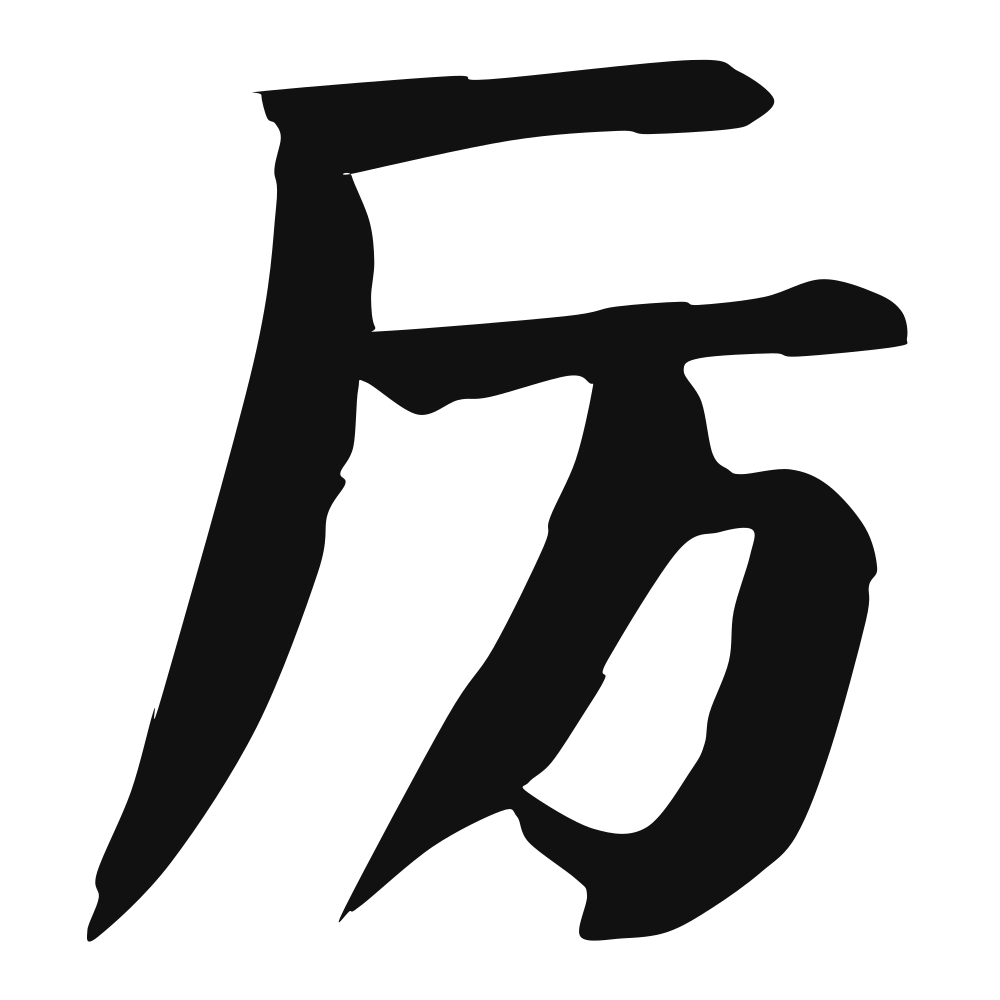
厲
surname Li; strict; severe
Closest English meanings
severe·strict·sharp
The Calligrapher — Yán Zhēnqīng 颜真卿
Tang master of robust regular script; co-creator of the enduring 'Yan style'.
Tang calligrapher (709–784), master of regular script/running script — the Tang moral paragon whose upright, muscular regular script became the model of Chinese integrity in writing. Tang dynasty
Etymology & Meaning · 字义溯源
### Soundlì — lì (4th tone). Free-standing morpheme ### Original meaningLì (4th tone). The Shuowen Jiezi defines it as 「旱石也。从厂,蠆省聲」 — a dry, coarse stone: 徐鍇 glosses 「旱石,麤悍石」, the rough stone you grind metal against. 厂 is the cliff-face, and so the stone; 蠆 (chài, scorpion) is the phonetic, written short. Everything else grows out of that whetstone. 《詩·大雅·公劉》「取厲取鍛」 — he took the grindstone and the hammer-stone; 《左傳·成公十六年》「秣馬厲兵」 — fodder the horses, sharpen the weapons; 《荀子·性惡》「鈍金必將待礱厲然後利」 — blunt metal must wait for the grindstone before it is sharp. From 'sharpened' comes 'severe': 《論語》「聽其言也厲」; 《禮·表記》「不厲而威」. From 'sharp' comes 'perilous': 《易·乾》九三「君子終日乾乾,夕惕若厲,无咎」. And one branch is genuinely dark — 《左傳·昭七年》「鬼有所歸,乃不爲厲」: a ghost with somewhere to belong does not become a 厲, one of the wandering, vengeful dead; 厲 also writes 癘 (plague) and 癩 (leprosy). Kangxi stroke count 15 (厂部+13). Honest disclosure: this is not a soft character, and no amount of packaging makes it one. Wuxing: naming tables give 火 (Fire); by sense — a stone that sharpens metal — some modern schools argue 金 (verify). ### The structure (形聲 · 从厂,蠆省聲 — cliff/stone (厂) with the scorpion (蠆) as shortened phonetic; the sting stands for the roughness of the stone)①厂hǎncliff-face / stonethe rock the stone comes from②蠆chàiscorpion (phonetic)the sting that stands for coarseness③厲lìwhetstone; severethe stone, and the severity it lends④礪lìgrindstone (later form)where the original sense went when 厲 was taken over by 'severe' ### In use todayItemReading / meaningNoteReadinglì (4th tone)single syllableCore sensesevere / formidable; (originally) whetstone厲害 formidable, 嚴厲 sternGrammarbound in modern use, free in classical厲行 to enforce strictly; 厲鬼 a vengeful ghostTattoo fitcaution — severe, and carries a ghost sensedisclose 厲鬼 before the client commits ### Closest words in English — and what each misses - Strict — 嚴 holds 'strict' on its own; 厲's older meaning is the stone that sharpened the edge severity comes from - Sharp — 利/銳 hold 'sharp'; 厲 is the instrument that makes things sharp, not the sharpness - Powerful — 厲害 is colloquial 'formidable / terrible'; it is street register, not the classical weight buyers imagine - Danger — 危 holds plain 'danger'; 厲 in 《易》 is danger as an edge that can be watched and survived (无咎)An honest note on grammar. Free in classical usage (厲 = to sharpen, severe, peril); in modern Chinese mostly bound — 厲害, 嚴厲, 厲行 — and the sharpening sense now belongs to 礪Where a Western reader can stand: 厲 (lì) is a whetstone — the coarse stone that makes blunt metal sharp. From it come
Cultural Story
厲 is the older form of 厉, sharp and stern. The Zuo Zhuan has the armies "feed the horses and sharpen the arms" -- 秣马厉兵. A judge spoke 厲声, in a voice that cut. Later 雷厲风行 praised an official who moved like thunder. The traditional graph keeps its rugged edges; the meaning never softened, from the whetstone to the rebuke.
Where a Western reader can stand: 厲 (lì) is a whetstone — the coarse stone that makes blunt metal sharp. From it come 'severe', 'stern', and 'perilous', and it appears in the Yijing as the knife-edge the watchful man walks at nightfall (夕惕若厲). It also forms 厲鬼, a vengeful ghost, so a literate Chinese reader feels an edge a Western buyer may not expect. As a tattoo it means discipline and hardness — self-sharpening, not softness.
Common words & phrases
- 厲害 terrible · fierce · severe
- 嚴厲 strict · severe
- 厲聲 in a stern voice
- 慘厲 harsh · grim
Read the story behind the character
A 嚴厲 master drills the students until they are correct; a pain is 厲害 enough to send someone to the clinic. The captain speaks 厲聲 and the deck falls silent. A 慘厲 wind off the strait keeps the boats in. The word keeps its old bite in the traditional script, measuring how hard a voice, a hurt, or a cold can press.
Own this character
Purchase delivers the original SVG of this glyph, brushed by Yán Zhēnqīng 颜真卿, ready to place on skin, paper, or screen.