
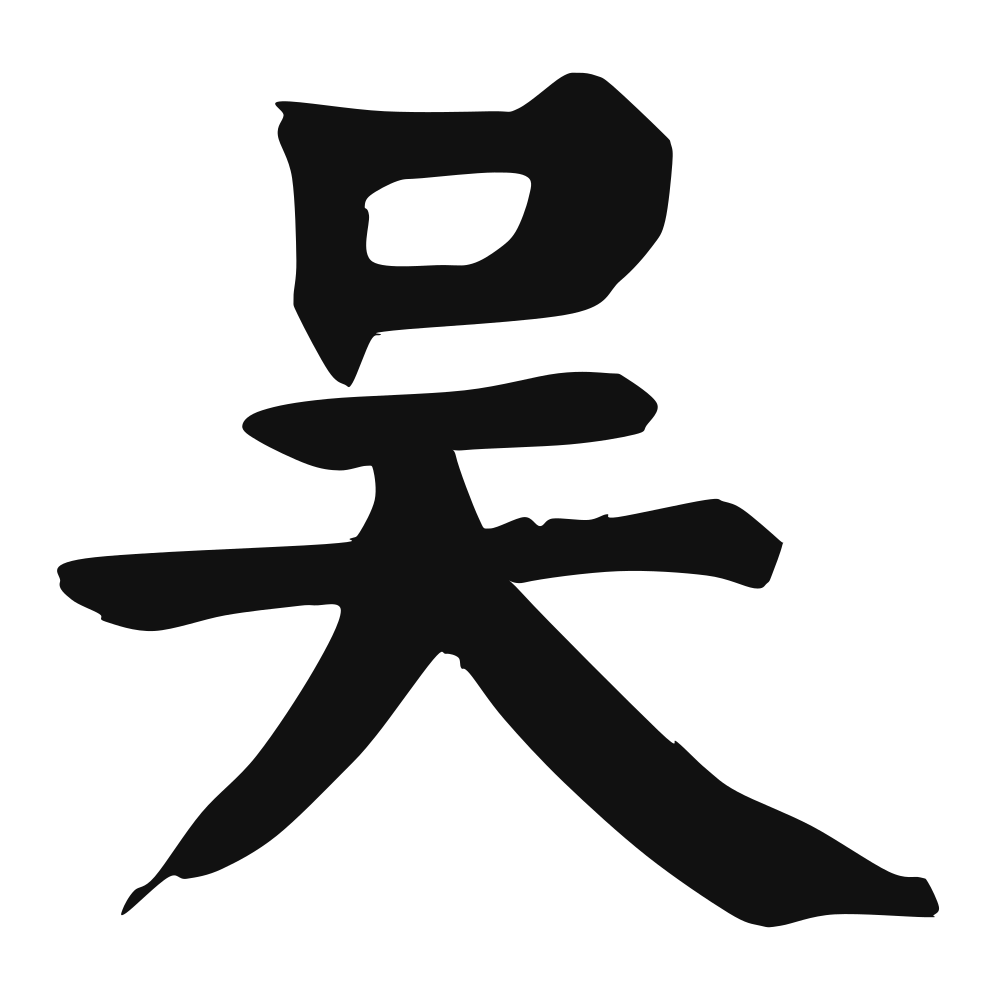
吳
surname Wu; area comprising southern Jiangsu, northern Zhejiang and Shanghai; name of states in southern China at different historical periods
Closest English meanings
Wu·state of Wu
The Calligrapher — Yán Zhēnqīng 颜真卿
Tang master of robust regular script; co-creator of the enduring 'Yan style'.
Tang calligrapher (709–784), master of regular script/running script — the Tang moral paragon whose upright, muscular regular script became the model of Chinese integrity in writing. Tang dynasty
Etymology & Meaning · 字义溯源
### Soundwú — wú (2nd tone). Often a bound morpheme — needs a partner word ### Original meaningWú (2nd tone). The Shuowen Jiezi entry reads 「姓也。亦郡也。一曰吳,大言也。从夨、口」 — a surname, and a commandery, and, by another account, 'big talk'; built from 夨 (a man with his head thrown back) and 口 (mouth). 徐鍇 explains the shape: 「大言,故夨口以出聲」 — for great utterance you tilt the head and let the voice out — and cites 《詩·魯頌·泮水》「不吳不揚」. 段玉裁 goes further: he deletes 「姓也亦郡也一曰吳」 as a later interpolation and argues that 「大言者,吳字之本義也」 — loud utterance is the root meaning, and surname and place-name are the borrowings. The Odes bear him out: 《詩·周頌·絲衣》「不吳不敖」, where 毛傳 glosses 「吳,譁也」 — no shouting, no arrogance. Separately, 天吳 in 《山海經》 is a water-god with eight heads, a human face and a tiger's body. The later word-game quoted in 《正字通》 from 《吳志·薛綜傳》 — 「無口爲天,有口爲吳」 — is a party trick, and the same source says so: 「此借字形爲諧語,非吳字本義」. Kangxi stroke count 7 (口部+4). Honest disclosure: 吳 is above all a proper noun — the ancient state of Wu, the Wu of the Three Kingdoms, 吳語 the dialect, and one of the commonest Chinese surnames. Wuxing: naming tables split between 金 (Metal) and 木 (Wood) (verify). ### The structure (會意 · 从夨从口 — a tilted head (夨) and a mouth (口); 徐鍇 「大言,故夨口以出聲」. Modern dictionaries often list it under 口部)①口kǒumouththe organ that lets the voice out②夨zèhead tilted backthe posture of shouting③大言dàyángreat utterance / loud talkthe Shuowen root sense, and 段玉裁's choice as the original meaning④吳國Wúguóthe state of Wuthe borrowing that outlived the root ### In use todayItemReading / meaningNoteReadingwú (2nd tone)single syllableCore sensethe state of Wu; a surnamethe classical verb 'to shout' is obsoleteGrammarproper noun吳語 Wu dialect; 姓吳 to be surnamed WuTattoo fitcaution — a surname and a place-namemeaningful as a family name; empty as an abstract virtue ### Closest words in English — and what each misses - None / Nothing — 無 (wú) is 'not-have'; 「無口爲天,有口爲吳」 is a shape joke, not an etymology — 《正字通》 says so - Shout — 呼/喊 hold 'to shout' in living Chinese; 吳's 大言 is classical and no longer spoken - Awaken / Enlightenment — 悟 (wù) is 'to wake up to'; same sound, different tone, different character — the commonest buyer error - Wu (the philosophy) — there is no 'Wu philosophy'; 吳 is a state and a family name, and any meaning beyond that is borrowed from somewhere elseAn honest note on grammar. Proper noun in modern Chinese — surname, state, dialect (吳語); the verbal sense 'to shout' is classical and deadWhere a Western reader can stand: 吳 (wú) is first a surname and an ancient kingdom — the Wu
Cultural Story
吳 (simplified 吴) was one of the southern states of the 春秋, rival to 越 and 楚; its people spoke the soft 吳語 (Wu dialect) still heard around Suzhou and Shanghai. 史記 recounts the rise and fall of 吳國 (Wu kingdom) and the cunning of 東吳 (Eastern Wu) in the 三國. The 口 over 天 hints at a people whose speech sounded "topsy-turvy" to northern ears. It is a name of rivers, silk, and verse.
Where a Western reader can stand: 吳 (wú) is first a surname and an ancient kingdom — the Wu of the lower Yangtze, of the Three Kingdoms, 吳鉤 the curved blade. Its Shuowen root is 大言, great or loud utterance. As a tattoo it is entirely legitimate as a family name — that is what most people wear it for — but as an abstract idea it is empty, and it is not 'enlightenment' (悟) or 'nothingness' (無), which sound almost the same.
Common words & phrases
- 吳國 Wu kingdom
- 吳語 Wu dialect
- 東吳 Eastern Wu
- 吳地 Wu region
Read the story behind the character
A tourist learns 吳語 (Wu dialect) to chat in water towns, and a history fan visits the ruins of 吳國 (Wu kingdom). Someone 姓吳 greets cousins at a reunion, while 東吳 (Eastern Wu) appears in every 三國 game. The 吳地 (Wu region) sells its tea and gardens to visitors. The character now tags a living dialect, a famous surname, and a romantic chapter of China's past carried into everyday talk and travel.
Own this character
Purchase delivers the original SVG of this glyph, brushed by Yán Zhēnqīng 颜真卿, ready to place on skin, paper, or screen.