
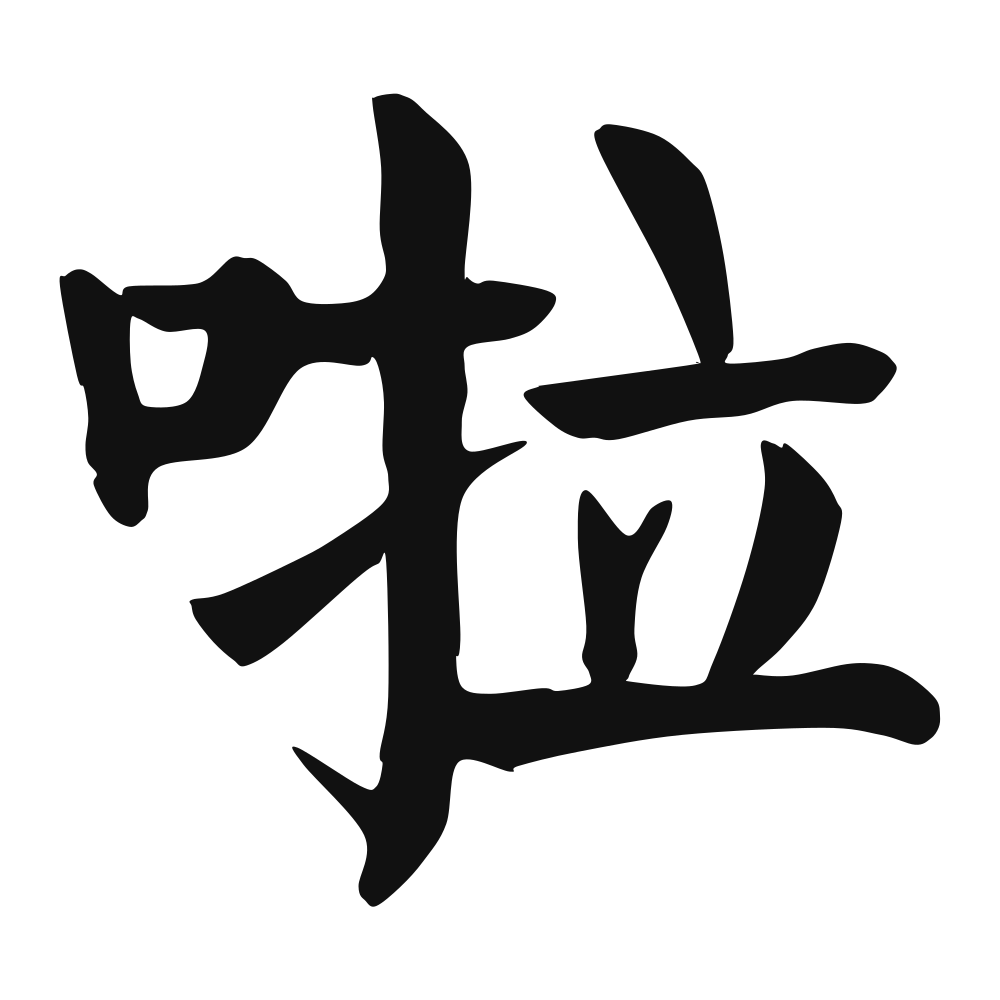
啦
(onom.) sound of singing, cheering etc; (phonetic); (dialect) to chat; sentence-final particle, contraction of 了啊, indicating exclamation; particle placed after each item in a list of examples
Closest English meanings
(particle)·(onomatopoeia)·la
The Calligrapher — Yán Zhēnqīng 颜真卿
Tang master of robust regular script; co-creator of the enduring 'Yan style'.
Tang calligrapher (709–784), master of regular script/running script — the Tang moral paragon whose upright, muscular regular script became the model of Chinese integrity in writing. Tang dynasty
Cultural Story
In the classical tradition: 啦 is a mouth particle combining 了 and 啊 into a lively 'la,' a spoken flourish absent from the Shuowen. 嘩啦 mimicked a splash or crash, and 喀啦 a crackle. Drama and folk song used 啦 to round off a line with relief or finality, the way a singer lands the last note. It is sound doing light work, turning a statement into something spoken aloud and done.
Common words & phrases
- 哗啦 splash · crash
- 喀啦 crackle
Read the story behind the character
In the modern world: The rain goes 嘩啦 — splash and crash — off the window, and ice 喀啦, crackles, in your glass. A kid shouts '放啦!' — let go! — on the slide, and a friend texts '走啦' as she leaves. 啦 is the bouncy particle that ends a thousand Chinese sentences with a sense of happening, finished, or off-we-go, the spoken period of everyday talk.
Own this character
Purchase delivers the original SVG of this glyph, brushed by Yán Zhēnqīng 颜真卿, ready to place on skin, paper, or screen.