
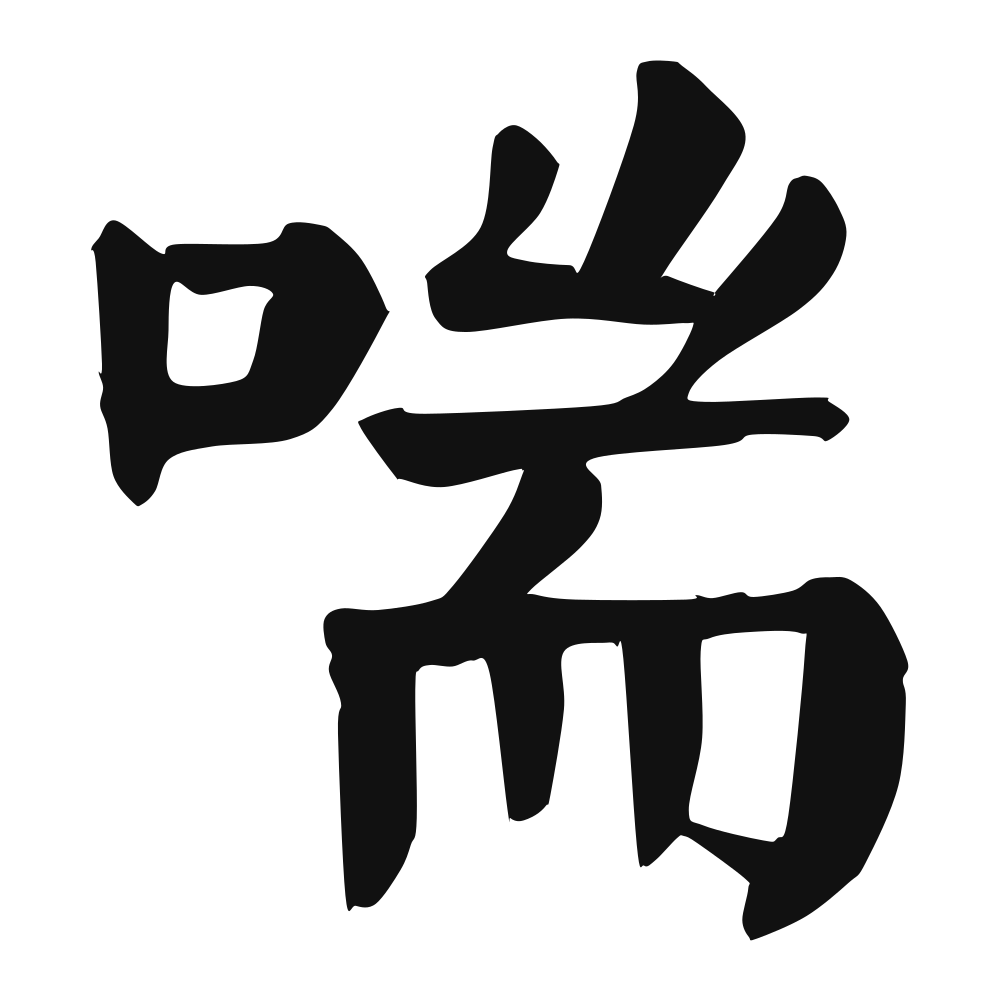
喘
to gasp; to pant; asthma
Closest English meanings
pant·breathe heavily·asthma
The Calligrapher — Yán Zhēnqīng 颜真卿
Tang master of robust regular script; co-creator of the enduring 'Yan style'.
Tang calligrapher (709–784), master of regular script/running script — the Tang moral paragon whose upright, muscular regular script became the model of Chinese integrity in writing. Tang dynasty
Etymology & Meaning · 字义溯源
### Soundchuǎn — chuǎn (3rd tone). Often a bound morpheme — needs a partner word ### Original meaningChuǎn (3rd tone). The Shuowen Jiezi defines it in two characters: 「疾息也。从口耑聲」 — hurried breathing. Duan Yucai's note makes the classical distinction explicit: 「此分別言之。息下曰:喘也。渾言之也」 — used precisely, 喘 is the laboured breath; used loosely, it is simply breath. The medical and philosophical citations are all of a piece. 《莊子·大宗師》: 「喘喘然將死」 — breathing hard, about to die. 《漢書·丙吉傳》: 「牛喘吐舌」 — the ox pants with its tongue out. 《史記·倉公傳》: 「令人喘逆氣不能食」. There is one gentler use: 《荀子·臣道》 「喘而言」, glossed 微言 — to speak softly, almost under the breath; the 《荀子·勸學》 parallel writes it 端而言, with the comment 端讀爲喘. Kangxi gives 12 strokes (口部+9); naming tables assign Metal (金), and several name-site tables flatly mark the character 凶, 'unlucky for a name'. ### The structure (形聲 · 从口,耑聲 — the mouth (口) with 耑 (duān, 'the tip / the beginning') as phonetic; the mouth at the edge of its air)①口kǒumouthbreathing made visible at the mouth②耑duāntip / beginningthe phonetic; the point at which something starts — or runs out③疾息jí xīhurried breaththe Shuowen definition, in Xu Shen's own two characters④息xībreath / to restthe word Duan Yucai pairs with it: loosely, 息 and 喘 are the same thing ### In use todayItemReading / meaningNoteReadingchuǎn (3rd tone)唐韻 昌沇切Core senseto pant; laboured breath喘气 · 喘息 · 哮喘 · 苟延残喘Grammarverb and nounmedical and everyday; no auspicious useTattoo fitno — illness, exhaustion, a bleak idiomsuggest 息 xī (breath/rest) or 氣 qì (vital breath) ### Closest words in English — and what each misses - Breath — 息 (xī) holds breath and rest; 喘 is breath that has gone wrong - Life force / Qi — 氣 (qì) holds vital energy; 喘 is its failure, not its presence - Rest — 息/歇 hold rest; 喘 is the opposite of rest - Whisper — 《荀子·臣道》 uses 喘 for soft speech, but only there; the living sense is pantingAn honest note on grammar. Verb and noun — 喘气 to pant, 喘息 to catch one's breath, 哮喘 asthma, 苟延残喘 to linger on at one's last gaspWhere a Western reader can stand: 喘 (chuǎn) means 'to pant'. The Shuowen defines it as hurried breathing, and the classical quotations are all of a piece — a man breathing hard at the point of death in the Zhuangzi, an ox with its tongue out in the Hanshu, a patient who cannot eat in the Shiji. In modern Chinese it is the word inside 哮喘 (asthma) and 苟延残喘 (to linger on at one's last gasp). It is not 'breath', not 'energy', not 'spirit'. We do not recommend it as a tattoo. If you want breath as a calm idea, use 息 (xī, breath and rest); if you want vital energy, use 氣 (qì
Cultural Story
The Shuowen gives 喘 as 疾息也, 'rapid breathing,' a character joining the breath radical 口 with 耑. In the Huangdi Neijing and the Suwen, 喘 names the labored breath of the sick, while Zhuangzi, with his love of small creatures, pictures all things 喘喘然 — faintly panting — as they draw the same breath of the Dao. To 喘息 meant both to gasp for air and, by extension, to catch a brief rest in troubled times, a poor man's moment of peace amid struggle.
Where a Western reader can stand: 喘 (chuǎn) means 'to pant'. The Shuowen defines it as hurried breathing, and the classical quotations are all of a piece — a man breathing hard at the point of death, an ox with its tongue out, a patient who cannot eat. In modern Chinese it is the word inside 哮喘 (asthma) and 苟延残喘 (to linger at one's last gasp). It is not 'breath', 'energy', or 'spirit'. We do not recommend it; for calm breath use 息, for vital energy 氣.
Common words & phrases
- 喘氣 pant · gasp
- 氣喘 asthma
- 喘息 pant · breather
- 喘咳 wheeze
Read the story behind the character
After sprinting to catch the last bus, a commuter 喘氣 (pants) on the curb; a child with 氣喘 (asthma) keeps an inhaler in her backpack and uses it before gym class. An overworked employee steals a 喘息 (breather) with a coffee between meetings, and an old man 喘咳 (wheezes) through a chest cold in winter. 喘 follows us from the playground to the hospital ward, marking every moment the breath runs short.
Why this character belongs on skin
A mouth beside the sign for the very tip of things — breath taken at the far end of what the body can do. This is the pant: the runner's rib-sawing gasp at the top of the hill, hands on knees, lungs like two wet bells rung too fast. The physicians of the old canon kept a whole science of disordered breath, because breath is where life visibly spends itself, the ledger anyone can read. But hear what else lives in the word: the pause after effort, the beat of stillness before the next stride, the animal wisdom of the body demanding its due. Nothing honest was ever achieved without this moment — the summit wheeze, the finished-page gasp, the cry after the last push of birth. This ink is your gasp, honored. Proof that you ran all the way to the top, and that the breath you fought for tasted of arrival.
Own this character
Purchase delivers the original SVG of this glyph, brushed by Yán Zhēnqīng 颜真卿, ready to place on skin, paper, or screen.