
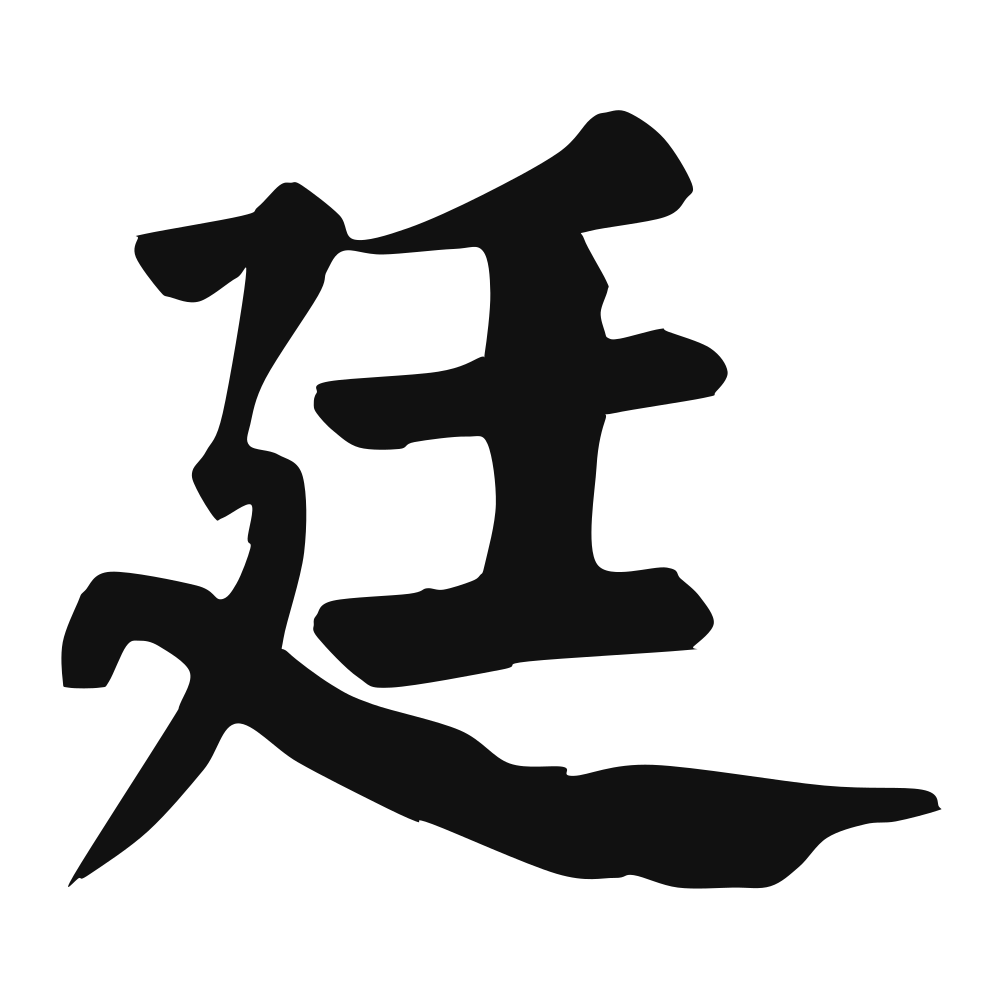
廷
palace courtyard
Closest English meanings
court·imperial court
The Calligrapher — Yán Zhēnqīng 颜真卿
Tang master of robust regular script; co-creator of the enduring 'Yan style'.
Tang calligrapher (709–784), master of regular script/running script — the Tang moral paragon whose upright, muscular regular script became the model of Chinese integrity in writing. Tang dynasty
Cultural Story
廷 is the open court before the throne where 廷臣 stood in rank and 廷議 hashed out a war. The word is power's front yard — not the bedchamber but the public face of rule, where a man could rise, speak, and be demoted in the same breath.
Common words & phrases
- 朝廷 court · imperial court
- 宫廷 palace · court
- 廷臣 court official
- 廷议 court deliberation
Read the story behind the character
朝廷 and 宫廷 now label the Forbidden City's ticketed rooms and the costume drama shot inside them. The censor and the debate are museum pieces; the character survives as heritage real estate and Saturday-night television, not as the place a decision is actually made.
Why this character belongs on skin
Power, when it is old, does not shout — it builds a hall. 廷 is the court, the royal courtyard where matters were weighed, where the ruler sat and the petitioners came, where order itself was performed as architecture. The character carries the sense of a place extended forward, a threshold you cross into judgment and ceremony. We in the West have traded the court for the boardroom and lost the gravity of it; we forget that authority was once something you entered on your knees. To carry 廷 is to claim your own inner hall, the place where you sit in judgment of your own life and decide what is lawful there. It is the tattoo for the one who refuses to be ruled from outside. Build the court within. Then be both king and subject, and rule the only territory that was ever yours.
Own this character
Purchase delivers the original SVG of this glyph, brushed by Yán Zhēnqīng 颜真卿, ready to place on skin, paper, or screen.