
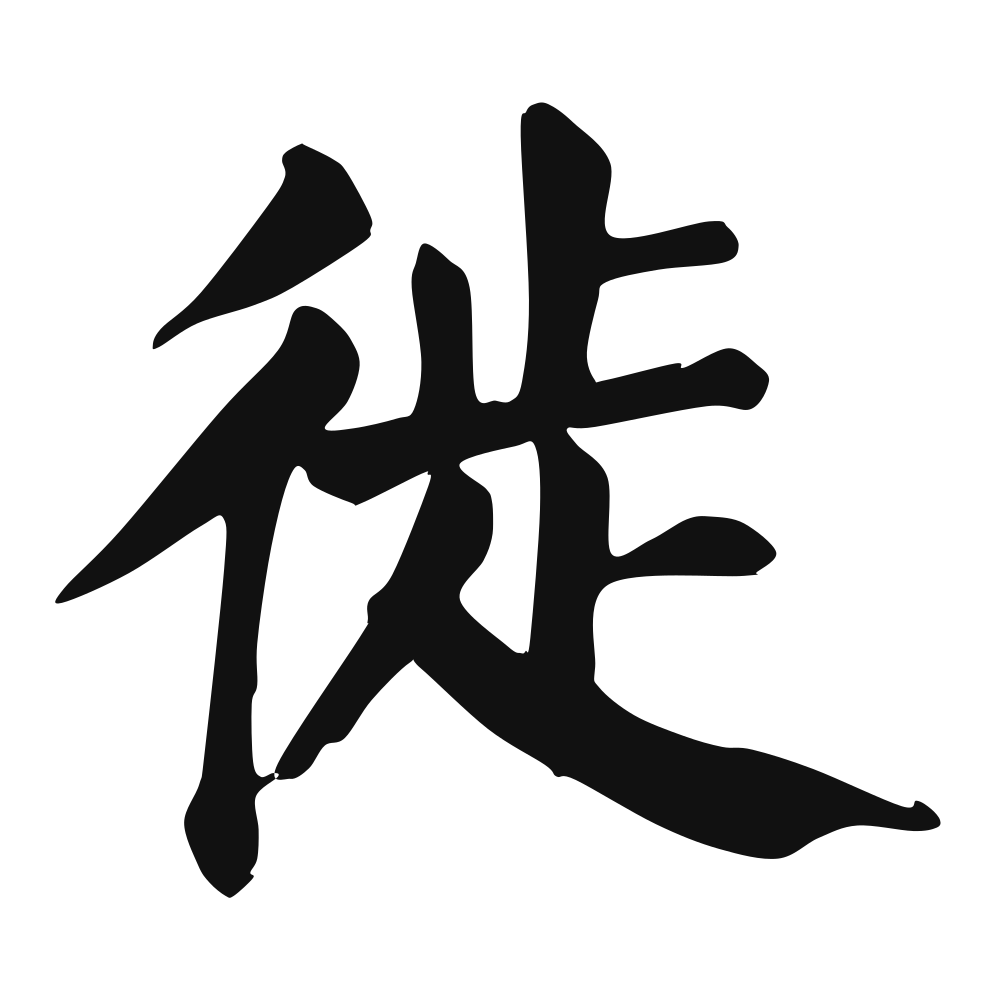
徙
(literary) to change one's residence
Closest English meanings
move·migrate·shift
The Calligrapher — Yán Zhēnqīng 颜真卿
Tang master of robust regular script; co-creator of the enduring 'Yan style'.
Tang calligrapher (709–784), master of regular script/running script — the Tang moral paragon whose upright, muscular regular script became the model of Chinese integrity in writing. Tang dynasty
Etymology & Meaning · 字义溯源
### Soundxǐ — xǐ (3rd tone). Free-standing morpheme ### Original meaningXǐ (3rd tone). The Shuowen Jiezi's head-entry for this word is written 𨑭: 「𨑭,迻也。从辵,止聲。𢓊,徙或从彳」 — 'to remove, to transfer', built from the go-radical 辵 with 止 as phonetic, and 徙 is explicitly recorded as the variant written with the step-radical 彳. The oracle-bone and early bronze forms, however, show 彳 plus 步 (two feet), so the oldest picture is simply feet moving — the sense of 'relocating one's dwelling' is what the word settled into. Classical Chinese uses it in three registers at once. It is the ordinary word for moving house: 《孟子》「死徙無出鄉」. It is a word of moral motion: 《論語·述而》「聞義不能徙,不善不能改,是吾憂也」 — 'to hear what is right and not be able to move toward it, to be unable to change what is bad in oneself: this is my sorrow.' And it is a word of law and punishment: 謫戍曰徙, and 《漢書》 has officials 免爲庶人,徙邊 — demoted to commoner and exiled to the frontier. Laozi makes not-moving the mark of a good settlement: 《老子》八十章 「使民重死而不遠徙」 — 'make the people take death seriously and not migrate far'. The derived binome 徙倚 means 'to pace, to linger' (《哀時命》「獨徙倚而彷徉」), and 孟母三徙 — the mother of Mencius moving house three times for her son's sake — made 徙 a byword for education through relocation. Honest disclosure: 徙 is neutral and dignified, but it carries a penal sense (徙邊, banishment to the frontier) alongside the voluntary one, and it is a verb about leaving, not about arriving. Kangxi stroke count 11 (彳部 + 8). Wuxing: Metal (金) in the naming tables (verify). ### The structure (形聲 / 會意之變 · 从彳(或从辵),止聲 — the step-radical plus 止; the older oracle forms show 彳 + 步, two feet in motion (Shuowen head-form: 𨑭,迻也))①彳chìto stepthe radical of walking; 徙 is the 彳-form of the word②步bùtwo feet / a pacethe earliest picture: feet actually moving③止zhǐfoot (phonetic)the Shuowen takes it as the sound-bearing element④邊biānthe frontierwhere 徙 could send you — 徙邊, exile to the border ### In use todayItemReading / meaningNoteReadingxǐ (3rd tone)single syllableCore senseto move one's dwelling; to migratealso 'to change one's ways' and, in law, 'to banish'Grammarfree verb (classical)遷徙 to migrate, 徙居 to move house, 徙倚 to pace and lingerTattoo fitcaution — dignified but outward-facingcarries a penal sense alongside the voluntary one ### Closest words in English — and what each misses - Travel / Journey — 旅/行 hold travelling; 徙 is relocating — the point is the home you leave, not the road - Freedom / Wanderlust — 逍遙/遊 hold free wandering; Laozi's ideal is explicitly 不遠徙, not going far - Change — 改/易 hold changing; 徙's change is a ch
Cultural Story
徙 is to move house, to shift the whole dwelling. 孟子 warned a bad ruler that the people would 徙 away, and 遷徙 is the birds' faithful crossing, the flock that treats the sky as one long road. The character is the uprooting — of a family, a flock, a people — done on purpose.
Where a Western reader can stand: 徙 (xǐ) means 'to move one's dwelling, to migrate' — the Shuowen glosses it 迻, 'to transfer'. Classical Chinese uses it three ways: moving house, moving morally toward what is right, and banishment to the frontier (徙邊). The famous story is 孟母三徙, Mencius' mother moving three times for her son. As a tattoo it reads as deliberate uprooting, with a shadow of enforced exile. If you want 'journey' or 'coming home', those are 旅 and 歸.
Common words & phrases
- 遷徙 migrate · move
- 流徙 drift · exile
- 徙倚 pace to and fro
- 徙居 move residence
Read the story behind the character
遷徙 is the geese a documentary films, the relocate a company announces, 徙居 the move a scholar makes for a post. The flock is a visa now; the uprooting is real. We still shift the dwelling, often for less than we left, which the birds at least never pretend.
Why this character belongs on skin
The birds know it before we do, the pull to leave, to gather what can be carried and cross the cold into somewhere unnamed. This character is drawn as a migration, a moving from one place to another under the weight of necessity. To xǐ is to relocate the self, to become the stranger in a new land, the refugee, the seeker, the one who trades the known for the possible. The Bible remembers such movement as the path of the faithful, Abraham leaving his father's house toward a promise. The Daoist trusts the water that flows elsewhere when the season turns. A man who wears this ink has left something behind and not looked back, or has looked back and walked on anyway. Place it along the calf, the muscle that carries us, and let it declare: I moved. I uprooted the life that held me, and the road, not the ruin, is now my home.
Own this character
Purchase delivers the original SVG of this glyph, brushed by Yán Zhēnqīng 颜真卿, ready to place on skin, paper, or screen.