
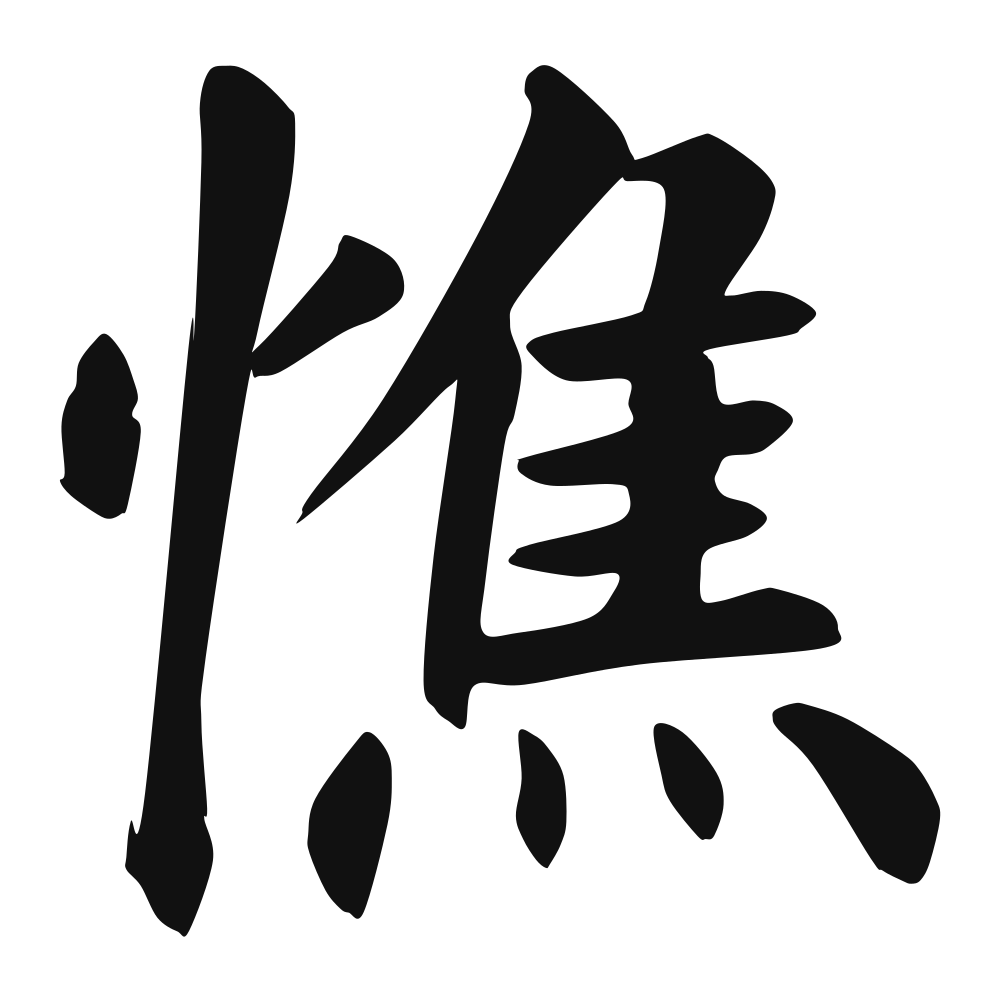
憔
usually seen in: wan and sallow (憔悴)
Closest English meanings
wan·haggard
The Calligrapher — Yán Zhēnqīng 颜真卿
Tang master of robust regular script; co-creator of the enduring 'Yan style'.
Tang calligrapher (709–784), master of regular script/running script — the Tang moral paragon whose upright, muscular regular script became the model of Chinese integrity in writing. Tang dynasty
Cultural Story
憔 exists only as half of 憔悴, the worn and withered look. The 楚辭 gives it to the exile by the river, the body spent by grief and exposure. The heart with 焦, scorched, is a person dried at the edges. Alone the character is unfinished, a word waiting for its partner.
Common words & phrases
- 憔悴 wan · haggard
- 憔悴不堪 extremely haggard
Read the story behind the character
憔 rides entirely inside 憔悴, the face after the loss or the illness — 憔悴不堪 is the hospital corridor's common sight. You would never say 憔 by itself; the pair is bonded so tight that one without the other reads as a typo. A joined word doing the work of one.
Why this character belongs on skin
Qu Yuan stood on the riverbank gaunt and uncombed, banished for loyalty, and the fisherman asked why he looked so worn. 憔悴, he answered—wasted with sorrow—and then he wrote the verses a nation still recites each Dragon Boat Festival before stepping into the water that took him. 憔 is the character of that look: the face after the long vigil, love unreciprocated, work that eats its worker, grief metabolizing the body's softness into angles. It is not flattering, and it is not meant to be. It is what devotion costs when charged to the flesh. Yet there is terrible beauty in it—the worn face testifies that something mattered enough to burn for. If your years left their ledger on you, if you have been told you look tired by people who have no idea why: this is your character. Worn is not beaten. Worn is proof.
Own this character
Purchase delivers the original SVG of this glyph, brushed by Yán Zhēnqīng 颜真卿, ready to place on skin, paper, or screen.