
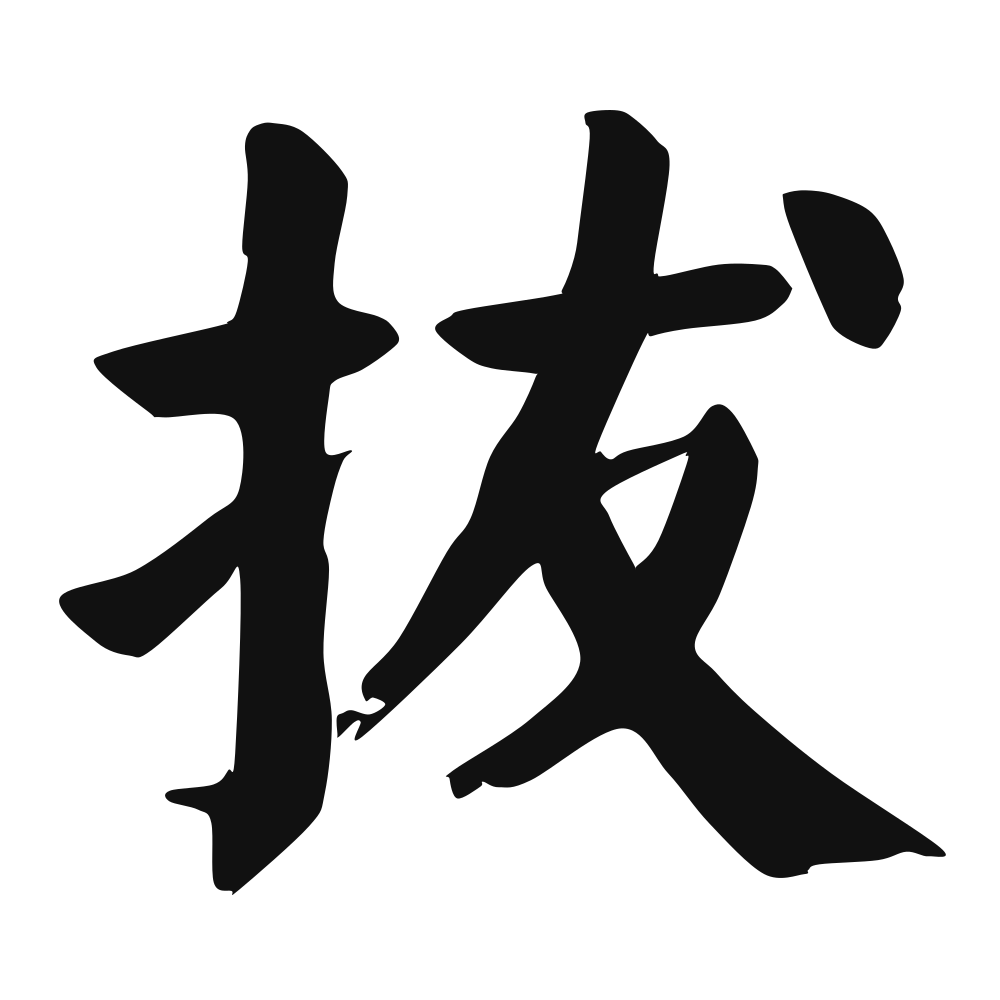
拔
to pull up; to pull out; to draw out by suction; to select; to pick; to stand out (above level); to surpass; to seize
Closest English meanings
pull up·extract·select
The Calligrapher — Yán Zhēnqīng 颜真卿
Tang master of robust regular script; co-creator of the enduring 'Yan style'.
Tang calligrapher (709–784), master of regular script/running script — the Tang moral paragon whose upright, muscular regular script became the model of Chinese integrity in writing. Tang dynasty
Etymology & Meaning · 字义溯源
### Soundbá — bá (2nd tone). Free-standing morpheme ### Original meaningBá (2nd tone). The Shuowen Jiezi defines it as 「擢也。从手犮聲」 — 'to draw up, to pull out', a hand (手) with 犮 (bó) as phonetic; 《蒼頡篇》 glosses 「引也」. The image is pulling something out with its root, and the Classics use that literal force in every direction at once. It is the word for standing firm: 《易·乾·文言》「確乎其不可拔」 — firm, so that it cannot be pulled up. It is the word for collective advance: 《易·泰》「拔茅茹,以其彙,征吉」 — pull up the cogon grass and the roots come together, because they are of one kind; the expedition is fortunate. It is the word for promotion: 《後漢·蔡邕傳》「連見拔擢,位在上列」 and 諸葛亮《出師表》「是以先帝簡拔以遺陛下」. It is the word for storming a city (《前漢·高帝紀》「攻碭,三日拔之」, glossed as taking a town the way you pull a tree up by the roots), for sudden rising (《漢書》「拔起隴畝之中」), and — via 《爾雅·釋詁》 — even for 'to exhaust, to finish' (殲、拔、殄,盡也). Honest disclosure: 拔 is a transitive physical verb, and two of its most famous appearances are warnings — 《孟子·盡心上》「拔一毛而利天下,不為也」 and the idiom 拔苗助長, pulling the seedlings up to help them grow. ### The structure (形聲 · 从手,犮聲 — hand (手) + 犮 (bó, 'a dog straining') phonetic; the hand doing the work, the phonetic suggesting strain and effort)①手shǒuhandevery sense begins as something a hand does②犮bóphonetic / strainingsupplies the sound; suggests the effort of the pull③擢zhuóto draw up, to promotethe Shuowen gloss; also the promotion sense, 拔擢④拔茅bá máopulling the cogon grass《易·泰》's image — roots intertwined, so one pull brings the class ### In use todayItemReading / meaningNoteReadingbá (2nd tone)single syllable; also a surnameCore senseto pull out; to promote; to stand out提拔 promote, 海拔 altitude, 拔尖 top of the classGrammartransitive verb, bound in compounds拔草, 拔牙, 提拔, 出類拔萃, 堅韌不拔Tattoo fitcaution — reads as the physical verb first拔萃 or 挺拔 carries 'stand out' unambiguously ### Closest words in English — and what each misses - Excellence — 傑/秀 hold eminence and excellence; 拔 is the act of rising above, and 拔萃 is the phrase that holds it - Strength — 力 holds strength; 拔 is strength applied to extraction — 力拔山兮 is a pull, not a posture - Promotion — 升/進 hold advance and promotion; 拔擢 is being lifted out of the common rank by someone's hand - Remove / Extract — 除/去 hold removal; 拔 keeps the sense of roots and resistance — you pull, and something givesAn honest note on grammar. Transitive verb, free in classical usage, bound in most modern compounds — 提拔, 拔擢, 拔萃, 海拔, 拔尖, 堅韌不拔; also a surnameWhere a Western reader can stand: 拔 (bá) means 'to pull up by the roots'. From that one physical act the
Cultural Story
Mencius tells of the man who hated his sprouts' slowness and pulled them up to help, 揠苗助長, then watched them all wilt. 拔 is that anxious yank, the hand that cannot wait for growing. The fable is the language's permanent warning against helpful violence, and every overeager parent since has been measured against that dead man's ruined garden row.
Where a Western reader can stand: 拔 (bá) means 'to pull up by the roots' — to draw something out so it stands above the rest. The Yijing says 確乎其不可拔, firm and impossible to uproot; Xiang Yu sang of strength to pull up a mountain. But 拔苗助長 ('pulling seedlings to help them grow') warns against forcing it. As a tattoo it carries real upward force; if you want 'rise above' without the shadow, 拔萃 or 挺拔 says it cleaner.
Common words & phrases
- 拔河 tug-of-war
- 提拔 promote
- 拔除 pull out · remove
- 海拔 altitude
- 拔苗助長 pull shoots to help growth
Read the story behind the character
Two teams 拔河, rope and mud and raw stubbornness; a boss 提拔s a junior; a peak's 海拔 is measured from the sea. The man and his sprouts are forgotten, but the word still means any pull that lifts something out of where it was, whether a weed, a career, or a village that suddenly finds itself on the map.
Why this character belongs on skin
From the mud of a lotus pond the flower rises clean, refusing the dark it was rooted in. The character is the pulling up — of a sword from stone, of a weed from the heart, of a self from the crowd that would flatten it. Warriors knew it as surpassing, the lone pine on the cliff that no wind can bow. To pull up is to extract yourself from what holds you down and stand, singular, against the horizon. It is not arrogance; it is the earned distance of one who did the hard unrooting. Carry this mark as a vow of elevation — that you will not stay sunk, that you will draw what is best in you out into the light and let it stand apart. The world rewards the uprooted who learn to bloom above the water.
Own this character
Purchase delivers the original SVG of this glyph, brushed by Yán Zhēnqīng 颜真卿, ready to place on skin, paper, or screen.