
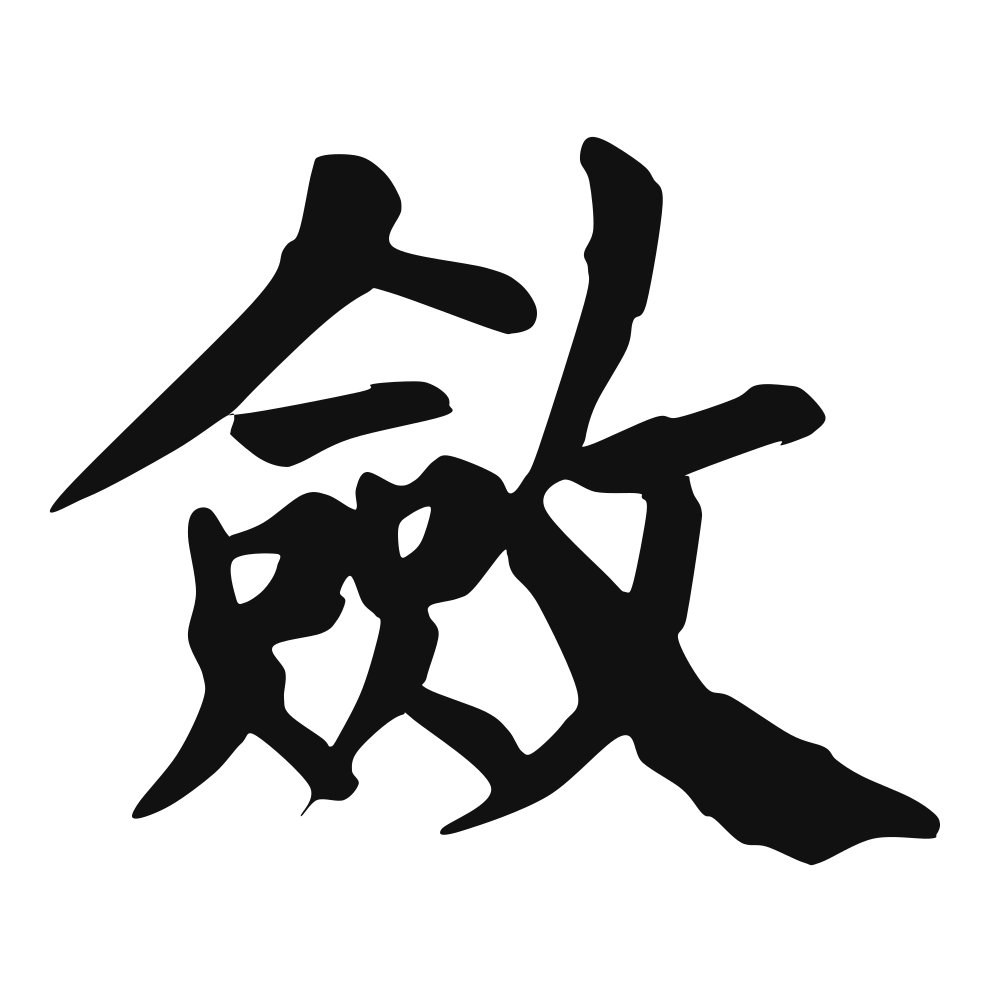
敛
(literary) to hold back; (literary) to restrain; to control (oneself); to collect; to gather; Taiwan pr. [lian4]
Closest English meanings
collect·restrain·hoard
The Calligrapher — Yán Zhēnqīng 颜真卿
Tang master of robust regular script; co-creator of the enduring 'Yan style'.
Tang calligrapher (709–784), master of regular script/running script — the Tang moral paragon whose upright, muscular regular script became the model of Chinese integrity in writing. Tang dynasty
Etymology & Meaning · 字义溯源
### Soundliǎn — liǎn (3rd tone); lián in the place-name 斂盂. Free-standing morpheme ### Original meaningLiǎn (3rd tone). The character inked is the simplified form; the classical and Kangxi form is 斂. The Shuowen Jiezi defines it as 「斂,收也。从攴,僉聲」 — 'to gather in', with 攴 (the hand holding a stick) for the sense and 僉 (qiān) for the sound. 《尔雅·释诂》 adds 「聚也」, the 疏 explaining 「斂者,率聚也」. Its classical range runs from the harvest to taxation to self-restraint: 《诗·小雅》 「此有不斂穧」 (here are sheaves left ungathered), 《书·洪範》 「斂時五福」 (to gather together the five blessings), 《周礼·天官·大宰》 「以九賦斂財賄」 (to levy the nine taxes), and Confucius's rebuke in 《论语·先进》 — 「季氏富於周公,而求也為之聚斂而附益之」 — where 聚斂 means squeezing the people for revenue. The beautiful modern senses, 收斂 (to draw in, to restrain oneself) and 內斂 (introverted, self-contained), come from this root. But there is a second root the buyer must be told about: 斂 is also written for 殮, 'to dress a corpse and place it in the coffin' — 《汉语大字典》 lists it as sense 12, 通「殮」. 小斂 and 大斂 are the two stages of the classical funeral in 《仪礼》 and 《礼记》. Kangxi: 17 strokes for 斂 (攴部+13); the simplified 敛 is written in 11. Honest disclosure: 敛 is genuinely elegant in its 收斂 sense and genuinely funerary in its 入斂 sense; both are real, and neither is harmless. ### The structure (形聲 · 从攴,僉聲 — the hand with a stick (攴) for the sense, 僉 (qiān) for the sound; the Shuowen gloss is 收也, 'to gather in')①攴pūto tap / a hand with a stickthe sense-bearing half — action taken upon something②僉qiānall togethersound-bearer; its 'all together' sense suits gathering into one③收shōuto gather inthe Shuowen gloss itself — 斂,收也④殮liànto lay out the deadthe loan-sense no buyer should be told about last ### In use todayItemReading / meaningNoteReadingliǎn (3rd tone); lián in 斂盂《唐韵》良冉切; a surname and a place-name also existCore senseto gather in; to draw back; to restrain oneself收敛 to draw in · 内敛 reserved · 敛容 to compose the faceGrammarfree verb; also loan-written for 殮敛财 to amass wealth · 横征暴敛 to extort taxes · 入殓 (written 殮) to encoffinTattoo fitcaution — elegant, but with a funerary doublebest inked with a companion word such as 收敛, never unexplained ### Closest words in English — and what each misses - Restraint — 节/制 hold restraint as discipline; 敛 is gathering-in, which is quieter and closer to autumn - Peace / Calm — 静/安 hold peace; 敛 is an action, not a state — you do it, you do not rest in it - Let go — 放/释 hold releasing; 敛 is the opposite motion — drawing in, holding in - Gather (exact) — this IS the match, but remember the second object: 敛 gathers grain, taxes
Cultural Story
敛 is the closing hand. 收敛 is the autumn gathering and the mourner's composed face; 聚敛 the hoard the critic condemns. 敛容 is to still the expression before the elder. The word is restraint as a virtue and as a vice — the harvest rightly kept, the tax wrongly wrung. The Shuowen sees the hand drawing in.
Where a Western reader can stand: 敛 (liǎn), traditionally 斂, means 'to gather in' and 'to draw back'. The Shuowen glosses it 收. Its graceful modern life is 收斂 (restrain oneself) and 內斂 (reserved), and in the old calendar 收斂 is autumn. But one thing must be said plainly: 斂 is also written for 殮, 'to lay out the dead', and 小斂 / 大斂 are the two stages of the funeral. Ink it as 收斂, with eyes open.
Common words & phrases
- 收斂 restrain · collect
- 斂財 amass wealth
- 聚斂 amass · hoard
- 斂容 compose one's expression
Read the story behind the character
收敛 is what the spending app tells you to do; 敛财 the official caught doing the opposite. 敛容 is the bow before the coffin. 聚敛 the corporation's hoard. The word still measures the draw of the hand — toward the chest in grief, toward the vault in greed — and names both with one plain stroke.
Why this character belongs on skin
Autumn gathers the petals back into the stem, and the wise man learns the same restraint, the art of pulling the self inward when the season demands it. This character means to collect, to restrain, to put away the excess that once served and now exhausts. To liǎn is to fold the hands, to lower the voice, to stop spending the spirit on what does not deserve it. The Confucian gentleman cultivates this restraint as a form of respect, the containment that makes a person trustworthy. The warrior sheathes the blade not from fear but from mastery. A man tattooed with this has known the noise of his own youth and chosen the quieter room. Let it rest at the throat, where restraint begins, and let it speak: I have drawn myself in from the world's edge. What I keep now, I keep on purpose, and the power I withheld is the power I still own.
Own this character
Purchase delivers the original SVG of this glyph, brushed by Yán Zhēnqīng 颜真卿, ready to place on skin, paper, or screen.