
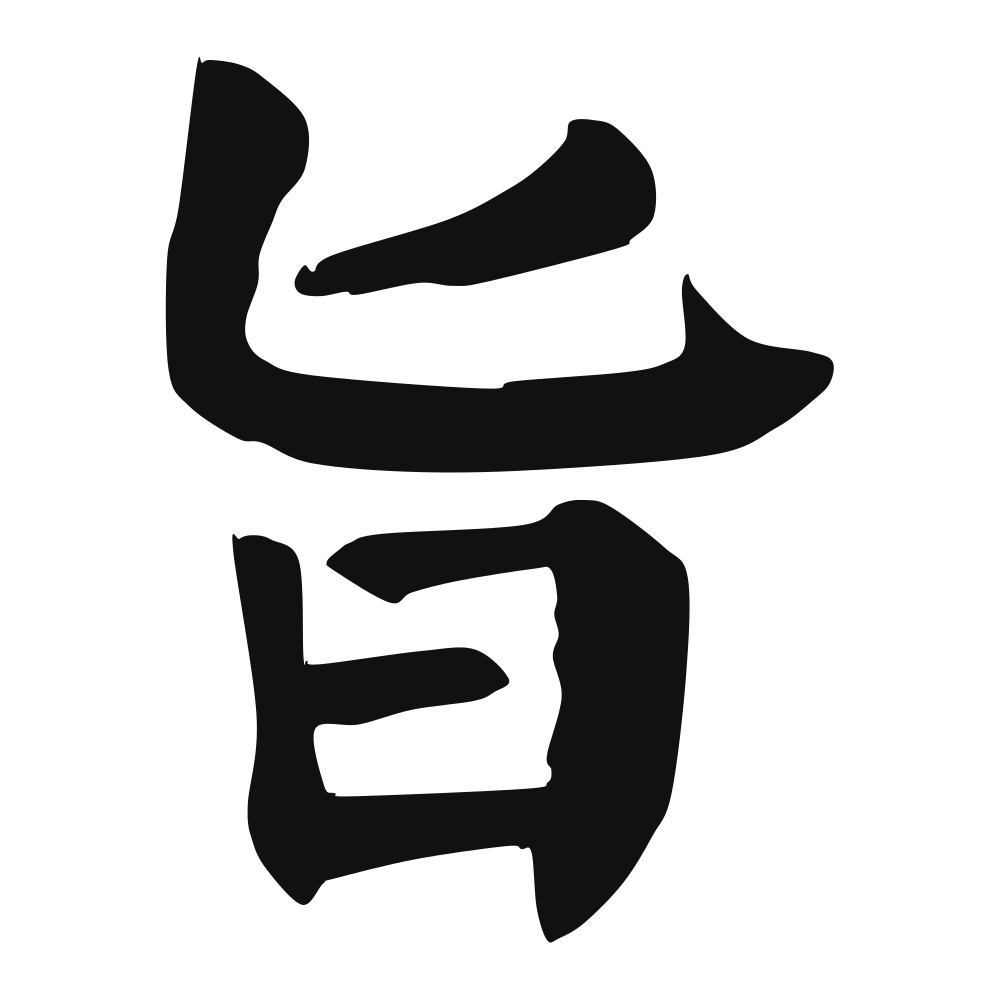
旨
imperial decree; purport; aim; purpose
Closest English meanings
purpose·decree·delicious
The Calligrapher — Yán Zhēnqīng 颜真卿
Tang master of robust regular script; co-creator of the enduring 'Yan style'.
Tang calligrapher (709–784), master of regular script/running script — the Tang moral paragon whose upright, muscular regular script became the model of Chinese integrity in writing. Tang dynasty
Etymology & Meaning · 字义溯源
### Soundzhǐ — zhǐ (3rd tone). Free-standing morpheme ### Original meaningZhǐ (3rd tone). The Shuowen Jiezi defines it as 「美也。从甘,匕聲」 — 'fine', built from 甘 (sweet) with 匕 as the phonetic, and Xu Shen gives 旨 its own small radical section (卷五·旨部), which tells you how old the word is. The oracle and seal forms are usually read as a spoon (匕) lifting food to the mouth: the graphic origin is taste, not authority. 《詩·邶風·谷風》 uses it plainly — 「我有旨蓄,亦以御冬」 ('I have good provisions stored, to get through the winter'), and 《詩·魯頌·泮水》 has 「既飲旨酒」. 《論語·陽貨》 gives it its moral edge: 「食旨不甘,聞樂不樂」 — in mourning, even good food has no savour. From 'fine tasting' it widened to 'excellent', then to 'purport, the drift of a thing': 《易·繫辭下》 「其旨遠,其辭文,其言曲而中」 — 'its meaning reaches far, its wording is patterned'. Only under the empire did it harden into the bureaucratic noun: 《正字通》 「凡天子諭告臣民曰詔旨,下承上曰奉旨」. So the honest order is: delicious → excellent → purport → imperial rescript. In modern Mandarin 旨 is a bound morpheme (宗旨 aim, 主旨 gist, 聖旨 edict) and rarely stands alone in speech. Kangxi naming tables assign Fire (火); no second school appeared in the tables checked. ### The structure (形聲兼會意 · 从甘,匕聲 — sweet (甘) with the spoon (匕) as phonetic; the early forms are read as a spoon carrying food to the mouth)①甘gānsweetthe taste at the root of the word②匕bǐspoonthe hand that lifts the food; also the phonetic③旨zhǐfine / deliciousthe original word: taste judged good④旨意zhǐyìpurport, intentionthe later, abstracted sense ### In use todayItemReading / meaningNoteReadingzhǐ (3rd tone)single syllableCore sensefine / delicious → purport, aimthe taste sense is the root; 'aim' is laterGrammarbound morpheme宗旨 aim · 主旨 gist · 聖旨 imperial edictTattoo fitcaution — 'purpose' is real, but the graph also carries 聖旨 and rarely stands alonesay which sense is meant on the skin ### Closest words in English — and what each misses - Purpose / Goal — 目的/目標 hold 'aim, target'; 旨 is the drift of a text or a life, not a target set - Meaning — 義/意 hold 'meaning'; 旨 is specifically the point a thing is driving at - Delicious — 甘/美 hold 'sweet, fine'; 旨 is the old word for it and is nearly dead in speech - Decree / Command — 詔/令 hold 'decree'; 旨 became 'edict' only through 聖旨, an institution of empireAn honest note on grammar. Bound morpheme in modern use — 宗旨 (aim), 主旨 (gist), 聖旨 (imperial edict); free only as the classical adjective 旨 'fine, delicious'Where a Western reader can stand: 旨 (zhǐ) began as the word for food that tastes good, widened to 'fine', and ended as 'the drift of a thing' — what it is getting at. I
Cultural Story
旨 is the mouth tasting truth. The Shuowen ties it to 甘, the sweet; 旨 was first 'delicious,' then 'the prince's will' — 圣旨 the edict, 旨意 the decree. 宗旨 the aim of the society. The word slid from the palate to the throne: what pleases the tongue becomes what issues from the ruler, both a kind of final say.
Where a Western reader can stand: 旨 (zhǐ) began as the word for food that tastes good, widened to 'fine', and ended as 'the drift of a thing' — what it is getting at. It is also the 旨 of 聖旨, the imperial edict, which is why it can feel bureaucratic. As a tattoo it reads as precision and intention rather than warmth; pair it (宗旨 'aim') if you want the sense fixed.
Common words & phrases
- 宗旨 aim · purpose
- 旨意 decree · will
- 聖旨 imperial edict
- 要旨 gist · main point
- 旨趣 purport
Read the story behind the character
宗旨 is the mission on the website; 旨意 the boss's 'wish.' 圣旨 is the costume drama; 要旨 the summary. 旨趣 the preface's 'point.' The word still carries the edict's weight into the minor — the club's purpose, the memo's gist. From the throne to the README, 旨 is the stated aim, the last word on why the thing exists.
Why this character belongs on skin
At its root this character is a spoon offering fine flavor to the mouth — meaning, purpose, the delicious core of a thing. 旨 is what the king's decree carried, and what your own life is starving for: a center, a why. We drift through tasks with no taste to them, but the moments that matter arrive with a flavor we never forget. To wear 旨 is to commit to intention over accident. It is the editor's command to every sentence, the warrior's reason before the charge, the lover's plain declaration: this is what I meant. A tattoo of this word sits like a hidden instruction beneath the skin, a reminder that you were not made to be random. Let it mark the place you press when you need to remember — the spine, the wrist — and taste, again, the purpose you keep choosing.
Own this character
Purchase delivers the original SVG of this glyph, brushed by Yán Zhēnqīng 颜真卿, ready to place on skin, paper, or screen.