
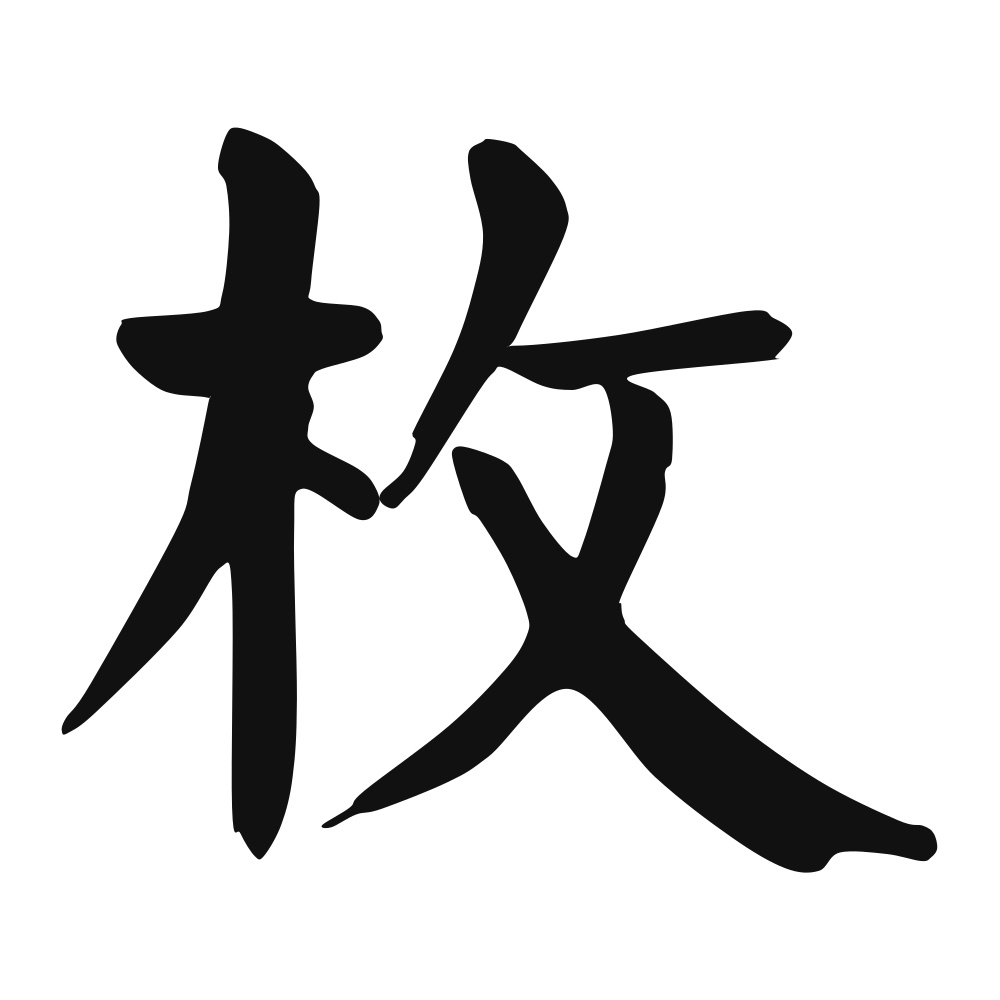
枚
surname Mei; (on product packaging) classifier for flat items (from Japanese 枚 "mai"); (old) stick used as a gag to prevent soldiers from talking while sneaking up on the enemy
Closest English meanings
piece·classifier·whip
The Calligrapher — Yán Zhēnqīng 颜真卿
Tang master of robust regular script; co-creator of the enduring 'Yan style'.
Tang calligrapher (709–784), master of regular script/running script — the Tang moral paragon whose upright, muscular regular script became the model of Chinese integrity in writing. Tang dynasty
Etymology & Meaning · 字义溯源
### Soundméi — méi (2nd tone). Free-standing morpheme ### Original meaningMéi (2nd tone). The Shuowen Jiezi defines it as 「榦也。可為杖。从木从攴」 — 'the trunk; it can serve as a staff', analysing the graph as 木 (wood) plus 攴 (a hand holding a stick). Xu Shen seals the definition with a line of the Odes, 《詩·大雅·旱麓》「施于條枚」, and the commentators fix the pair that governs the word: 枝曰條,幹曰枚 — 'branch is tiao, trunk is mei'. 《詩·周南·汝墳》 uses it in the plainest possible scene: 「遵彼汝墳,伐其條枚」 — along the high banks of the Ru she cuts branches and trunk. A staff of wood, cut and taken. Its second career is stranger and better: 《周禮·秋官》 establishes an office called 銜枚氏, 'he of the gag-sticks', whose men policed noise at state rites; armies took the practice over, and soldiers crossing enemy lines held a chopstick-shaped bit of wood between their teeth. 《左傳·襄十八年》 has 「以枚數闔」 and the commentators note 馬箠曰枚 — a riding-whip too. Honest disclosure: to a modern Chinese reader 枚 is overwhelmingly the polite classifier for small objects (一枚郵票, 不勝枚舉), which descends from the adverbial sense 'one by one' seen in 《書·大禹謨》「枚卜功臣」 — 'divining them minister by minister'. The 'staff' is the root, but the classifier is the living use. ### The structure (會意 · 从木从攴 — wood (木) + a hand holding a stick (攴); the wood you tap, beat and finally lean on)①木mùwood; treethe material the character is made of②攴pūto tap; a hand with a stickthe hand that works the wood③條tiáobranchthe pairing: 枝曰條,幹曰枚 — branch and trunk④銜枚xiánméiwood held in the teeththe soldier's gag that buys an army its silence ### In use todayItemReading / meaningNoteReadingméi (2nd tone)homophone of 梅 plum, 媒 go-between, 煤 coalCore sensetree trunk usable as a staff; a gag-stickroot sense; the classifier developed from 'one by one'Grammarclassical noun; modern classifier + surname一枚郵票 · 不勝枚舉 · 銜枚疾走Tattoo fitcaution — clean root sense, but reads as a classifier todayworks best when paired: 條枚, 銜枚 ### Closest words in English — and what each misses - Tree / wood — 木 holds 'tree' and 樹 the standing tree; 枚 is the trunk already cut and usable - Branch — 條/枝 hold 'branch'; classical usage opposes 條 to 枚 — branch against trunk - Plum — 梅 (méi) holds 'plum'; identical sound, unrelated word and graph - Silence — 默/靜 hold silence outright;枚 only reaches it through 銜枚, an act, not a stateAn honest note on grammar. Free morpheme in classical usage (條枚, 銜枚, 枚卜); in modern Mandarin chiefly a classifier for small objects (一枚銀幣, 不勝枚舉) and a surname (漢枚乘)Where a Western reader can stand: 枚 (méi) began as the trunk of a tree cut down to make a walking-staff — so
Cultural Story
枚 was a slender twig, and soldiers marching at night were made to 衔枚 — bite a stick — so they could not speak or be heard. The character became a neat classifier: 一枚, one small thing, a coin, a bomb, a star. The 論語-era army and the modern counter share one wooden root of silence and of counting.
Where a Western reader can stand: 枚 (méi) is a small piece of wood — the trunk, or a timber that can be made a staff, per the Shuowen. It is also the slip held between the teeth to keep silence on a night march (銜枚), and today it is the classifier for trees and for buildings. As a tattoo it is dry, spare, disciplined, but reads as a counter or fragment to most eyes; pair it as 銜枚 if you mean held-tongue silence.
Common words & phrases
- 一枚 one piece
- 枚舉 enumerate
- 不勝枚舉 too many to enumerate
- 銜枚 silence troops (archaic)
Read the story behind the character
枚 is the classifier for small solid objects: 一枚硬币, 一枚戒指, even 一枚导弹 in headlines. 枚举 is the programmer's word for listing items; 不胜枚举 the essay's too many to count. 衔枚 is long dead, a detail in a war film. The character is a counter with a soldier's gag in its past.
Why this character belongs on skin
Before coin, there was the counted twig. Originally a slender wooden stick used to keep score, later a measure for anything small and many — this is the character of accounting, of the honest tally a life keeps with itself. The soldier in the field was paid by it; the scholar counted his virtues the same way. To carry it is to refuse the lie that everything is infinite: we are given a number of days, of chances, of loves, and the dignity is in counting them true. It is a sober, almost warrior mark — the quiet ledger that says I know my measure and I do not cheat it. Ink it near the wrist where you once learned to count, and let it stand for the unromantic courage of keeping score with yourself, faithfully, to the end.
Own this character
Purchase delivers the original SVG of this glyph, brushed by Yán Zhēnqīng 颜真卿, ready to place on skin, paper, or screen.