
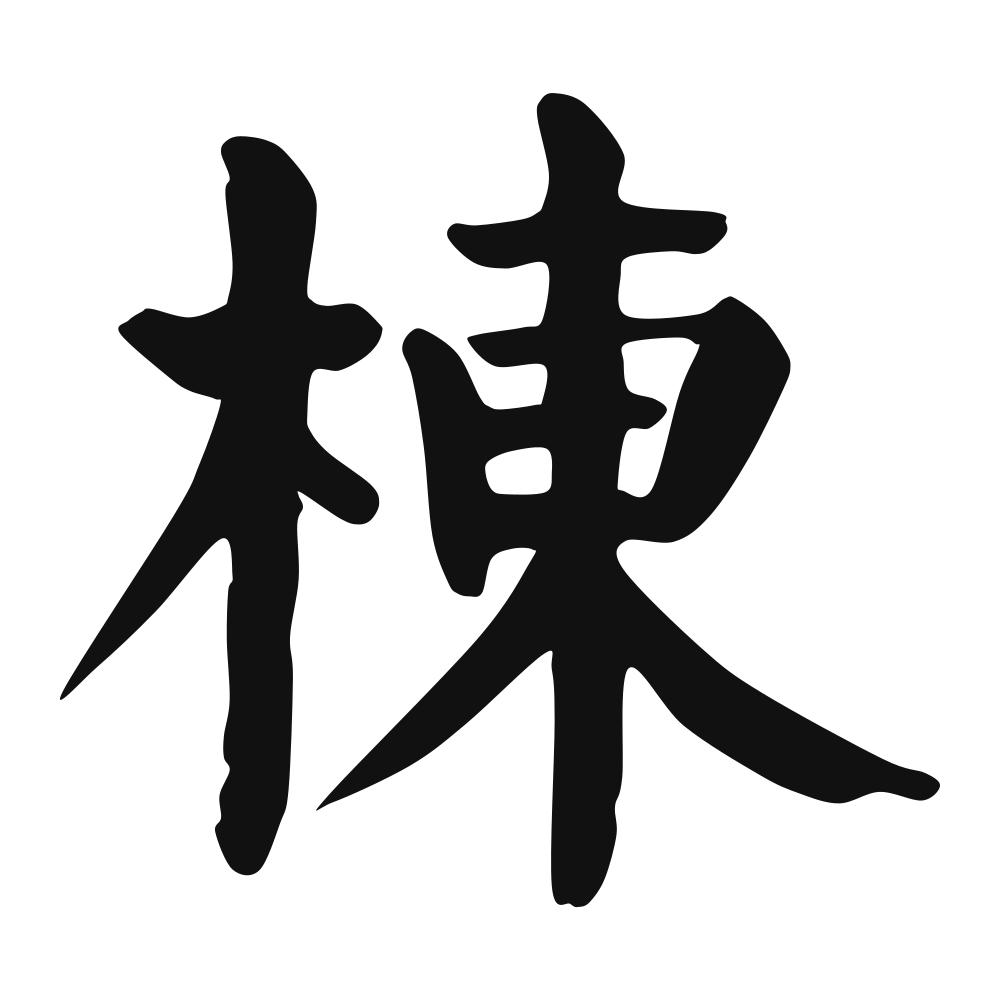
栋
ridgepole (old)
Closest English meanings
ridgepole·pillar·building
The Calligrapher — Yán Zhēnqīng 颜真卿
Tang master of robust regular script; co-creator of the enduring 'Yan style'.
Tang calligrapher (709–784), master of regular script/running script — the Tang moral paragon whose upright, muscular regular script became the model of Chinese integrity in writing. Tang dynasty
Etymology & Meaning · 字义溯源
### Sounddòng — dòng (4th tone). Free-standing morpheme ### Original meaningDòng (4th tone). The Shuowen Jiezi defines it as 「極也。从木東聲」 — 'the ridge', built from wood (木) with 東 giving the sound. 極 in Xu Shen's usage is the highest point, and Liu Xi's 《釋名》 spells the idea out: 棟,中也,居屋之中也 — 'the ridgebeam is the middle: it sits at the centre of the house'. The 《爾雅·釋宮》 gives the architectural gloss 棟謂之桴, and every later source repeats that the 棟 is the one horizontal timber from which the whole roof hangs. Because of that it became, early and permanently, the word for a person who bears weight: 《左傳·襄公三十一年》「子於鄭國,棟也」 (you are the ridgebeam of Zheng), and 《國語·魯語上》 sharpens it into a principle, 「不厚其棟,不能任重」 — if you do not make the ridge thick, it cannot carry the load. The Yijing takes it as the governing image of an entire hexagram: 《易·大過》 is built on the ridgebeam — 九三「棟橈,凶」 (the ridge sags: danger) against 九四「棟隆,吉」 (the ridge rises high: good fortune). 《漢書》 and later name tables also record 棟 as a star: 《博雅》「大角謂之棟星」. One honest correction: the character you are looking at, 栋, is the 20th-century simplified shape; Kangxi counts 12 strokes for 棟 (木部+8), and every classical source above is talking about 棟. ### The structure (形聲 · 从木,東聲 — the wood radical plus 東 (east) as phonetic; simplified by replacing 東 with 东)①木mùwoodthe timber the beam is cut from②東dōngeastthe phonetic, retained whole in the traditional 棟③極jíthe highest pointthe Shuowen's defining word — the roof's top line④棟樑dòngliángpillar of the statebeam and girder together: the idiom for a person who bears weight ### In use todayItemReading / meaningNoteReadingdòng (4th tone)dōng only as a tree in 《管子·地員篇》Core sensethe ridgebeam; the load-bearerhorizontal roof timber, not an upright postGrammarfree morpheme + classifier棟樑 pillar of the state; 一棟房子 one buildingTattoo fityes-standalone — universally understood, no negative sensewrite 棟 if you want the classical form ### Closest words in English — and what each misses - Pillar / column — 柱 holds the upright post; 棟 is the horizontal beam resting on it - Strength — 力/強 hold raw strength; 棟 is strength in a specific place, under a specific load - Leader — 領袖/主 hold leadership; 棟 is承重者 — the bearer, not the commander - Roof — 屋/宇 hold the building; 棟 names the single timber the rest depends onAn honest note on grammar. Free morpheme — 棟樑 'pillar of the state'; also a classifier for buildings (一棟房子) and, rarely, a tree name read dōngWhere a Western reader can stand: 栋 (dòng) means the ridgebeam — the one horizontal timber at the top of a Chinese roof from wh
Cultural Story
栋 is the ridgepole, the central beam a whole roof hangs from — and 栋梁 became the metaphor for the man a state rests on, the talent that holds the house of government up. A 一棟 was one roof, one structure. The character is the timber at the very top, bearing all that the walls below pass upward.
Where a Western reader can stand: 栋 (dòng) means the ridgebeam — the one horizontal timber at the top of a Chinese roof from which every rafter hangs. Shuowen glosses it 'the highest point'. Because a thin beam means a collapsed house, the word became Chinese for a person who can be leaned on: 棟樑 is 'pillar of the state', and the Guoyu states plainly that a thin ridge cannot carry the load. The Yijing devotes a hexagram to it. As a tattoo it is warm and dependable, not aggressive — capacity, not bravado. The form shown is simplified; the classical shape is 棟.
Common words & phrases
- 棟樑 pillar · mainstay · talent
- 棟宇 building · house
- 一棟 one building
Read the story behind the character
栋 counts buildings: 一棟 the tower a developer sells, 栋宇 the old word for a hall, 栋梁 the principal a speech calls the school's backbone. The character moved from beam to edifice to person of weight. It is the syllable that measures a structure and the person who is one, holding the rest up.
Why this character belongs on skin
The great beam is laid and the house can finally stand against the sky. The ridgepole, the central timber that carries the whole roof, the spine of the dwelling. We speak of a talent fit to be the beam of the nation, one who holds the weight of others without bending. To be the beam is a silent vocation: you are not seen, you are above, you simply bear. The family sleeps beneath you unaware. To carry this mark is to accept the load willingly, the role of the one who holds, who makes the shelter possible. It is a grave, honoring mark, inked along the spine or the shoulder blades, the body's own ridge. Let it name you as the support, the quiet timber in someone's weather. You were cut to bear. The roof of lives rests where you stand.
Own this character
Purchase delivers the original SVG of this glyph, brushed by Yán Zhēnqīng 颜真卿, ready to place on skin, paper, or screen.