
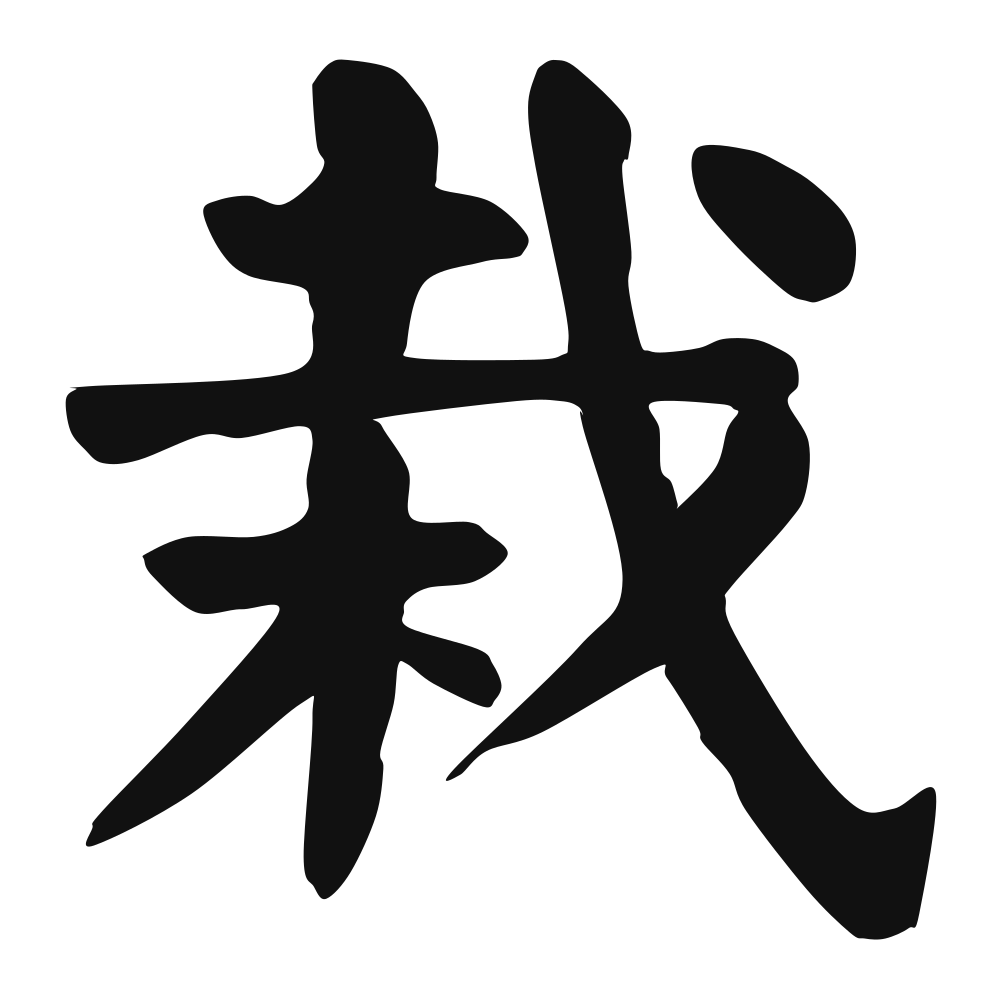
栽
to plant; to grow; to insert; to erect (e.g. a bus stop sign); to impose sth on sb; to stumble; to fall down
Closest English meanings
plant·grow·frame
The Calligrapher — Yán Zhēnqīng 颜真卿
Tang master of robust regular script; co-creator of the enduring 'Yan style'.
Tang calligrapher (709–784), master of regular script/running script — the Tang moral paragon whose upright, muscular regular script became the model of Chinese integrity in writing. Tang dynasty
Etymology & Meaning · 字义溯源
### Soundzāi — zāi (1st tone); Shuowen's fanqie 昨代切 gives zài for the walling-board sense (two readings). Free-standing morpheme ### Original meaningZāi (1st tone). The Shuowen Jiezi defines it as 「栽,築牆長版也。从木𢦏聲」 — 'the long boards for ramming a wall' — and clinches the definition with a line of the Zuo zhuan: 《春秋傳》曰「楚圍蔡,里而栽」 ('when Chu besieged Cai they measured the ground and set the boards'). So the word's origin is not gardening at all: it is the wooden shuttering of the hangtu technique, the upright posts and long planks clamped together while earth is pounded between them. Duan Yucai spells out what it meant: 「植之謂之栽。栽之言立也」 — 'setting them upright is called zai; zai means to stand up'. Xu Shen's fanqie here is 昨代切 (zài), the reading for the walling-board sense; the modern zāi comes from the second reading recorded in Kangxi, 祖才切, under which the same dictionary quotes 《中庸》「栽者培之」 and notes 穉曰栽,長曰樹 — the young plant is zai, the grown one is shu. Already in the Han this slip had happened: Zheng Xuan's note on the Zhongyong says 栽猶殖也。今時人名艸木之殖曰栽 — 'in current speech people call planting 栽' — so the planting sense is old but demonstrably secondary to the building sense. Honest disclosure for anyone wearing it: modern Chinese also uses 栽 for falling (栽跟头, to take a tumble) and for framing someone falsely (栽赃, to plant evidence). Those are not classical senses, but they are what a bare 栽 can call to mind today. ### The structure (形聲 · 从木,𢦏聲 — the wood radical with 𢦏 (to hurt / to wound, here phonetic only) giving the sound; today written 栽 with 戈 + 木)①木mùwoodplanks, posts, and later the young tree itself②𢦏zāiphonetic: to woundborrowed for sound alone — it contributes no meaning③築zhùto ram (earth)the craft that gave the word its origin: 築牆長版④培péito bank up soil around「栽者培之」 — what you do after planting is the real work ### In use todayItemReading / meaningNoteReadingzāi (1st tone) Shuowen's 昨代切 (zài) belongs to the older walling senseCore senseto plant; to set uprightroot sense: the formwork board for earth wallsGrammarfree verb栽樹 · 栽培 · but also 栽跟头 fall / 栽赃 frameTattoo fitcaution — positive classical sense, negative colloquial echoespair it: 栽培 is safe and clear ### Closest words in English — and what each misses - Grow — 生/長 hold growth itself; 栽 is the human act of setting something in place - Seed — 種 holds sowing and also seed; 栽 puts a young plant already started into the ground - Build — 築 holds building, and owns the root sense of 栽 — the formwork board - Nature — 自然 holds nature; 栽 is labour applied to nature, not nature itselfAn honest note on gra
Cultural Story
栽 is to set a 木 upright in the earth — to plant — and the gardener's 栽培 became the metaphor for training a protégé. But 栽赃 is to plant evidence on someone, and 栽跟头 to plant your face in the dirt. One verb, the garden and the setup, the same downward motion meaning opposite things.
Where a Western reader can stand: 栽 (zāi) means 'to plant', but that is not where it started. Shuowen defines it as the long wooden boards used to build rammed-earth walls, and from 'stand a plank upright' came 'set a young plant in the ground'. Modern colloquial Chinese also uses it for tumbling over (栽跟头) and planting false evidence (栽赃). As ink, the compound 栽培 — 'to cultivate', used of raising people — carries the good sense far more safely than the bare character. Its Wuxing element is contested between Wood and Metal; treat it as a declared choice.
Common words & phrases
- 栽培 cultivate · train
- 栽树 plant a tree
- 栽种 plant · grow
- 栽赃 frame · plant evidence
- 栽跟头 take a fall · stumble
Read the story behind the character
栽 is the dig and the disgrace: 栽树 the sapling a city plants on a Tuesday, 栽培 the mentor who cultivates you, 栽种 the farmer's spring. 栽赃 is the frame-up in a crime drama; 栽跟头 the failure a rival enjoys. The character is the act of putting something down — a tree or a lie that won't wash.
Why this character belongs on skin
You press the small tree into the earth with both hands and feel the future take root beneath your nails. This is the planting — the deliberate act of trusting soil you will not live to see flower. But the same character means to fall, to sprawl, to be thrown down by your own footing. The farmer plants; the drunkard falls; the tongue plants a lie in another's mouth. To live is to do all three. The Daoist laughs at the man who plants and calls the harvest his, for the wind decides. Yet we plant anyway, because the planting is the only honest prayer. Wear this character and you accept the bargain: stand, stumble, sow. The ground receives everything. Let your skin remember that to fall is only the first half of growing.
Own this character
Purchase delivers the original SVG of this glyph, brushed by Yán Zhēnqīng 颜真卿, ready to place on skin, paper, or screen.