
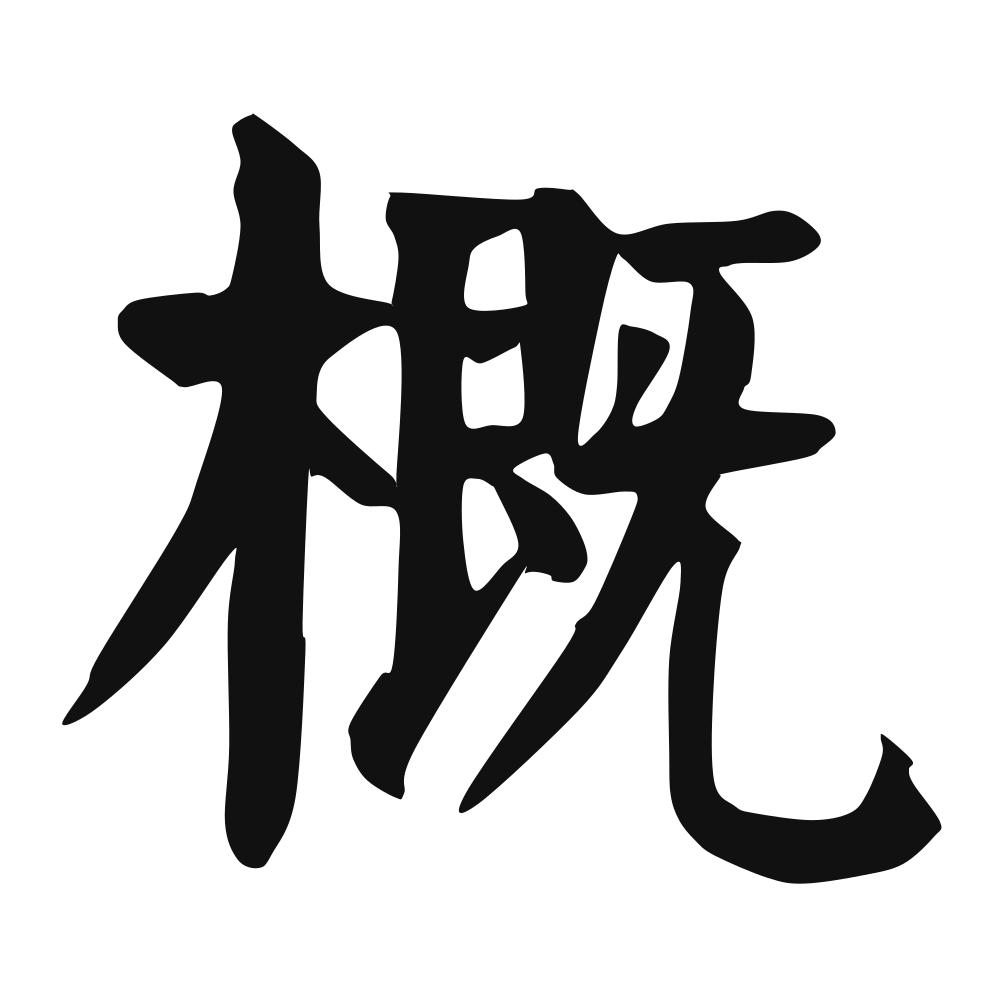
概
(bound form) general; approximate; without exception; categorically; (bound form) bearing; deportment
Closest English meanings
generally·approximately·bearing
The Calligrapher — Yán Zhēnqīng 颜真卿
Tang master of robust regular script; co-creator of the enduring 'Yan style'.
Tang calligrapher (709–784), master of regular script/running script — the Tang moral paragon whose upright, muscular regular script became the model of Chinese integrity in writing. Tang dynasty
Etymology & Meaning · 字义溯源
### Soundgài — gài (4th tone). Often a bound morpheme — needs a partner word ### Original meaningGài (4th tone). Strictly speaking the Shuowen Jiezi has no entry under 概; it records the older form 槩 and defines it as 「槩,𣏙斗斛。从木旣聲」 — 'the strickle [that levels] the bushel-measure', wood radical with 旣 for sound. Duan Yucai judged the transmitted text defective and supplied two characters, printing instead 「所㠯𣏙斗斛也」 — 'that by which one levels the bushel' — with the note 㮣本器名。用之平斗斛亦曰㮣: it is a tool's name, and the act of levelling with it took the same word. In other words: a straight-edged board you draw across the top of a measuring vessel so the grain is honest rather than heaped, and no one cheats either way. The lexicographers then watched it spread. Duan lists the extensions in one breath — 引伸之義爲節㮣、感㮣、挭㮣 — 'moral bearing, sighing, the outline of a thing' — and modern Chinese still runs on those: 大概 roughly, 一概 uniformly, 概念 concept, 概率 probability, 胜概 a fine prospect, 气概 bearing. Ritual usage added a second object entirely: the Kangxi records 《周禮·春官·鬯人》 「凡祼事用概」, a libation vessel with a red band, and notes that the graph is borrowed for 溉 (to rinse) and for 慨 (to sigh). Base your citation not on those but on the philosophers, who loved the strickle as a picture of justice: 《韓非子·外儲說》 says flatly 槩者,平量者也 — 'the 概 is what makes the measure level'; 《管子·樞言》 turns it on a human being, 釜鼓滿則人槪之,人滿則天槪之 — 'when the pot is full a man strikes it level; when the man is full, Heaven does'; and 《荀子·宥坐》 makes it a definition of rightness, 盈不求概,似正 — 'water, brimming, needs no strickle — it is level by itself, like impartiality.' ### The structure (形聲 · 从木,旣聲 — wood radical with 旣 (already; finished) as phonetic; the canonical Shuowen form is 槩, with 㮣, 槪 and today's standard 概 as later variants)①槩gàithe strickle (Shuowen form)the dictionary head-form; 概 is the modern standard variant②斗斛dǒuhúthe bushel and its doublethe measures this tool was made to level③慨kǎito sigh (heart radical)the proper graph for 慷慨 / 感慨 — often confused with 概④節概jiégàimoral bearingthe noble extension Duan Yucai lists first ### In use todayItemReading / meaningNoteReadinggài (4th tone)homophone of 蓋 lid, 溉 irrigateCore senselevel; roughly; bearingthe tool's name became a word for 'the general shape of things'Grammarbound morpheme in modern use大概 · 一概 · 概念 · 概率 · 气概Tattoo fitcaution — no bad sense, but modern hearing is 'approximately'for 'bearing', the classical graph is 慨 ### Closest words in English — and what each misses - Balance — 平/衡 hold balance; 概 is the tool that produces it in a specifi
Cultural Story
概 is a flat scoop used to level a heap of grain - the Shuowen calls it the tool that makes measure even. Because it struck off the excess, 概 came to mean 'in general' and 'the governing spirit' of a thing. A 概念 is the outline of an idea, and 氣概 is a person's bearing or mettle. The word thus moves from the farmer's measuring stick to the philosopher's grasp of the whole.
Where a Western reader can stand: 概 (gài) began as a tool — the flat stick drawn across a grain measure so the bushel is honest. Shuowen files it as 槩, 'that by which the bushel is levelled'. The philosophers made it moral: Guanzi warns that when a man is full, Heaven levels him; Xunzi praises water that needs no levelling — impartiality. But in everyday Chinese today it mostly means 'roughly' (大概), and its 'bearing' sense lives only in 節概 and 气概, while 慷慨 properly uses the heart-radical 慨.
Common words & phrases
- 大概 probably · roughly
- 概念 concept
- 概括 summarize
- 氣概 spirit · mettle
- 一概 all · without exception
Read the story behind the character
You speak 大概, roughly, about the time, and learn a 概念, a concept, in class. A summary 概括, generalizes, the article, while a soldier shows 氣概, spirit and mettle, under fire. Rules apply 一概, all without exception. From a grain scoop to a textbook, 概 is the word for the broad stroke that levels detail into sense - the measure that tells what something is, in sum.
Why this character belongs on skin
You know the feeling of stepping back from detail until the whole appears—the shoreline resolving from noise into shape. That is this character: a sweep of the hand over a tray, leveling the grain, taking the measure of everything at once. The Daoists called it knowing the Way by not choking the sprouts—governing with a light touch, trusting the pattern beneath the clutter. 概 is the confidence to carry the whole without gripping every part. There is calm in that, and power: the person who sees the outline is never lost in it. Put it on your forearm, where you flex your hand each morning—a quiet vow to keep the wide view, to trust the shape of things, and to move through the world like someone who has already read the ending.
Own this character
Purchase delivers the original SVG of this glyph, brushed by Yán Zhēnqīng 颜真卿, ready to place on skin, paper, or screen.