
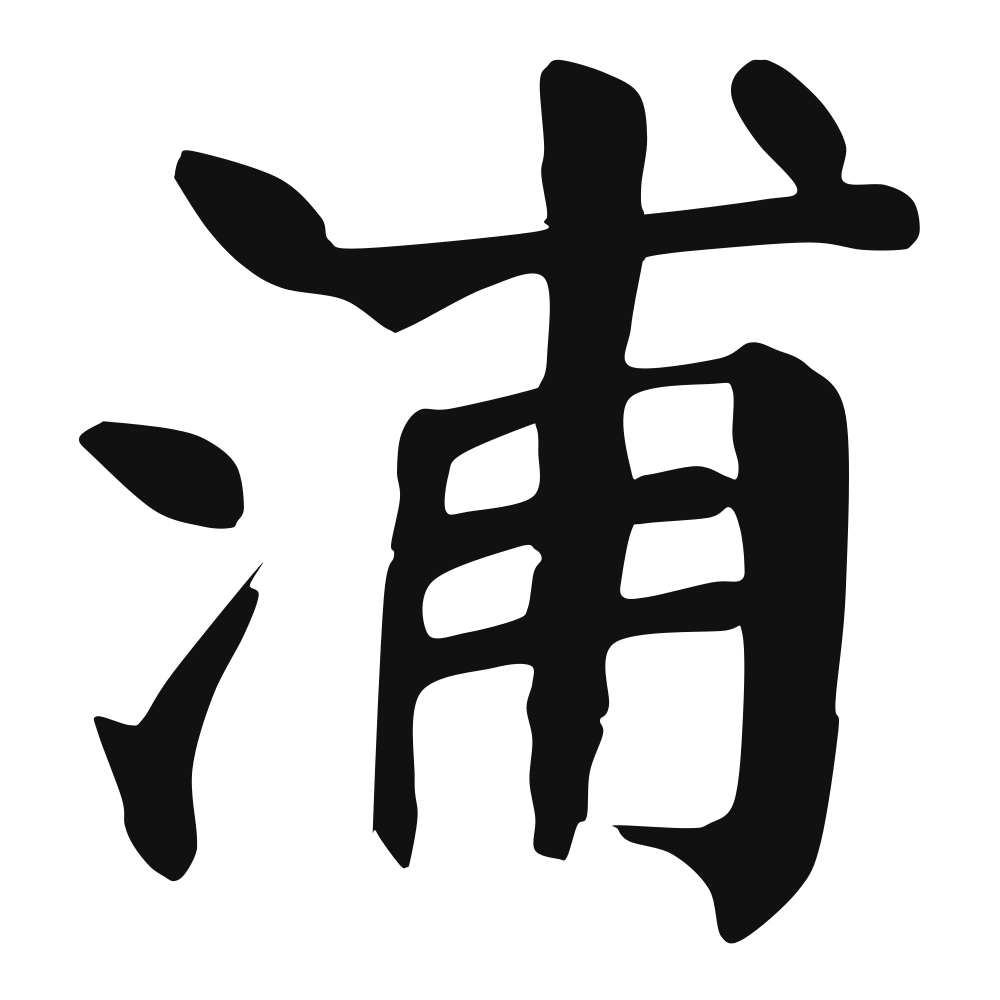
浦
surname Pu; river bank; shore; river drainage ditch (old)
Closest English meanings
riverbank·inlet
The Calligrapher — Yán Zhēnqīng 颜真卿
Tang master of robust regular script; co-creator of the enduring 'Yan style'.
Tang calligrapher (709–784), master of regular script/running script — the Tang moral paragon whose upright, muscular regular script became the model of Chinese integrity in writing. Tang dynasty
Etymology & Meaning · 字义溯源
### Soundpǔ — pǔ (3rd tone). Free-standing morpheme ### Original meaningPǔ (3rd tone). The Shuowen Jiezi defines it in two words — 「浦,瀕也。从水甫聲」 — 'a shore', water for the sense and 甫 for the sound. Duan Yucai expands: 「水瀕也。瀕下曰水厓,人所賓附也」 — the water's edge, the place people come to and attach themselves to; and he anchors it in the Odes: 《詩·大雅》 「率彼淮浦」, with the old commentary glossing 浦 as 厓, the bank. The word lives exactly there in classical Chinese: 《楚辭·九歌·湘君》 「望涔陽兮極浦」 (gazing toward Cen-yang, to the far shore), 《呂氏春秋·本味》 「江浦之橘」 (the oranges of the river shore), and 《戰國策·秦策》 「還為越王禽于三江之浦」 for the meeting-place of waters. Later it narrows to 'the place where a river meets the sea' (《玉篇》「水源枝注江海邊曰浦」) and to a river's mouth — 合浦, 浦口, 黃浦. Kangxi: 11 strokes (水部 + 7); the modern standard form writes 10. Wuxing: Water (水) by radical, but the 五格 stroke-count school reads Kangxi 11 as tail-digit 1, which is Wood (木) — the two schools disagree here (verify). ### The structure (形聲 · 从水,甫聲 — water for sense, 甫 for sound; the radical carries all the meaning)①氵shuǐwaterthe radical: this is a word about water's border②甫fǔa man's styling (phonetic)the sound-bearer; contributes no meaning③浦pǔriver-shorethe line where water stops and ground begins④瀕bīnshore (Shuowen's gloss)the very word Xu Shen used to define 浦 ### In use todayItemReading / meaningNoteReadingpǔ (3rd tone)single syllable; also a surnameCore sensethe shore; a river's meeting with the seaplace, not emotionGrammarnoun of place (place-name element)浦口 · 合浦 · 黃浦江Tattoo fityes-standalone — calm and legiblereads as shoreline; also works as a surname ### Closest words in English — and what each misses - Universal / Wide — 普 (pǔ) holds 'universal'; 浦 is a shoreline — the common homophone trap - Harbour / Port — 港 / 埠 hold the built harbour; 浦 is the natural meeting of waters, not the quay - Bank / Embankment — 岸 holds the bank as a raised edge; 浦 is the water-side flat, the place people come to - Sea — 海 holds the sea; 浦 is the point where a river reaches itAn honest note on grammar. Free morpheme in classical Chinese (率彼淮浦); in modern use it is a noun of place — 浦口, 合浦, 黃浦江 — and a surname (《晉起居注》 has 浦選).Where a Western reader can stand: 浦 (pǔ) means the shore — the flat place where a river meets a greater water, where a stream opens into the sea. Xu Shen's dictionary defines it in one word: 瀕, 'shore'. It is the image in the oldest Chinese love-poetry ('gazing to the far shore'), and it is the -pu in 黃浦江. As a tattoo it reads as calm, open, and welcoming: not the sea, not the deep, but the edge where you stand. N
Cultural Story
浦 means a river mouth or bank where a stream joins the great water. The Chu ci sings of parting at the 浦, and ports grew where 浦 opened to the sea. It is a word of thresholds, where the small current meets the tide, where travelers embark and the land loosens into moving water at last.
Where a Western reader can stand: 浦 (pǔ) means the shore — the flat place where a river opens into a greater water. An ancient poem calls it 'the far shore' where a lover waits. With Yan Zhenqing, the calligrapher of civic, public script, it reads as a threshold and a welcome: open, level, unhurried.
Common words & phrases
- 黄浦江 Huangpu River
- 浦口 Pukou
- 江浦 riverbank
Read the story behind the character
Shanghai grew around the 黄浦江 (Huangpu River), whose 浦 banks hold the Bund and the towers of Pudong. The district of 浦口 (Pukou) sits across from Nanjing, and 江浦 (riverbank) names recall those old meeting points of land and flowing river where ferries once crowded at dawn.
Why this character belongs on skin
There is a particular mercy at the river mouth, where fresh water loses its argument with the tide and the two become something neither was alone. 浦 is that shoreline—the harbor, the bank where boats are moored, the soft edge where land concedes to water and both are gentled. It is the place of departure and return, where the traveler is loosed and welcomed in the same breath. The Dao loves such thresholds, the in-between where opposites bow to each other. To be marked here is to know you are a meeting place, not a border—where the wild current of you calms into something a harbor can hold. Let the ink rest at the wrist, the place things are tied and loosed. It says you are someone's shore, the calm water where another's journey ends.
Own this character
Purchase delivers the original SVG of this glyph, brushed by Yán Zhēnqīng 颜真卿, ready to place on skin, paper, or screen.