
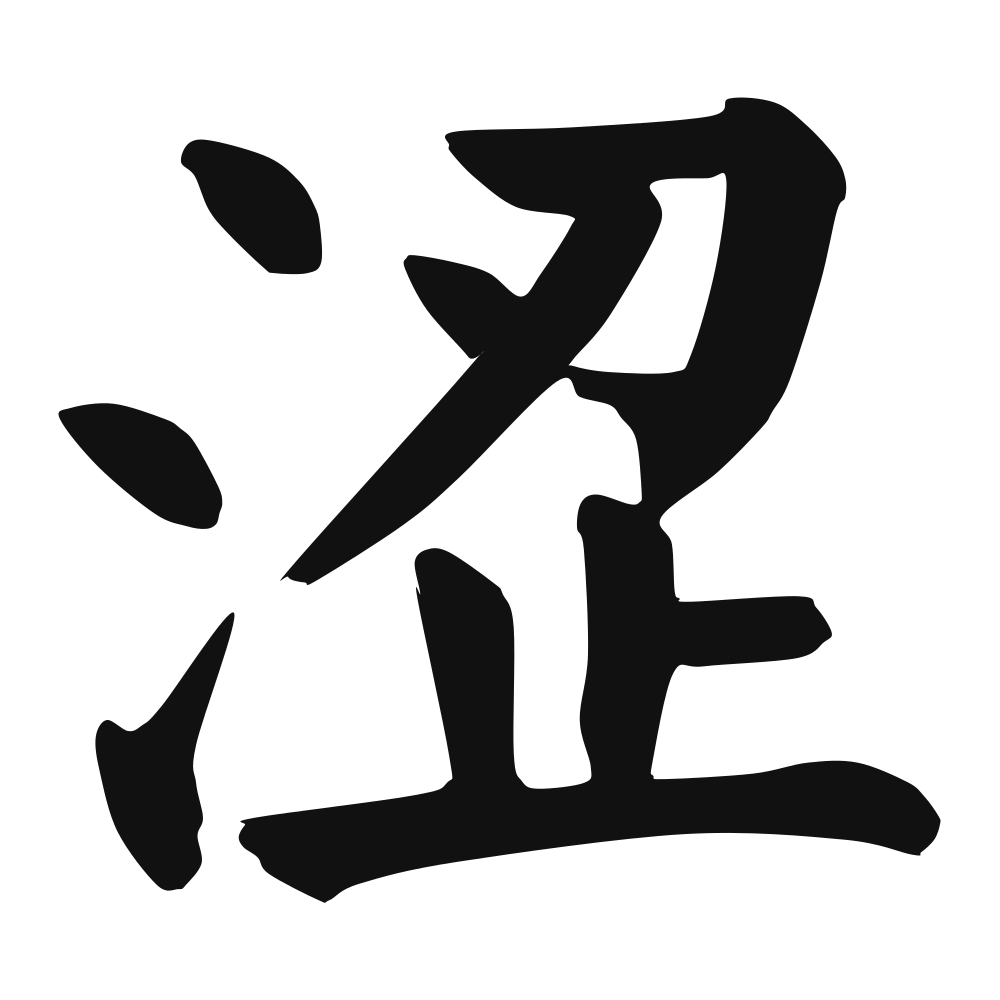
涩
astringent; tart; acerbity; unsmooth; rough (surface); hard to understand; obscure
Closest English meanings
astringent·rough·awkward
The Calligrapher — Yán Zhēnqīng 颜真卿
Tang master of robust regular script; co-creator of the enduring 'Yan style'.
Tang calligrapher (709–784), master of regular script/running script — the Tang moral paragon whose upright, muscular regular script became the model of Chinese integrity in writing. Tang dynasty
Etymology & Meaning · 字义溯源
### Soundsè — sè (4th tone). Free-standing morpheme ### Original meaningSè (4th tone). Honest note on the source: the Shuowen Jiezi's head-entry is 濇 — 「濇,不滑也」 — 'not slippery'; 澀 is the later common form, and the Kangxi dictionary records it flatly: 「澀…與歰同。《說文》不滑也」. The phonophore 歰 is itself a picture: four feet pressed two against two, the very image of things catching instead of sliding. So the oldest meaning is physical — a surface that will not let anything pass smoothly. From there it spreads: to taste (杜甫 《病橘》 「酸澀如棠梨」, sour and mouth-drying as a wild pear), to the body (《素問·至真要大論》 「短而濇」, the pulse that comes short and catching), to music and speech (白居易 《琵琶行》 「冰泉冷澀弦凝絕,凝絕不通聲暫歇」 — the cold spring, the string that catches and stops), and to prose (艱澀, writing that will not go down). Kangxi: 澀 16 strokes (水部 + 12); the simplified 涩 writes 10. Wuxing: Water (水) by radical, but the 五格 stroke-count school reads Kangxi 16 as tail-digit 6, which is Earth (土) — the schools disagree (verify). ### The structure (形聲 · 从水,歰聲 — water plus 歰, itself a picture of four feet pressed against each other; the Shuowen head-entry is 濇, of which 澀 is the common later form)①氵shuǐwaterthe radical: smoothness and its absence②歰sèfour feet pressed together (phonetic + root)the original picture of not-sliding; the word's true source③澀sèastringent, roughthe common form: everything that catches④滑huáslipperythe word 澀 exists to negate ### In use todayItemReading / meaningNoteReadingsè (4th tone)single syllableCore sensenot sliding; astringent; rougha texture before it is a feelingGrammaradjective, mostly bound in modern use苦澀 · 乾澀 · 生澀 · 艱澀 · 羞澀Tattoo fitcaution — honest, unflattering, deliberatefor someone who means 'I do not go down smoothly' ### Closest words in English — and what each misses - Bittersweet — 苦 holds 'bitter' as taste and as life; 澀 is a texture — the mouth-drying catch, not a feeling about life - Sad — 悲 / 愁 hold sorrow; 澀 has no sorrow in it, only friction - Shy — 羞 holds shame/bashfulness; 羞澀 is a modern compound and the shyness comes from 羞, not from 澀 - Rough / coarse — 粗 holds coarseness of grain; 澀 is specifically the failure to slide — a surface, a pulse, a string, a sentenceAn honest note on grammar. Adjective, free in classical usage, mostly bound in modern Mandarin — 苦澀, 乾澀, 生澀, 艱澀, 羞澀.Where a Western reader can stand: 涩 (sè) means 'not sliding'. That is the whole of it, and everything else follows — the drying taste of an unripe pear, the pulse that comes short and catching, the pipa string that freezes on a cold spring and stops the music, prose th
Cultural Story
涩 means astringent, the puckering of unripe fruit, and then rough or awkward. Tea connoisseurs prized a fine 涩 that cleared the mouth, while a 涩 style stumbled. The word gathers friction, the tongue's recoil, the pen's hesitation, the social scrape of saying the wrong thing at dinner.
Where a Western reader can stand: 涩 (sè) means 'not sliding' — the drying taste of an unripe pear, a pulse that catches, a string that freezes and stops the music. Yan Zhenqing's brush refuses to glide; it catches and bears weight. As a tattoo it is deliberate honesty, not romance: 'I do not go down smoothly.'
Common words & phrases
- 苦澀 bitter · astringent
- 生澀 unskillful · raw
- 晦澀 obscure
- 羞澀 shy
- 澀味 astringent taste
Read the story behind the character
We wince at 苦澀 (bitter, astringent) tea and laugh off a 生澀 (unskillful, raw) first attempt at piano. A 晦澀 (obscure) textbook frustrates students, a 羞澀 (shy) girl hides behind her hair, and the 澀味 (astringent taste) of persimmon dries the mouth in seconds flat.
Why this character belongs on skin
Bite into a green persimmon and your mouth learns what 涩 means—that dry, clever shrinkage, the flavor that withholds before it gives. The character was born of water that will not flow smooth, and so it names everything rough, unhurried, a little difficult on purpose. There is virtue in the unpolished. The Daoist honors the uncarved block; the wise lover knows the sweetest closeness keeps a faint resistance, a texture you return to. To ink this is to refuse the easy, the saccharine, the too-ready smile. It is a claim that you are not here to be swallowed whole. Wear it as a small honed edge, a reminder that some things must be tasted slowly, that the mouth puckers before it understands, and that what stays with you longest was never the smoothest thing you met.
Own this character
Purchase delivers the original SVG of this glyph, brushed by Yán Zhēnqīng 颜真卿, ready to place on skin, paper, or screen.