
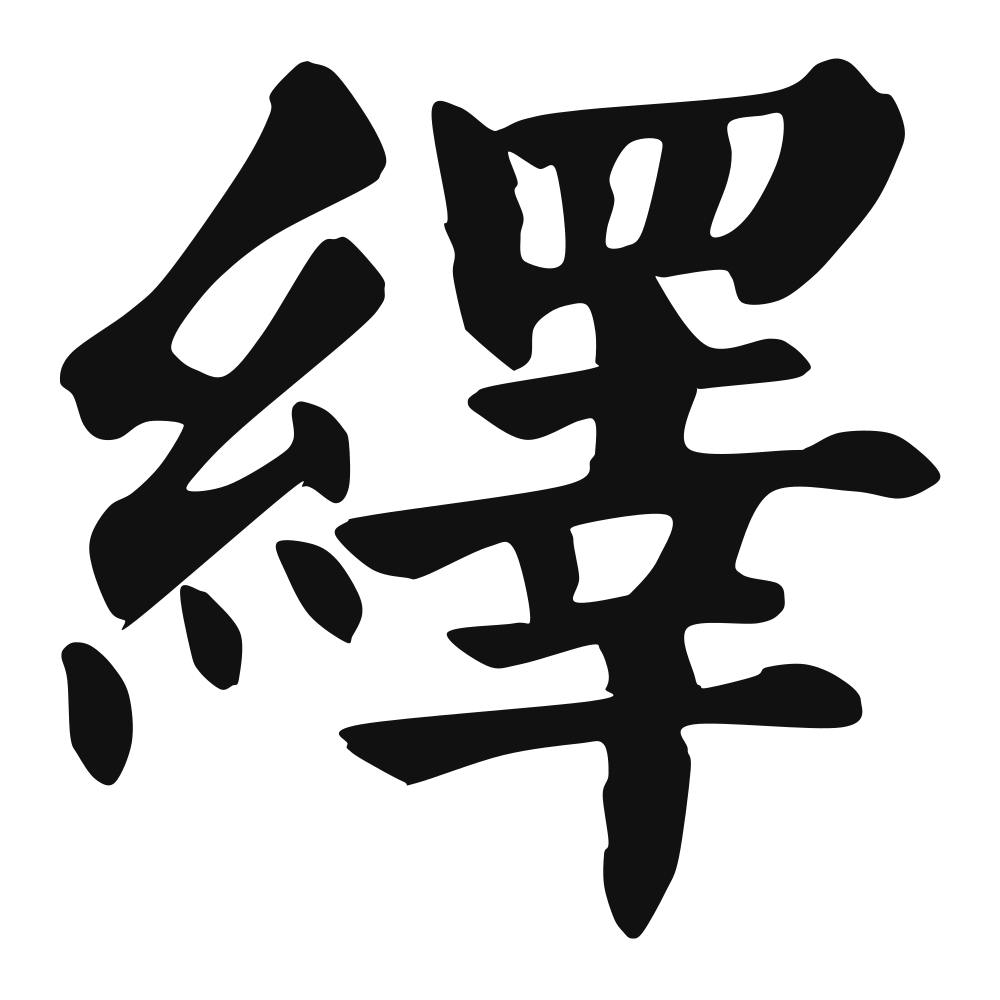
绎
continuous; to interpret; to unravel; to draw silk (old)
Closest English meanings
unravel·continuous·deduce
The Calligrapher — Yán Zhēnqīng 颜真卿
Tang master of robust regular script; co-creator of the enduring 'Yan style'.
Tang calligrapher (709–784), master of regular script/running script — the Tang moral paragon whose upright, muscular regular script became the model of Chinese integrity in writing. Tang dynasty
Etymology & Meaning · 字义溯源
### Soundyì — yì (4th tone). Free-standing morpheme ### Original meaningYì (4th tone; traditional 繹). The Shuowen Jiezi defines it as 「抽絲也。从糸睪聲」 — 'to draw out silk': the 糸 radical sets the field (silk), 睪 (yì) carries the sound, and the picture is a hand teasing one unbroken thread out of a cocoon. That single image is the whole later career of the word, which runs on two tracks: 'to draw out an ordered thread' (尋繹, 演繹) and 'running on without a break' (絡繹不絕, 繹如). 《揚子·方言》「繹,理也。絲曰繹之」 glosses it as bringing order out of tangle; 《爾雅·釋詁》「繹,陳也」 as setting out in order. The finest classical use is in the rite of archery: 《禮記·射義》「射之爲言繹也…繹者,各繹己之志也」 — 'archery is called yi: each man draws out his own intention'. 《公羊傳》 uses 繹 for the sacrifice repeated the morning after the main one: 「繹者何?祭之明日也」. Honest disclosure: in modern Chinese 繹 almost never stands alone — it lives inside 演繹 (deduction) and 絡繹不絕 (an unbroken stream). ### The structure (形聲 · 从糸,睪聲 — silk (糸) for the field, 睪 (yì) for the sound; the hand that draws the thread out)①糸mìsilk (radical)the field: everything here is thread②睪yìto watch over / (phonetic)the sound-bearer; also the eye that follows the thread③抽絲chōu sīto draw silkthe Shuowen definition — one filament teased out of the cocoon④繹yìto draw out; unbrokenfrom the thread: to draw out an order, and to run on without breaking ### In use todayItemReading / meaningNoteReadingyì (4th tone)single syllable; traditional 繹Core senseto draw out and order; unbrokenoriginally 'to draw silk' from a cocoonGrammarbound morpheme (modern)演繹 deduction; 尋繹 to trace out; 絡繹不絕 an unbroken streamTattoo fitcaution — classical, and half a word to modern eyesreads as patient unravelling; pair it if you want it to read cleanly ### Closest words in English — and what each misses - Translate / Interpret — 譯 (yì, 言 radical) holds 'to translate'; 繹 is 糸 — 'to draw out a thread', not to render speech - Deduce — 演繹 is the compound that means deduction; 繹 alone is the drawing-out that makes it possible - Mystery — 秘/玄 hold mystery and the dark; 繹 is the opposite gesture — making the hidden thread visible - Continuous — 連/續 hold plain continuity; 繹's continuity is earned — a line drawn out by work, not simply uncutAn honest note on grammar. Free morpheme in classical usage (《禮·射義》「繹者,各繹己之志也」); in modern Mandarin a bound morpheme — 演繹 (deduction), 尋繹 (to trace out), 絡繹不絕 (an unbroken stream)Where a Western reader can stand: 绎 (yì) began as the word for drawing one thread out of a cocoon. Because a drawn thread is both 'an order recovered from tangle' and 'a line that runs on',
Cultural Story
绎 was the patience-work of finding a silk thread's end and drawing it steadily out of the tangle, so classical readers used it for prying meaning steadily out of a text: 寻绎 the classics, line after line. From drawing out a thread it was a short step to drawing out a principle, and 演绎 came to name reasoning that unfolds conclusions the way silk unwinds.
Where a Western reader can stand: 绎 (yì) began as drawing one thread from a cocoon — so it means both 'recovering order from tangle' and 'continuing without break.' An old archery rite says each man 'draws out his own intent,' the target being honesty not victory. Yan Zhenqing's patient hand matches. Honest note: alone it reads as half a word; pair it, and don't confuse it with 'translate' (譯).
Common words & phrases
- 演繹 deduce · deduction
- 絡繹 continuous · uninterrupted
- 尋繹 elucidate · unravel
Read the story behind the character
Yì thrives in fandom and philosophy. Online detectives 演绎, deduce, a thriller's ending from frame-by-frame clues; studios 演绎, adapt and perform, a classic novel into a new film, each director adding threads. On holiday weekends, scenic gates report crowds 络绎, in continuous stream, while book reviewers praise essays that 寻绎, tease out, an author's hidden logic.
Why this character belongs on skin
There is a thread you did not know you were following. At dusk, when the lamps turn amber and the day loosens its grip, something in you starts to unwind — not a breaking, but an unspooling, the way silk slips from the loom one bright filament at a time. The ancients called this yì: to draw out, to continue, to make plain what was once tangled. It is not force but attention. A Daoist would say the Way is not grasped but traced, followed until the pattern shows itself. You are both the thread and the hand that follows it. To carry this mark is to admit you are still becoming, still being read, line by slow line. The story is not finished; it is being drawn out. Let it live on your skin, where the unwinding never ends, and where one quiet day you let it become ink.
Own this character
Purchase delivers the original SVG of this glyph, brushed by Yán Zhēnqīng 颜真卿, ready to place on skin, paper, or screen.