
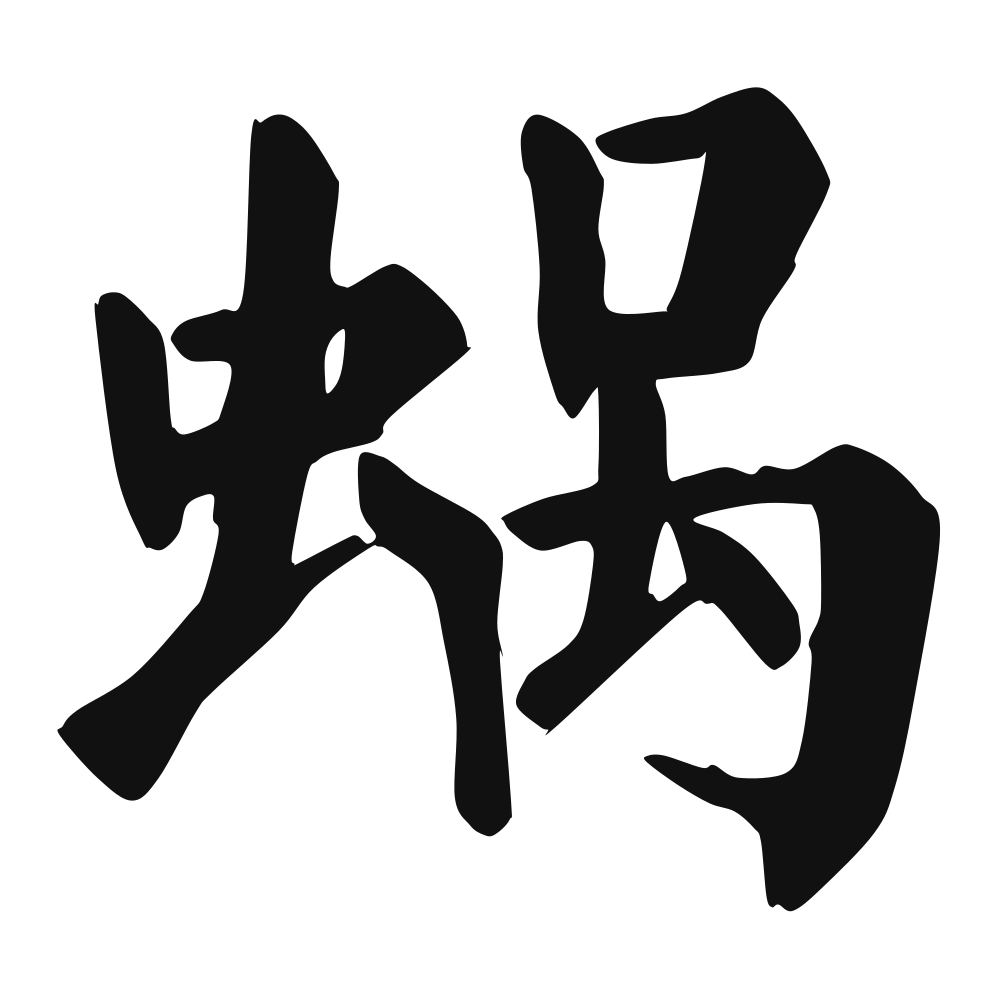
The Calligrapher — Yán Zhēnqīng 颜真卿
Tang master of robust regular script; co-creator of the enduring 'Yan style'.
Tang calligrapher (709–784), master of regular script/running script — the Tang moral paragon whose upright, muscular regular script became the model of Chinese integrity in writing. Tang dynasty
Cultural Story
Zhuangzi once told of two states, 触氏 and 蛮氏, that waged war over territory no larger than the two horns of a snail. The philosopher's 蜗牛 became the measure of human pettiness, a whole world of ambition crammed onto a creature smaller than a fingernail. From this came 蜗居, a humble dwelling so cramped it might be a snail's shell. To live in a 蜗居 was to accept smallness without shame, tucked into the world like a soft body inside its spiral.
Common words & phrases
- 蜗牛 snail
- 蜗居 humble dwelling · small home
- 蜗壳 spiral casing (e.g. turbine)
Read the story behind the character
On a rainy evening, a child crouches on the balcony watching a 蜗牛 leave a silver trail across the tile. Across the city, a young tenant calls her single rented room a 蜗居, a joke about how the whole of her life coils into one small spiral. Meanwhile an engineer inspects the 蜗壳 of a hydroelectric turbine, its curved housing shaped exactly like a snail's shell to channel the water's force. The same little animal names a child's pet, a cramped home, and a power plant.
Why this character belongs on skin
The snail carries its house and moves at the speed of patience, and Chinese literature has long been tender toward it — 蜗居, a snail's dwelling, is what modest city apartments are still called, half joke, half elegy. But look closer at the creature. Its trail is silver; it leaves evidence of every journey. Its shell is architecture it never has to mortgage. And its pace, mocked by the hurried, is exactly calibrated to its needs — the Buddhists could hardly invent a better emblem of walking one's own path without measuring it against another's. The fable of the snail climbing the temple wall to reach the bell that rings enlightenment is centuries old: it arrives, eventually, the way all sincere travelers do. To wear 蜗 is to reclaim slowness as a stance. Home on your back, road ahead, silver behind you. The fast ones arrive first; the slow ones arrive entirely.
Own this character
Purchase delivers the original SVG of this glyph, brushed by Yán Zhēnqīng 颜真卿, ready to place on skin, paper, or screen.