
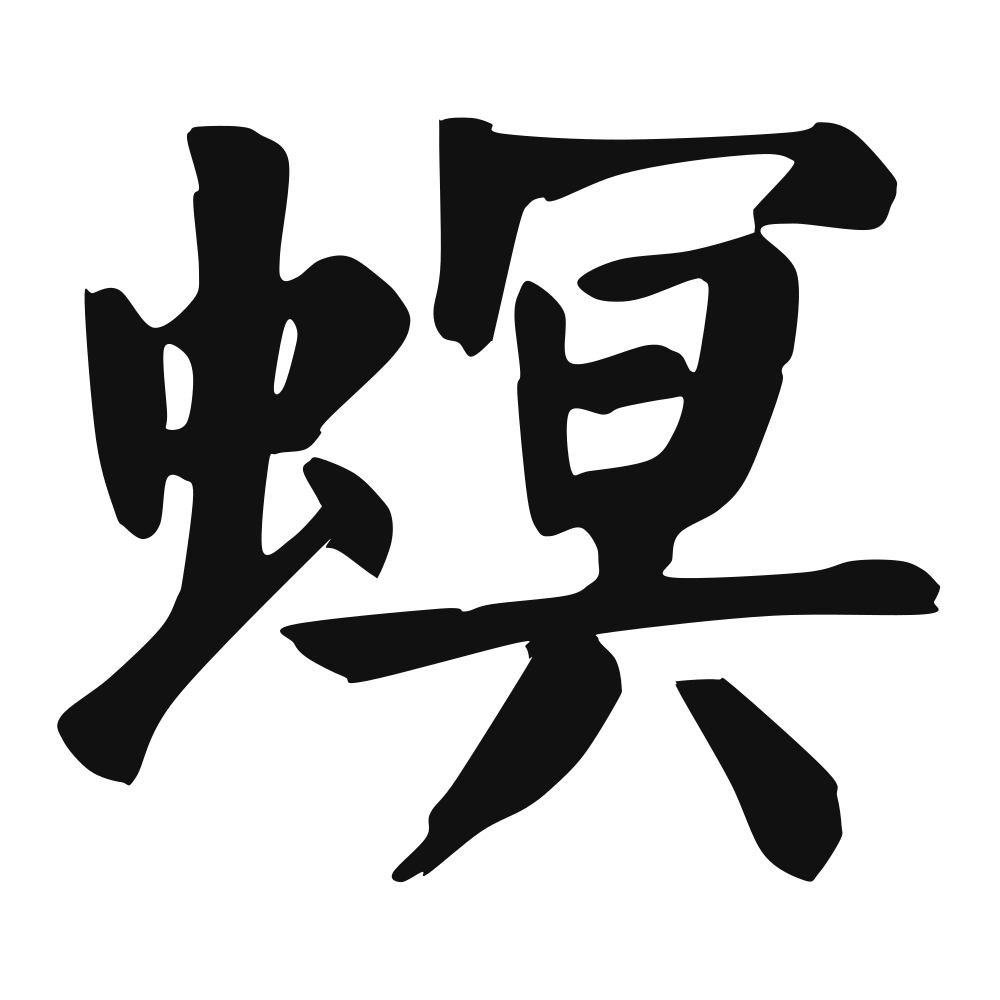
螟
boring insect; snout moth's larva (Aphomia gullaris or Plodia interpuncuella or Heliothus armigera etc), major agricultural pest
Closest English meanings
borer larva (pest)
The Calligrapher — Yán Zhēnqīng 颜真卿
Tang master of robust regular script; co-creator of the enduring 'Yan style'.
Tang calligrapher (709–784), master of regular script/running script — the Tang moral paragon whose upright, muscular regular script became the model of Chinese integrity in writing. Tang dynasty
Cultural Story
The 诗经, in its 小宛 ode, says 螟蛉有子,蜾蠃负之, the borer moth has a child, and the wasp carries it off. Old readers took this to mean the wasp adopted the 螟蛉 caterpillar as its own, and so 螟蛉 became the word for an adopted son. Farmers knew the real 螟虫 too well, the larva boring into rice stems and dropping whole paddies to ruin, while the adult 螟蛾 fluttered up at dusk. The character thus holds both a tender fiction of family and a farmer's dread of the stem.
Common words & phrases
- 螟虫 borer (pest)
- 螟蛾 snout moth
- 螟蛉 adopted child (idiom)
Read the story behind the character
In a rice extension office, an agronomist pins a 螟蛾 to a board and warns a village that the 螟虫 has been found boring this season's stalks. A farmer walks his paddy at dusk, spotting the pale moths and reaching for the light trap. Meanwhile a lawyer drafts papers for a 螟蛉 adoption, the ancient word for a child taken in as one's own still on the form. From the extension office to the flooded field to the courthouse, 螟 keeps its two old meanings: the pest in the stem and the child in the family.
Own this character
Purchase delivers the original SVG of this glyph, brushed by Yán Zhēnqīng 颜真卿, ready to place on skin, paper, or screen.