
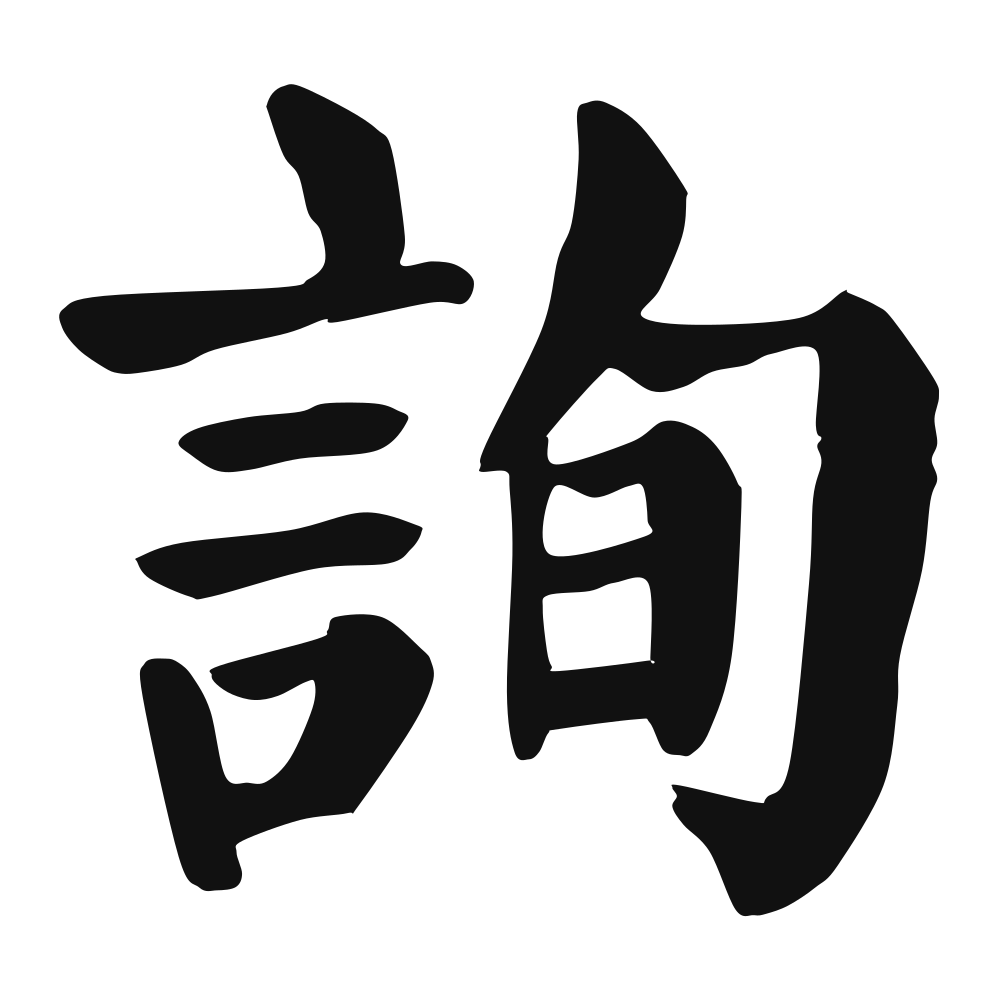
询
to ask about; to inquire about
Closest English meanings
inquire·ask·consult
The Calligrapher — Yán Zhēnqīng 颜真卿
Tang master of robust regular script; co-creator of the enduring 'Yan style'.
Tang calligrapher (709–784), master of regular script/running script — the Tang moral paragon whose upright, muscular regular script became the model of Chinese integrity in writing. Tang dynasty
Etymology & Meaning · 字义溯源
### Soundxún — xún (2nd tone). Often a bound morpheme — needs a partner word ### Original meaningXún (2nd tone). The Shuowen Jiezi defines it as 「謀也。从言旬聲」 — 'to take counsel', a phonetic compound on 言 with 旬 as the sound element. Note what the Shuowen says and does not say: the Warring-States sense of 询 is not 'to ask a question' in the modern information sense but 'to consult', and the classical lexicons are careful to grade it — 《左傳·襄四年》「咨親爲詢」 and 《國語》「咨才爲諏,咨事爲謀,咨義爲度,咨親爲詢」, i.e. consulting kin and intimates is 询, consulting talent is 诹. Its canonical citations are governmental: 《書·舜典》「詢事考言」 (examine the work, test the words) and 《詩·小雅·皇皇者華》「周爰咨詢」. 《爾雅·釋詁》 also glosses it 「信也」 in the Song-Wei dialect, where 询 and 洵 were written interchangeably. Honest disclosure: 询 is a procedural, administrative word — asking in order to govern well — not a virtue or an image. As a single character on skin it reads as 'inquire', which is thinner than most buyers expect. ### The structure (形聲 · 从言,旬聲 — speech (言) + the sound 旬 (a ten-day cycle); the word for a question put to others)①言yánspeechcounsel is spoken②旬xúna ten-day cyclethe phonetic element; also 'to go all the way round'③諮zīto consultthe near-relative the classics pair it with④詢xúnto take counselthe traditional form artists will set ### In use todayItemReading / meaningNoteReadingxún (2nd tone)single syllableCore senseto consult / inquireclassical 'to take counsel', not modern data-lookupGrammarbound morpheme, verb询问 inquire, 咨询 consult, 查询 look upTattoo fitcaution — clean word, thin as a standalone imagereads as office vocabulary to a native reader ### Closest words in English — and what each misses - Ask — 問 (wèn) is the plain, classical 'to ask'; 询 is the formal, consultative asking of officials - Seek — 求 (qiú) holds 'to seek' with desire behind it; 询 is procedural and unemotional - Curiosity — 好奇 holds curiosity; 询 implies a decision is being served, not a whim - Wisdom — 智 (zhì) holds wisdom itself; 询 is only the asking that may lead thereAn honest note on grammar. Bound morpheme in practice — 询问 (to inquire), 咨询 (to consult), 查询 (to look up), 质询 (to question formally); it does not usually stand alone in modern speechWhere a Western reader can stand: 询 (xún) means 'to consult, to take counsel'. The Shuowen glosses it with a single word — 謀, 'to deliberate' — and its oldest appearances are governmental: 《書·舜典》「詢事考言」, test the work and examine the words. Nothing in it is mystical. As a tattoo it is clean and unobjectionable but genuinely thin: to a Chinese reader a lone 询 reads as the first half of 咨询 ('c
Cultural Story
The Plank hymn in the Majestic Odes advises, 'The men of old said: consult even the woodcutter', xun yu chu rao, a line that made xun, to inquire, the mark of a humble ruler. The character joins words to a going-forth to ask; to xun was to seek counsel beneath your station, to prize truth over rank. From the king's question to the elder's, xun was the act of admitting you do not know and letting another fill the gap.
Where a Western reader can stand: 询 / 詢 (xún) is to consult, to inquire, to take counsel. The Shijing has an envoy driving his horses and stopping everywhere to ask — in the Odes, inquiry is a form of service, not doubt — and the Documents gives 詢事考言, 'examine the work, test the words.' As a tattoo the lone glyph meets a Chinese reader as office vocabulary (咨询 / 查询). It is an honest working word, closer to 'look up' than to any virtue; if you mean 'the seeker,' the words are 求, 问 and 学.
Common words & phrases
- 諮詢 consult
- 查詢 query · inquire
- 詢問 ask · inquire
- 探詢 inquire
Read the story behind the character
A founder zi xun, consults, a lawyer; a bank app lets you cha xun, query, your balance; a doctor xun wen, asks, the symptoms; a scout tan xun, inquires, about the road. The character lives in the asking, the help desk, the form, the polite question. It names the moment a person sets down pride to seek what they lack, the old democratic habit of asking even the woodcutter, now routed through a chatbot and a hotline.
Why this character belongs on skin
There is a question you have carried longer than any answer, a knock at the door of the self that no one else hears. 询 is to ask, to consult—the character built from words and round, as if inquiry were a slow turning, a circling of what cannot yet be spoken. Socrates called it the only wisdom, to know that you do not know; the Buddha sat beneath the tree and let the question ripen rather than seize the easy reply. To ink 询 onto your skin is to make a vow against certainty, to keep the doorway open when the world demands you choose. It is the posture of the traveler who stops a stranger not for directions but for the sound of another mind. Let this character rest where your hand can find it, a small rebellion against the tyranny of knowing. The mark asks nothing of you but that you keep asking, and the asking, in the end, is the only homeland you will not lose.
Own this character
Purchase delivers the original SVG of this glyph, brushed by Yán Zhēnqīng 颜真卿, ready to place on skin, paper, or screen.