
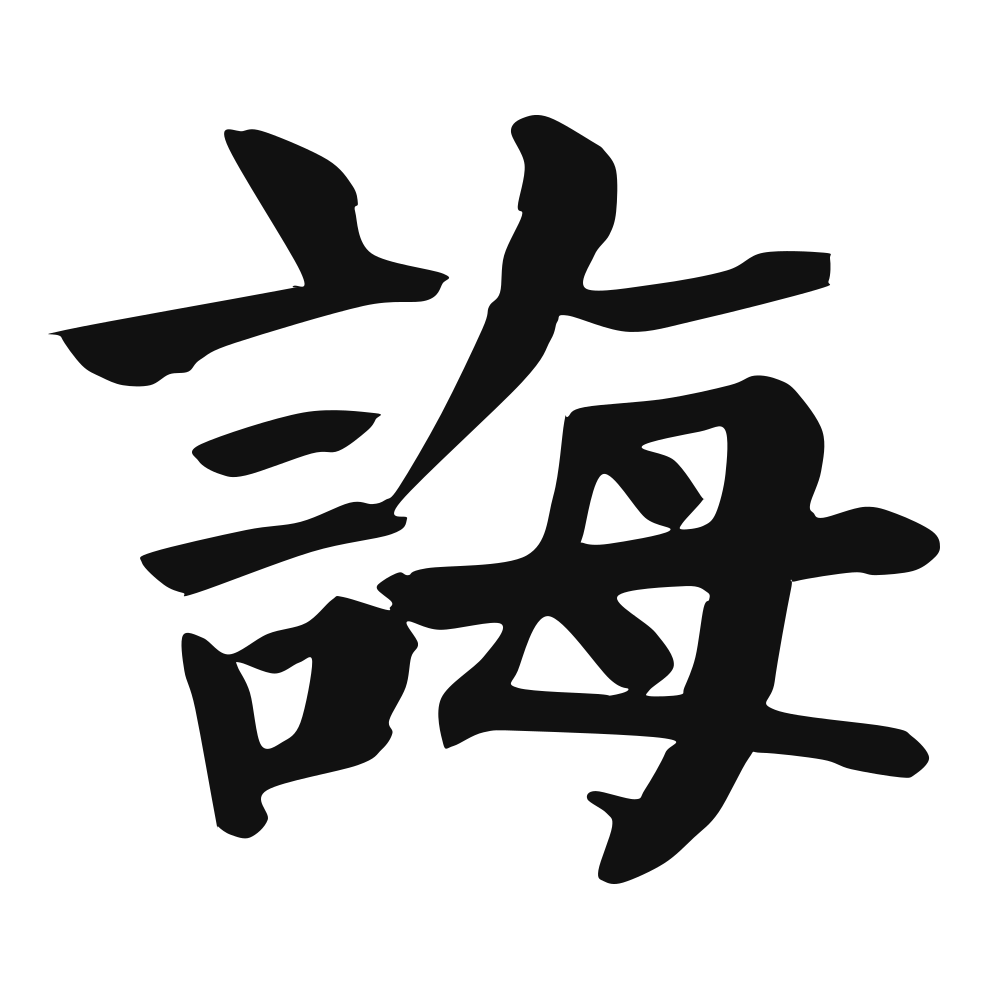
诲
to teach; to instruct; to induce
Closest English meanings
teach·instruct
The Calligrapher — Yán Zhēnqīng 颜真卿
Tang master of robust regular script; co-creator of the enduring 'Yan style'.
Tang calligrapher (709–784), master of regular script/running script — the Tang moral paragon whose upright, muscular regular script became the model of Chinese integrity in writing. Tang dynasty
Etymology & Meaning · 字义溯源
### Soundhuì — huì (4th tone). Often a bound morpheme — needs a partner word ### Original meaningHuì (4th tone). The Shuowen Jiezi defines it as 「曉敎也。从言每聲」 — 'to teach by making clear', with Xu Kai's explanation 「丁寧誨之,若決晦昧也」 (to teach insistently, as if clearing away darkness). The sound element 每 shares its root with 晦 (dark), so the word carries the image of illumination: teaching as the removal of obscurity. Its classical usage is almost entirely good: 《論語·述而》「誨人不倦」 (never weary of teaching others) — the line Confucius says of himself; 《書·說命》「朝夕納誨,以輔台德」 (receive instruction morning and evening to support my virtue); 《詩·小雅》「敎誨爾子,式穀似之」. But the same character has a second, darker grammar that must be disclosed: 《易·繫辭》「慢藏誨盜,冶容誨淫」 — careless storage teaches thieves, painted looks teach lust — where 诲 means 'to induce, to draw on'. Honest disclosure: 诲 is a bound, slightly formal morpheme whose highest sense is teaching, and whose compounds include 诲淫诲盗 — a famous phrase about inviting corruption. As a standalone tattoo it will read to a Chinese reader as half of 教诲 (instruction) rather than as a virtue in its own right. ### The structure (形聲 · 从言,每聲 — speech (言) + 每 (the sound element, cognate with 晦 'dark'); teaching imagined as the removal of obscurity)①言yánspeechteaching is done in words②每měieach (sound element)the phonetic; cognate with 晦, 'dark'③晦huìdark, obscurewhat teaching removes: 若決晦昧④教誨jiàohuìto instructthe word 诲 actually lives in ### In use todayItemReading / meaningNoteReadinghuì (4th tone)single syllableCore senseto teach / to instructsecondary sense: to induce (诲盗, 诲淫)Grammarbound morpheme教诲 to instruct; 诲人不倦 tireless in teachingTattoo fitcaution — fine sense, but bound and carries a negative idiomconsider 教 or the phrase 誨人不倦 ### Closest words in English — and what each misses - Teach — 教 (jiào) is the ordinary, standalone 'to teach'; 诲 is the literary half of 教诲 - Learn — 學 (xué) holds learning from the student's side; 诲 is strictly what the teacher does - Wisdom — 智 (zhì) holds wisdom as a possession; 诲 is the act of passing something on - Advise — 誡 (jiè) holds warning and admonition; 诲 is instruction, and only incidentally correctionAn honest note on grammar. Bound morpheme — 教诲 (to instruct), 诲人不倦 (never weary of teaching), 诲淫诲盗 (to invite corruption); it does not stand alone in modern speechWhere a Western reader can stand: 诲 (huì) means 'to teach' — specifically to teach by making something clear. The Shuowen defines it as 曉教也, and the old commentary explains the image: 丁寧誨之,若決晦昧也, 'to teach insistently, as if clearing away darknes
Cultural Story
In the Analects Confucius describes his own teaching as hui ren bu juan, instructing others without ever growing weary. The character hui carries that patient, recurring tone of a master correcting the same fault for the tenth time. Yet the same stroke warns in hui yin hui dao, that to teach lust and violence is itself a corruption, so hui is never neutral, it shapes who the listener becomes.
Where a Western reader can stand: 诲 / 誨 (huì) is to teach, to instruct — the Lunyu has Confucius describe himself as 誨人不倦, 'never weary of teaching others,' the character's finest hour. As a tattoo the lone glyph is a bound morpheme, half of 教誨, so it feels unfinished; 教 carries it in one character. Honest caveat: the word also means 'to induce,' and the Yijing idiom 誨淫誨盜 ('display invites theft, ornament invites lust') is a well-known negative phrase, so the glyph is not unambiguously clean to a native reader.
Common words & phrases
- 教诲 teaching · instruction
- 诲人不倦 teach tirelessly
- 诲淫诲盗 incite lust and violence
Read the story behind the character
A homeroom teacher closes the lesson with a few words of hui jie, the settled teaching of a long career, and a tired parent later repeats the same patient line at the kitchen table. The idiom hui ren bu juan now names any mentor who simply will not stop showing up. The character hui still hums with the classroom's steady, unrewarded devotion.
Why this character belongs on skin
Speech given as a mother gives — that is 诲, to teach, to instruct with the patience of one who repeats until the lesson lands. Confucius 诲 his disciples without weary; the good parent 诲 by living where the child can watch. To ink it is to honor the ones who taught you without glory: a coach, a mentor, a friend who told you the truth when flattery was easier. We are all somebody's 诲, and somebody's teacher in turn. The character is gentle, a verb of care, the opposite of the lecture. Carry it as a quiet vow to pass the thing on. Let it sit where the hand rests, a reminder that what you learned was a gift carried to you across generations and now entrusted to your keeping. The ink is the lesson made permanent, the teaching that outlives the teacher's voice, and asks only that you, in turn, teach.
Own this character
Purchase delivers the original SVG of this glyph, brushed by Yán Zhēnqīng 颜真卿, ready to place on skin, paper, or screen.