
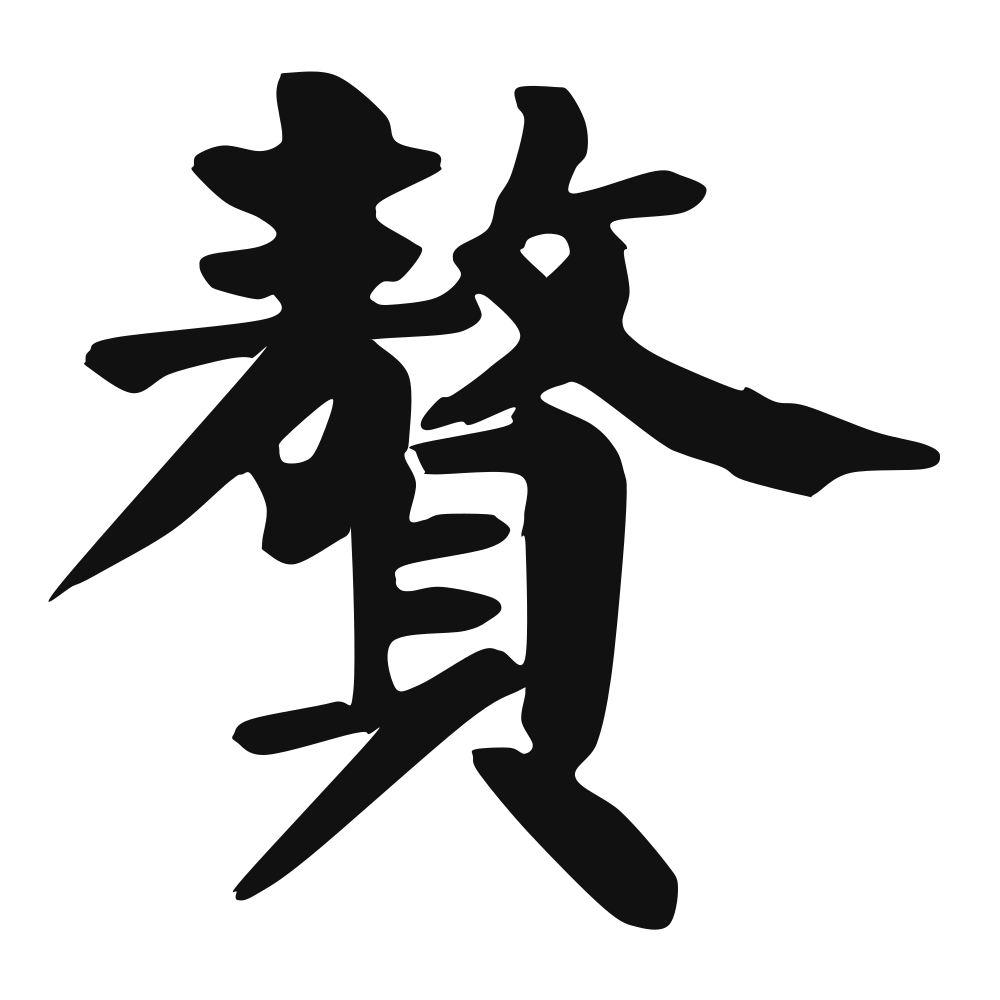
赘
(bound form) superfluous; (bound form) (of a man) to move into the household of one's in-laws after marrying; (of the bride's parents) to have the groom join one's household
Closest English meanings
superfluous·redundant·resident son-in-law
The Calligrapher — Yán Zhēnqīng 颜真卿
Tang master of robust regular script; co-creator of the enduring 'Yan style'.
Tang calligrapher (709–784), master of regular script/running script — the Tang moral paragon whose upright, muscular regular script became the model of Chinese integrity in writing. Tang dynasty
Etymology & Meaning · 字义溯源
### Soundzhuì — zhuì (4th tone). Free-standing morpheme ### Original meaningZhuì (4th tone). The Shuowen Jiezi defines it as 「以物質錢。从敖貝。敖者,猶放貝當復取之也」 — 'to pledge a thing for money': 敖 here means 'to put out', and 貝 is the pledge you intend to come back and redeem. The root sense is pawn, and the Kangxi entry follows it through: 「贅,質也。家貧無有聘財,以身爲質也」 (a poor man with no bride-price pledges his own body). From 'pledged, stuck on, taken back later' the word slides into its modern meanings — 《莊子·大宗師》「彼以生爲附贅縣疣」 (they treat life as a wart stuck to the body), 《老子》「其在道也,曰餘食贅行」 (leftover food and a superfluous act), 《史記·滑稽列傳》「淳于髡者,齊之贅壻也」 (the son-in-law who married into his wife's house), and 《詩·大雅》「具贅卒荒」 where 贅 is borrowed for 綴 'to attach'. Kangxi counts 18 strokes (貝部+11); naming tables split between 火 and 金 (verify). Honest disclosure: 赘 means 'superfluous, redundant, burdensome'. It is the word inside 累贅 (cumbersome) and 贅述 (needless repetition). It is not a tattoo character. ### The structure (會意 · 从敖从貝 — 敖 ('to put out') + 貝 (the pledge); Xu Shen: 「敖者,猶放貝當復取之也」)①敖áoto put out / roamthe pledge is 'put out' with the intent of return②貝bèicowrie / valuethe valuable handed over as security③贅zhuìto pawnthe Shuowen sense: 以物質錢④綴zhuìto attachthe Shijing borrows 贅 for 綴; 'attached' is how 'superfluous' arose ### In use todayItemReading / meaningNoteReadingzhuì (4th tone)single syllableCore sensesuperfluous; burdensome; to pawnoriginally the pledge you redeem laterGrammarbound morpheme累贅 cumbersome, 贅述 redundancy, 入贅 marry into the wife's houseTattoo fitno — no positive reading exists in classical or modern Chinesechoose 足 (enough) or 放 (release) instead ### Closest words in English — and what each misses - Extra — 餘/剩 hold 'left over' neutrally; 贅 implies it should not be there - Burden — 累 holds 'burden, weary'; 贅 is the burden that is also useless - Growth — 疣 is the literal wart; 贅 is the metaphor, and before that the pawn - Marry into — 入贅 is the whole word; 贅 alone reads 'superfluous' firstAn honest note on grammar. Bound morpheme — 累贅 cumbersome, 贅述 redundancy, 贅婿 the son-in-law taken into the wife's house, 入贅 to marry into the bride's family; no common free useWhere a Western reader can stand: 赘 (zhuì) began as 'to pawn' — handing over something valuable with the intention of redeeming it. From there it came to mean 'stuck on, superfluous, burdensome': Zhuangzi's wart, Laozi's leftover food, the 累贅 that slows you down. Modern Chinese uses it in 贅述 (needless repetition) and 贅肉 (a growth). There is no positive reading to recover here, and we will not invent one.
Cultural Story
In Qin and Han law, the 赘婿, a man who married into his wife's family, ranked among the low and was drafted to guard the frontier, a living sign of how 入赘 was scorned. 累赘, a burden, and 赘述, saying too much, both grow from that sense of what hangs on awkwardly. To be taken in by a wife's family was once a mark no law could wash off.
Where a Western reader can stand: 贅 (zhuì) began as 'to pawn' and came to mean 'stuck on, superfluous' — Zhuangzi's wart, Laozi's leftover food. There is no positive reading. Yan Zhenqing's monumental, clean hand is its opposite. Read it without optimism: this is the burden, not the boon, and we will not dress it as one.
Common words & phrases
- 累赘 burdensome · encumbrance
- 入赘 marry into wife's family
- 赘述 repeat unnecessarily
- 赘疣 wart · superfluity
Read the story behind the character
At a family dinner, an aunt calls a broken printer 累赘, a burden, and a writer is told not to 赘述, repeat, the point. A matchmaker still arranges an 入赘, a man marrying in, in the countryside. A doctor freezes off a 赘疣, a wart. The old scorn now clings to clutter and small annoyances.
Why this character belongs on skin
Every life accumulates what it does not need. 赘 names the superfluous—the tumor, the useless appendix, 赘肉, excess flesh, 赘述, words past the point. Its radical is money: originally a pledge, a hostage payment, a son-in-law who married into his wife's household and was thought a burden. The character is honesty itself. Stoics and monks built entire disciplines on this insight: subtraction as salvation. What weighs on you that is not yours? To ink 赘 is a strange, bracing gesture—wearing the word for excess as a reminder to travel light, to cut, to release. Or as an act of defiance: what the world calls superfluous, I call myself. The monasteries practice it each season—clear the cell, mend or discard, keep only what serves—because clutter, the teachers say, is only postponed decision. Both readings cut clean.
Own this character
Purchase delivers the original SVG of this glyph, brushed by Yán Zhēnqīng 颜真卿, ready to place on skin, paper, or screen.