
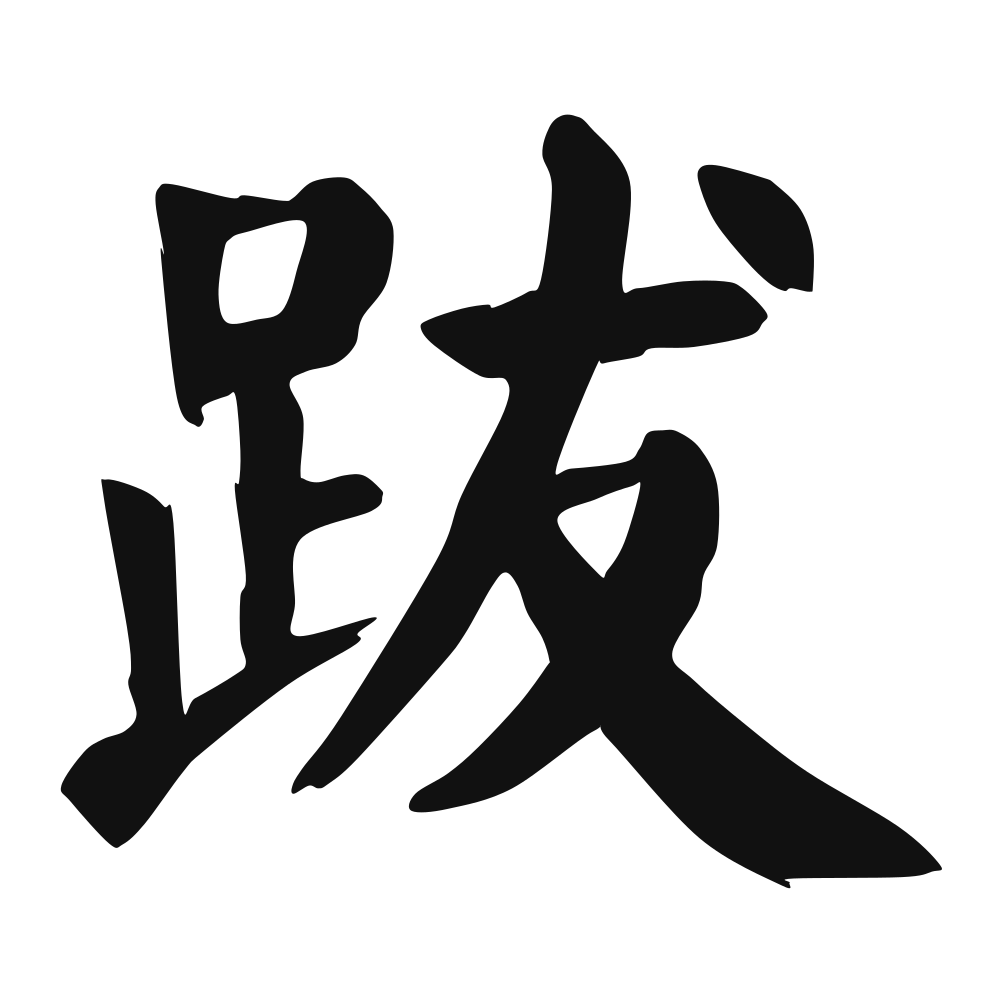
跋
postscript; to trek across mountains
Closest English meanings
cross mountains·postscript
The Calligrapher — Yán Zhēnqīng 颜真卿
Tang master of robust regular script; co-creator of the enduring 'Yan style'.
Tang calligrapher (709–784), master of regular script/running script — the Tang moral paragon whose upright, muscular regular script became the model of Chinese integrity in writing. Tang dynasty
Cultural Story
In the 诗经's 载驰, written by the principled Xu Mu, the lady cries that the 大夫跋涉, the lords trek, to reach her, their long wading and climbing a measure of the trouble. 跋涉 is that hard going on foot. Later ages gave 跋 a second life as the 题跋, the colophon at the end of a scroll.
Common words & phrases
- 跋涉 trek · trudge
- 跋扈 domineering · tyrannical
- 题跋 colophon · postscript
- 跋文 postscript
Read the story behind the character
At a mountain trail, hikers 跋涉, trudge, through rain while a curator reads the 题跋, colophon, at the end of a painting and a critic calls a boss 跋扈, domineering. A scholar pens a 跋文, postscript. The trek of Xu Mu's lords now names both a muddy climb and the note at a book's close.
Why this character belongs on skin
The walking radical beside a hand raised in effort — this is the tramp of it, the march through grass and mud that leaves your boots wrecked and your mind strangely clear. In the classics it names the hard overland part of a journey: climbing the mountains, fording the rivers, the whole body of a life in motion. Pilgrims know the word in their knees; so does anyone who has left a city, a marriage, a country, a former self, and walked out into the unlit part of the map with no guarantee of shelter. The road does not care about your reasons. It only measures your steps. You do not trek because it is pleasant — you trek because the far side is real, and only contact with the real cures. Mark the road on your skin, at the ankle or along the calf. Let the ink be every mile you refused to quit.
Own this character
Purchase delivers the original SVG of this glyph, brushed by Yán Zhēnqīng 颜真卿, ready to place on skin, paper, or screen.