
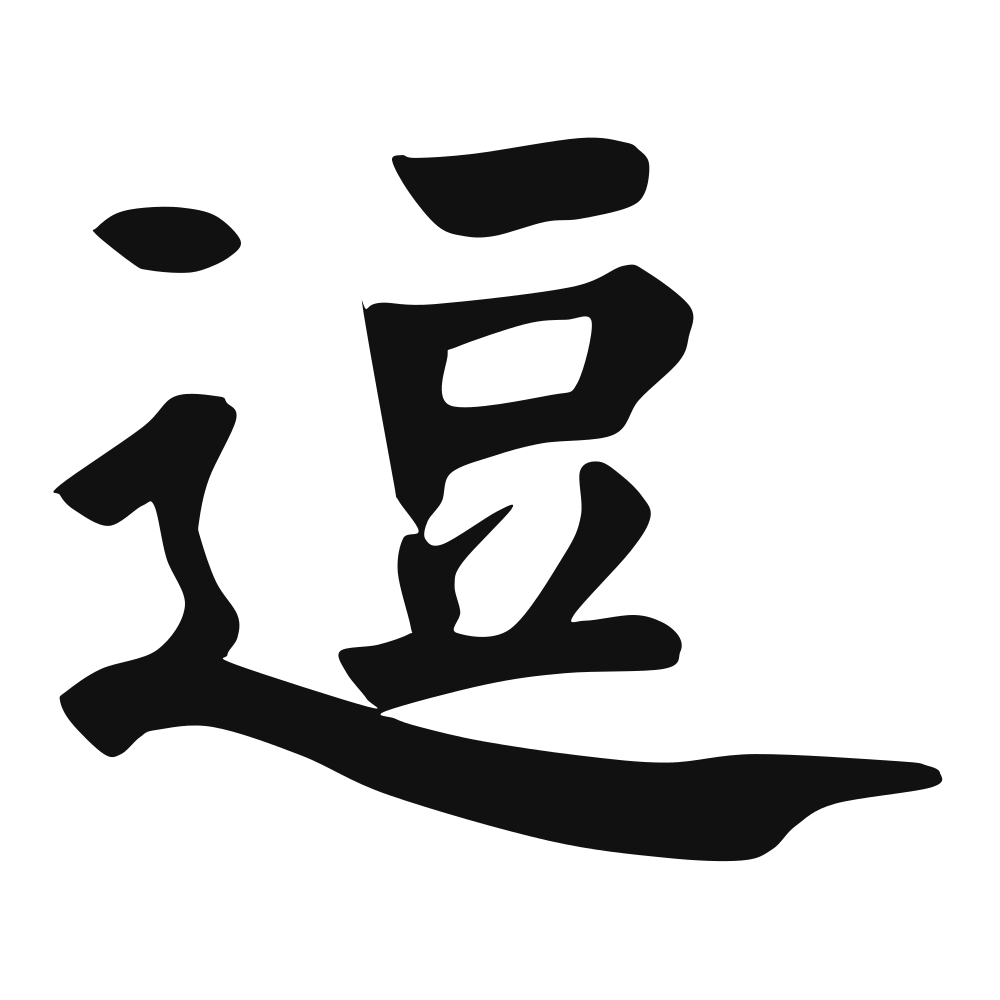
逗
to tease (playfully); to entice; (coll.) to joke; (coll.) funny; amusing; to stay; to sojourn; brief pause at the end of a phrase (variant of 讀|读[dou4])
Closest English meanings
tease·amuse·stay
The Calligrapher — Yán Zhēnqīng 颜真卿
Tang master of robust regular script; co-creator of the enduring 'Yan style'.
Tang calligrapher (709–784), master of regular script/running script — the Tang moral paragon whose upright, muscular regular script became the model of Chinese integrity in writing. Tang dynasty
Cultural Story
Dou has two lives: to halt on the road — Han documents punished soldiers who dou-liu-ed, lingering — and to tease a laugh out of someone. Halting turned playful somewhere between the barracks and the marketplace.
Common words & phrases
- 逗笑 amuse · make laugh
- 逗号 comma
- 逗留 stay · stop over
- 逗乐 amuse
- 逗趣 amusing
Read the story behind the character
Dou brightens modern life: douxiao (crack a joke) at the awkward silence, doule (amuse) the baby till she shrieks, douqu (playful) captions under the family group photo, doulid (stroll around) the night market after dinner. Even punctuation joined in: the douhao (comma), the pause mark itself.
Why this character belongs on skin
To 逗 is to stay a moment longer than you should, to tease the edge of a thing — a child tugging a sleeve, a traveler lingering at the gate though the road is open. It is play and provocation both, the small refusal to leave when leaving would be correct. There is a Daoist lightness in this, a knowing that the serious life forgets how to be touched. To wear 逗 is to keep your capacity for the unnecessary, the joke, the pause that changes everything. It is charm as a discipline. Ink it where a smile would reach — the wrist, the corner of the shoulder — a mark that says I stopped to tease the world when I could have walked on. You are the lingering hand, the one who made the departure worth remembering, the delay that became the story.
Own this character
Purchase delivers the original SVG of this glyph, brushed by Yán Zhēnqīng 颜真卿, ready to place on skin, paper, or screen.