
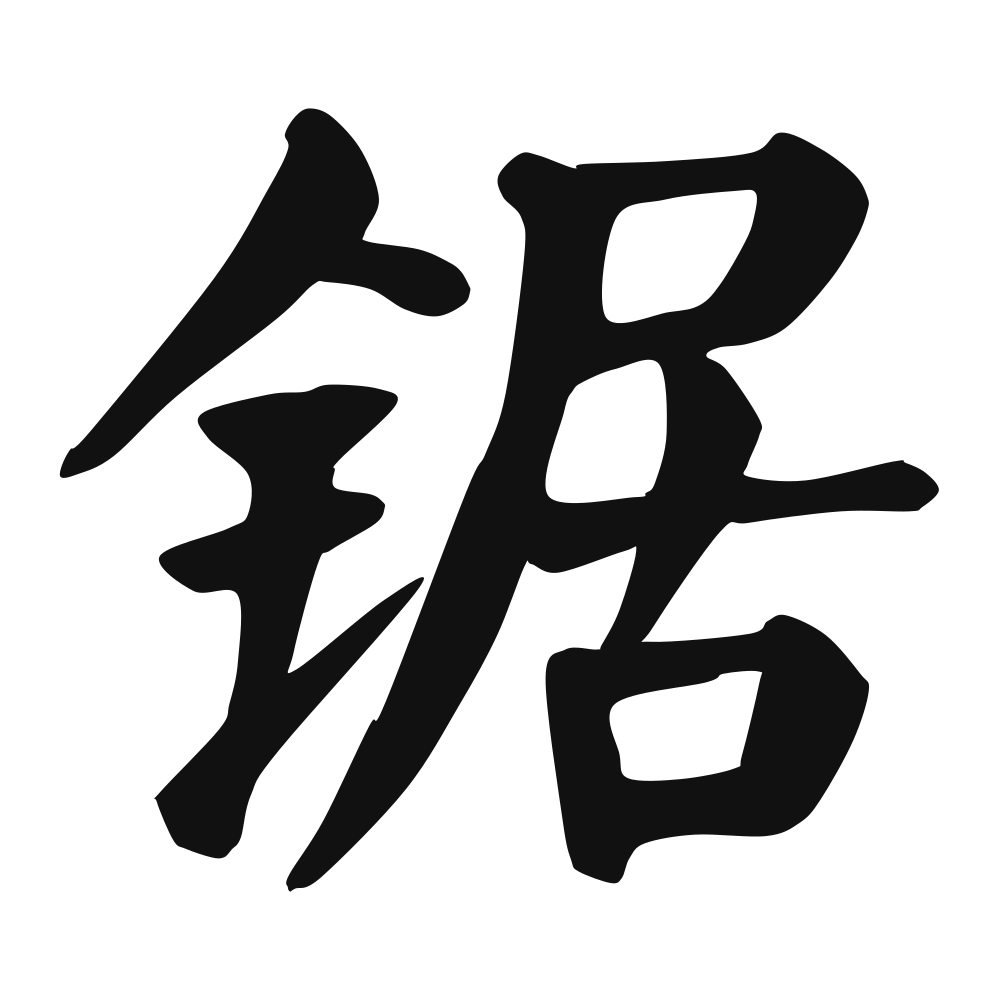
The Calligrapher — Yán Zhēnqīng 颜真卿
Tang master of robust regular script; co-creator of the enduring 'Yan style'.
Tang calligrapher (709–784), master of regular script/running script — the Tang moral paragon whose upright, muscular regular script became the model of Chinese integrity in writing. Tang dynasty
Cultural Story
锯 pairs metal with 居 and names the saw, the toothed blade drawn back and forth to sever wood and stone. The《説文》gives it as the tool that splits; from the carpenter's bench to the lumber site, 锯 is the patient, thirsty line drawn across matter.
Common words & phrases
- 锯齿 sawtooth · serration
- 锯子 saw
- 电锯 chainsaw · power saw
Read the story behind the character
A 锯子 cuts the plank, its 锯齿 the serrated teeth that bite; a 电锯 roars through a trunk in seconds. From the carpenter's bench to the lumber site, 锯 is the patient, thirsty line drawn across matter.
Why this character belongs on skin
Metal, plus a phonetic of an old dwelling—锯 is the saw, the toothed instrument that changes wood's mind one stroke at a time. Its verbs are honest: 锯开, to saw open; 锯断, to saw off. There is no instrument more decided. A saw does not negotiate; it commits, tooth by tooth, and the cut, once made, cannot be unmade. Every life requires this tool eventually. The friendship amputated before it poisoned you. The career severed cleanly so a truer one could grow. Buddhism calls it non-attachment; gardeners call it pruning; either way the principle is the same—some things must be cut for the rest to live. A saw leaves a flat, bright wound that seasons into something smooth. This character is the moment of the cut, held in ink: the clean edge, the falling branch, and the tree standing lighter afterward, unapologetic, feeding its roots instead of its ghosts.
Own this character
Purchase delivers the original SVG of this glyph, brushed by Yán Zhēnqīng 颜真卿, ready to place on skin, paper, or screen.