
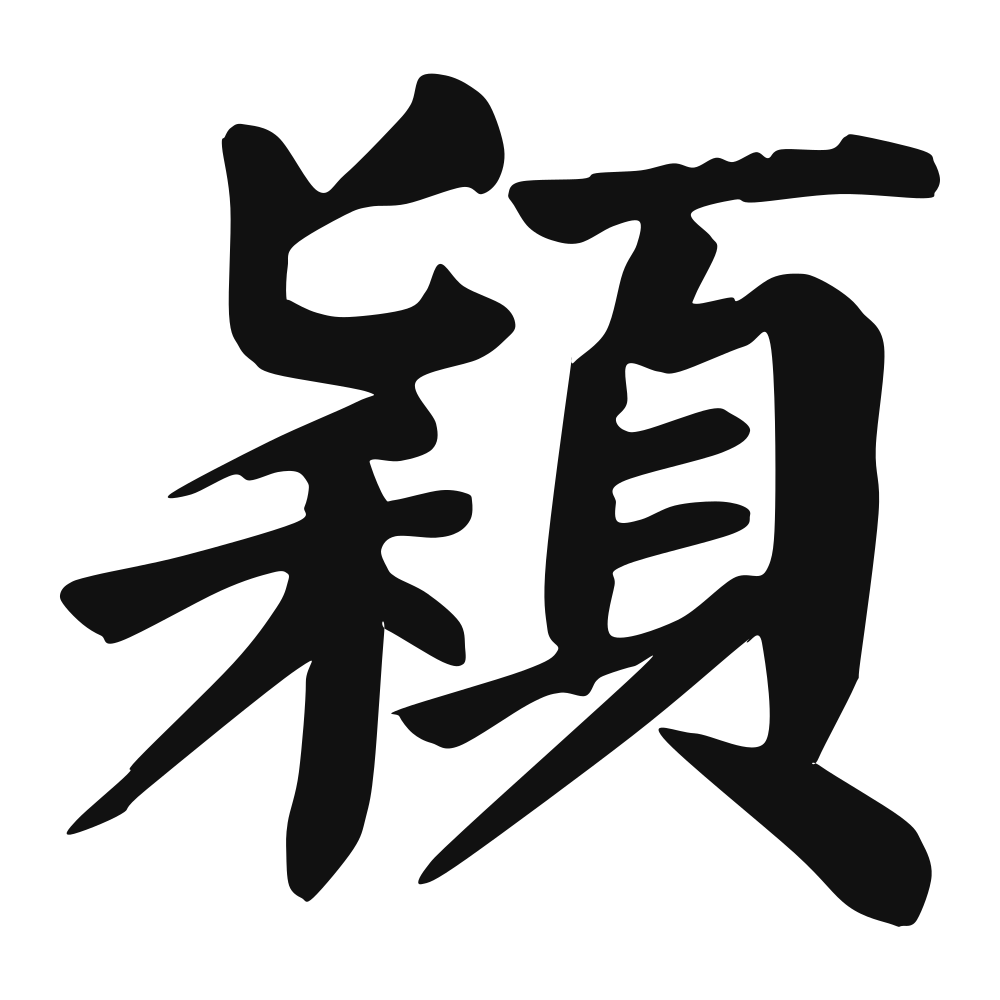
颖
head of grain; husk; tip; point; clever; gifted; outstanding
Closest English meanings
clever·sharp-tipped
The Calligrapher — Yán Zhēnqīng 颜真卿
Tang master of robust regular script; co-creator of the enduring 'Yan style'.
Tang calligrapher (709–784), master of regular script/running script — the Tang moral paragon whose upright, muscular regular script became the model of Chinese integrity in writing. Tang dynasty
Cultural Story
颖 builds on 頁 with 禾 'grain,' meaning the sharp tip of a rice ear that stands out from the rest. 《說文》 gives 穎 as 禾末也, the ear's point. Because the tip leads, 颖 came to mean clever, quick, and outstanding in native talent.
Common words & phrases
- 聪颖 clever · bright
- 新颖 novel · original
- 颖悟 quick-witted
- 颖异 unusually clever
Read the story behind the character
颖 means clever and sharp: 聪颖 bright, 新颖 novel and original, 颖悟 quick-witted, 颖异 unusually clever. A 新颖 design wins the contest; a child 聪颖 at math; the poet's 颖异 voice surprises the judges into silence and then applause.
Why this character belongs on skin
颖 is the tip of the grain — the small, hard point at the ear of rice or millet where the plant gathers all its season into a single spike. The character sets grain beside a word for the end of a thread, and from that agricultural precision it drew its shining metaphor: 颖 came to mean the very point of anything — the sharpness of an awl poked through a sack, and from there, newness, brilliance, a mind that stands out of the sheaf. The ancients had a story for it:毛遂, the retainer overlooked for years, who at last pushed himself forward like an awl through its bag — the point showing instantly, because a point is made to. Talent is like that; it cannot be fully sheathed. To wear 颖 is to stop apologizing for standing up above the field — to be, without arrogance, the part of the harvest that catches the light first.
Own this character
Purchase delivers the original SVG of this glyph, brushed by Yán Zhēnqīng 颜真卿, ready to place on skin, paper, or screen.