
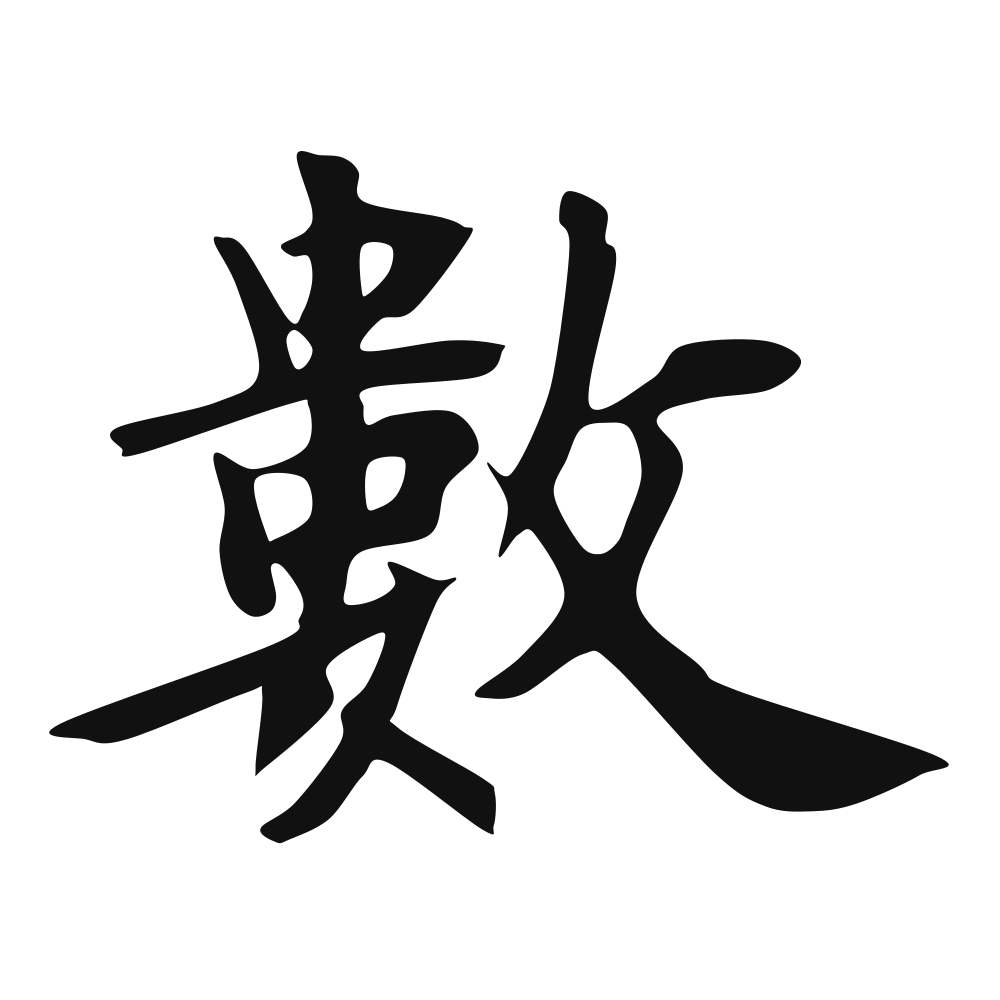
数
to count; to count as; to regard as; to enumerate; to list; number; figure; several; a few; (literary) frequently; repeatedly
Closest English meanings
number·count·several·figure
The Calligrapher — Yáng Shìqí 杨士奇
Ming statesman renowned for his regular script and the Taige (court) style.
Ming calligrapher (), master of regular script — known for 台阁体. Ming dynasty
Etymology & Meaning · 字义溯源
2 · The Character: 数 Shù (数, traditional 數) means number, figure, or fate (shù); and 'to count' (shǔ). It is the measured reckoning.
Cultural Story
数 is the counted world. The mathematicians of the Song 数 the stars and the taxes; 数学 the discipline. 无数 is 'beyond counting' — the dead in the chronicle. The word is the human itch to tally: the army, the harvest, the years. A tutor drills 数量 into the boy until the abacus falls quiet.
Where a Western reader can stand: Where a Western reader can stand: 'number' or 'to count' (and 'fate') — the measured reckoning; abstract as ink, so pair it with intent. Honest caveat: a lone 数 reads as 'number', which is a bound, not a feeling — it also means 'fate' (命数) and 'several' (数次). Set it beside a date, a name, or a limit you mean to keep, and the count becomes a statement.
Common words & phrases
- 数学 mathematics · math
- 数字 number · digit · figure
- 数量 quantity · amount · number
- 数据 data · figures
- 无数 countless · innumerable
- 多数 majority · most
Read the story behind the character
数学 is the class everyone dreads; 数字 the number on the screen. 数据 is the new oil; 数量 the box you tick. 无数 the fans; 多数 the vote. From the pedometer to the census, 数 is the verb of measure we trust more than memory — the count that settles the argument and the bill.
Why this character belongs on skin
数 is the character of the count — and of fate doing the counting. Its oldest work was arithmetic, the tapping of counting rods across a scholar's mat, but the word never stayed innocent: 天数, the number of Heaven, meant destiny; 气数, one's allotment of breath, meant the span a dynasty or a man had left. To say 气数已尽 — the count is finished — was to declare an empire falling, and everyone understood. The ancients looked up at the moving heavens, found them punctual, and concluded the universe keeps books. Yet the tradition never quite surrendered to the ledger; between fate and free action it kept a narrow, honorable margin, the space where a general changes his dispositions and a man reforms his life. To wear 数 is to live like that: aware of the tally, uncrushed by it — making your moves as if the count were settled, and praying, working, as if it were not.
Own this character
Purchase delivers the original SVG of this glyph, brushed by Yáng Shìqí 杨士奇, ready to place on skin, paper, or screen.