
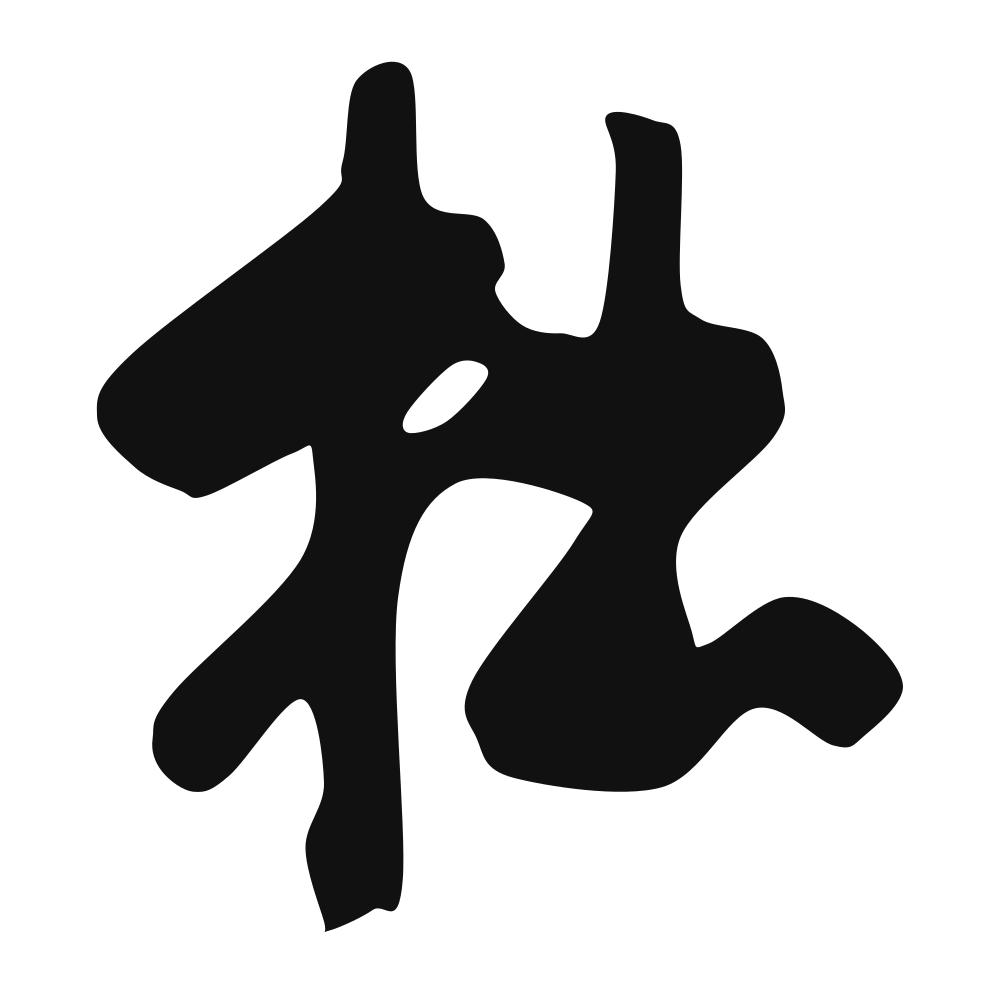
拙
awkward; clumsy; dull; inelegant; (polite) my; Taiwan pr. [zhuo2]
Closest English meanings
clumsy·awkward·feeble
The Calligrapher — Yáng Shǒujìng 杨守敬
Qing scholar who bridged stele and model-book traditions.
Qing calligrapher (), master of running script/regular script — known for 《平碑记》. Qing dynasty
Etymology & Meaning · 字义溯源
2 · The Character: 拙 Zhuō (1st tone). The Shuowen: 「拙,不巧也。从手出聲」 — unskillful, from hand (手) with 出 (chū) for sound. The word honours honest clumsiness: 《老子·道德经》 「大巧若拙」 (great skill seems clumsy); 《庄子》 prizes 拙 against clever artifice; and 勤能补拙 (diligence makes up for clumsiness) is a household maxim. Grading: 拙 alone reads as 'clumsy / unskillful' — negative on the surface — but the Daoist tradition redeems it as 'artless, honest'. Disclose the foolish surface; the redeeming phrase is 大巧若拙. Caution as a lone tattoo; a reader may first see 'clumsy'.
Cultural Story
Laozi wrote that great skill looks clumsy, 大巧若拙, the master's work pretending to be the beginner's. 拙 is the honored awkwardness, the unglazed pot, the brushstroke that does not try too hard. The Daoist turned failure into a style, and a thousand later painters spent their lives trying to look as accidentally good as the old man said they should.
Where a Western reader can stand: Where a Western reader can stand: 拙 is the Daoist paradox — the greatest skill appears clumsy, from Laozi's 大巧若拙 — the craft that hides its craft, close to the English 'uncrafted' in praise of the master who makes it look easy. Honest caveat, stated plainly: the bare character means 'clumsy, dull, stupid' and a Chinese reader will see the insult before the paradox, so it must be worn or printed only inside 大巧若拙, 守拙 or 抱朴守拙. Yang Shoujing's stele-school clerical hand is the ideal vehicle — the plain, squared strokes of ancient stone, the very picture of artless mastery carried to Japan by a man who taught the modern school from antiquity.
Common words & phrases
- 笨拙 clumsy · awkward · stupid
- 拙劣 inferior · clumsy · poor
- 拙见 my humble opinion
- 拙作 my humble work · my poor writing
- 眼拙 fail to recognize (polite)
Read the story behind the character
A writer signs off 拙見, my clumsy opinion, a ritual humility; a gift is 拙作, my poor little work. The word is mostly self-deprecation now, the modesty formula a Chinese letter cannot do without. The Daoist paradox survives as politeness, which is its own kind of skill, and nobody is fooled, which is also exactly the point of the performance.
Why this character belongs on skin
We have been taught to hide our awkwardness, to sand it smooth—but zhuō keeps it, and calls it holy. The Daoists knew: the greatest skill looks like clumsiness, the master moves like a child who has not yet learned to perform. Zhuō is the hand that fumbles, the line that wanders, the love that arrives without grace. In a world polished to a lie, there is a deep relief in the unskillful—the honest mark of someone still becoming. The sage chooses zhuō on purpose, the way a potter leaves the thumbprint in the clay. Let this be the character you wear against the grain of perfection, proof that you would rather be true than flawless, that your rough edges are not a failure but a signature. The unshaped is the most alive.
Own this character
Purchase delivers the original SVG of this glyph, brushed by Yáng Shǒujìng 杨守敬, ready to place on skin, paper, or screen.