
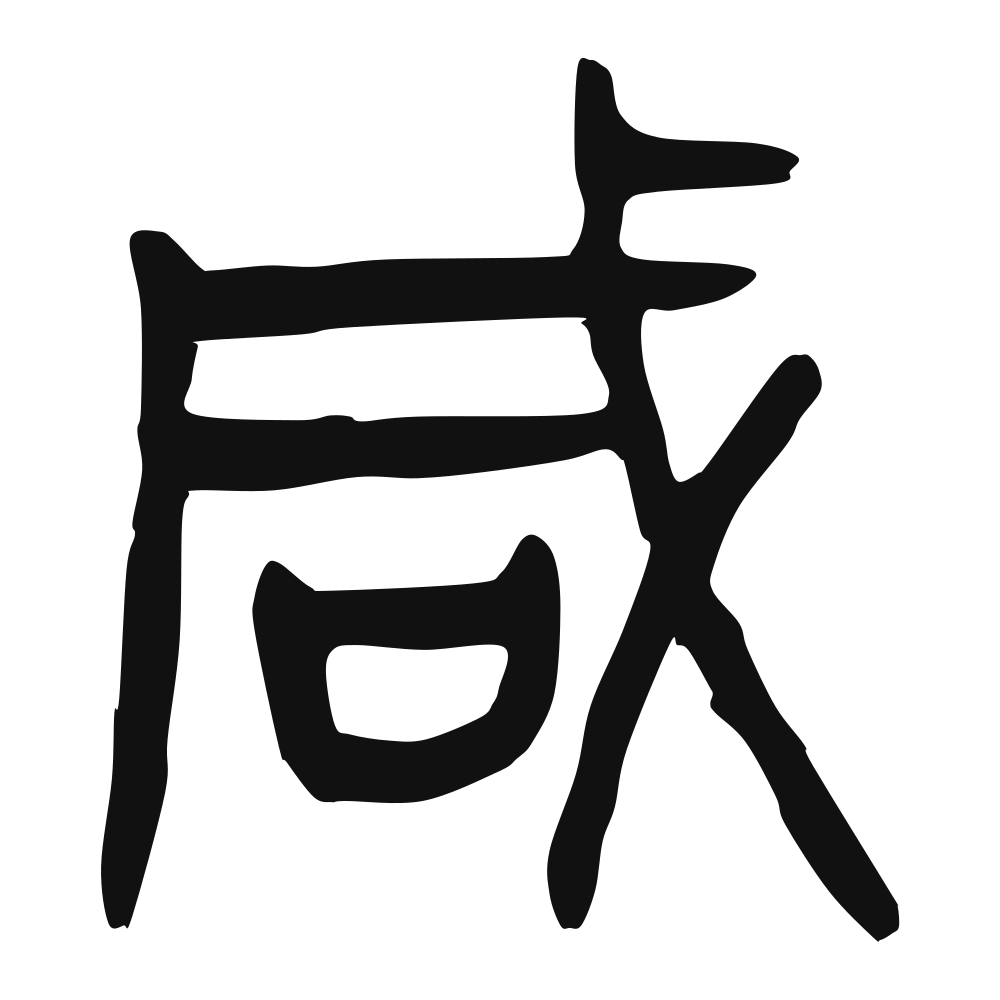
咸
surname Xian; all; everyone; each; widespread; harmonious; salted; salty; stingy; miserly
Closest English meanings
salty·all·everything
The Calligrapher — Yáng Yīsūn 杨沂孙
Qing seal-script master famed for blending bronze and small seal scripts.
Qing calligrapher (), master of seal script — known for 《文字蒙求》. Qing dynasty
Etymology & Meaning · 字义溯源
2 · The Character: 咸 Xián (2nd tone). 《说文·口部》: 「咸,皆也。悉也。从口从戌。戌,悉也。」 — 'all; entirely; from mouth and 戌.' The classical word means totality: 《书·舜典》 「四罪而天下咸服」 — four punished, and all under heaven submitted. Its deepest life is in the 《易经》, where 咸 names hexagram 31 and is glossed by the 彖 as 感 without the heart-radical: 「咸,感也。柔上而刚下,二气感应以相与」 — influence: the soft above and the firm below, two energies resonating and joining. The 大象 adds 「山上有泽,咸;君子以虚受人」 — a lake on a mountain; the noble one receives others by being empty. Honest disclosure — a major landmine. In simplified Chinese 咸 also absorbed 鹹 and now primarily means 'salty'; 咸鱼 ('salted fish') is common slang for a hopeless slacker, and 咸猪手 means a groper. Mainland readers see 'salty' first.
Cultural Story
In the classical tradition: 咸 in the Shuowen is explained as 'all, everything,' and the 詩經 sings that all submitted to the king's rule. Yet in daily old China the same sound meant salt: 咸菜, salted vegetables, were the peasant's year-round side dish, and 咸魚, dried fish, kept a family alive through winter. Salt was tax and power; the 鹽商 grew rich while 咸味 seasoned every humble bowl of congee.
Where a Western reader can stand: Resonance in the bronzes' own script: 咸 as the Xian hexagram in Yang Yisun's great-seal hand. Western readers must know the simplified reading is 'salty' — wear the phrase (咸宜), never the bare character.
Common words & phrases
- 咸菜 pickled vegetables · salted vegetables
- 咸味 salty taste
- 咸鱼 salted fish · dried fish
- 咸淡 saltiness · degree of saltiness
- 咸水 salt water · brine
- 咸肉 salted meat · bacon
Read the story behind the character
In the modern world: At the breakfast table 咸菜 — salted vegetables — and 咸魚, salted fish, sit beside congee, and dad tests the 咸淡, the saltiness, with a spoon before adding soy. 咸肉, bacon-like salted meat, fries with greens, 咸水, brine, boils dumplings, and the 咸味, salty taste, of instant noodles is what students crave at midnight. Salt is still the soul of Chinese home cooking.
Why this character belongs on skin
The sea tastes of everything and nothing—salt, the oldest flavor, the one that carries all others. 咸 means salty, but in the classical tongue it also meant all, the whole, the universal: everyone under heaven. So the character holds a beautiful contradiction, that which is particular (a taste) and that which is total (all). The Daoists might smile: the drop contains the ocean. To carry 咸 is to claim both your singular savor and your belonging to the vast. A Western soul could wear it as a salt-mark, a covenant with the common human brine—we are all steeped in the same. Let this character sit on your shoulder like sea-spray, a quiet reminder that your small bitter-sweetness is also everyone's. The ink dries and you are, at once, yourself and the whole salt world.
Own this character
Purchase delivers the original SVG of this glyph, brushed by Yáng Yīsūn 杨沂孙, ready to place on skin, paper, or screen.