
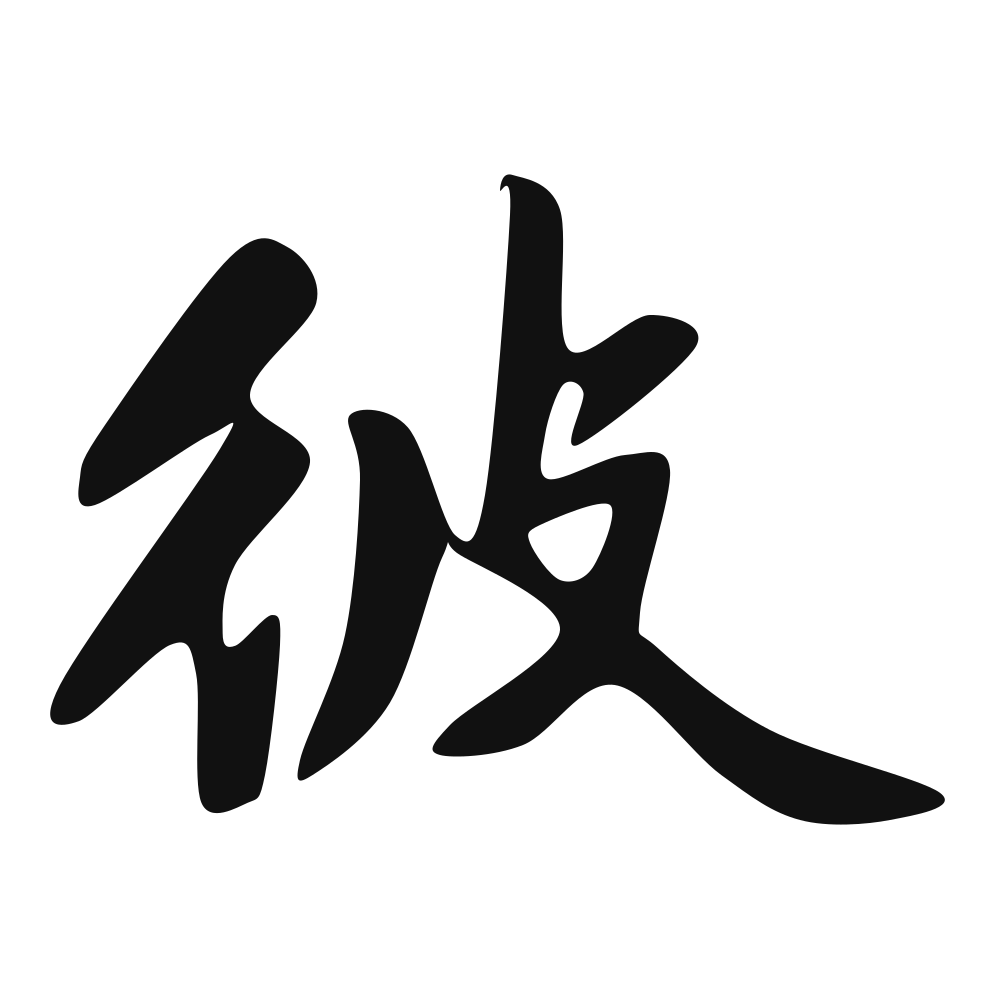
彼
that; those; (one) another
Closest English meanings
that·the other·those
The Calligrapher — Yǒng Xīng 永瑆
Qing prince famed for elegant regular script in the Zhao-Ouyang manner.
Qing calligrapher (), master of regular script — known for 成亲王. Qing dynasty
Etymology & Meaning · 字义溯源
2 · The Character: 彼 彼 (bǐ, 3rd tone) is defined in the Shuowen Jiezi as 往有所加也。从彳皮聲 — 'going and applying oneself to something over there'; the 彳 radical is a crossroads, a step taken. Kangxi files it at 8 strokes under 彳. It became the classical pronoun for that, the other, the far side. 《詩·魏風·碩鼠》 gives its most famous appearance: 逝將去女,適彼樂土 — 'I swear I will leave you and go to that happy land.' 《孫子·謀攻》 gives its most quoted: 知彼知己,百戰不殆 — 'know the other, know yourself, and a hundred battles hold no danger.' Buddhism then took the word for the far shore, 彼岸, nirvana reached across the river of suffering. Honest disclosure: 彼 is a grammar word. Alone it reads as a dangling 'that' — Chinese readers will wait for the noun that never comes. And 彼岸 is a memorial season in Japan (お彼岸, the equinox rites for the dead), so the Buddhist reading carries funerary weight there.
Cultural Story
彼 is the other shore, the there across from here. 詩經 gathers 彼采葛兮, she who picks ferns over there, just out of reach, and 彼岸 is the far bank the 曼珠沙華 blooms on, the world after this one. The character is distance made personal, the not-you that you watch.
Where a Western reader can stand: Where a Western reader can stand: 'that / the other / the far side' — 知彼知己 (know the other as clearly as yourself) or 彼岸 (the further shore). Honest caveat: 彼 is a classical function word and alone it reads as a dangling 'that'; in Japan 彼岸 is the equinox grave-visiting season and 彼 means 'he/boyfriend' (kare). Yong Xing's princely regular script makes a paired inscription look immaculate — but do not wear the single graph, and never call 彼岸 'paradise'.
Common words & phrases
- 彼此 each other · one another · mutual
- 彼岸 the other shore · paradise · the opposite bank
- 彼时 at that time · then
- 彼处 that place · there
Read the story behind the character
彼此 is the word that ends a thank-you, 彼岸 the opposite bank a ferry crosses, or the afterlife a funeral mentions. The ferns are a text from someone far; the far bank is still death. We name the other shore constantly, and cross to it seldom, which is the old grief exactly.
Own this character
Purchase delivers the original SVG of this glyph, brushed by Yǒng Xīng 永瑆, ready to place on skin, paper, or screen.