
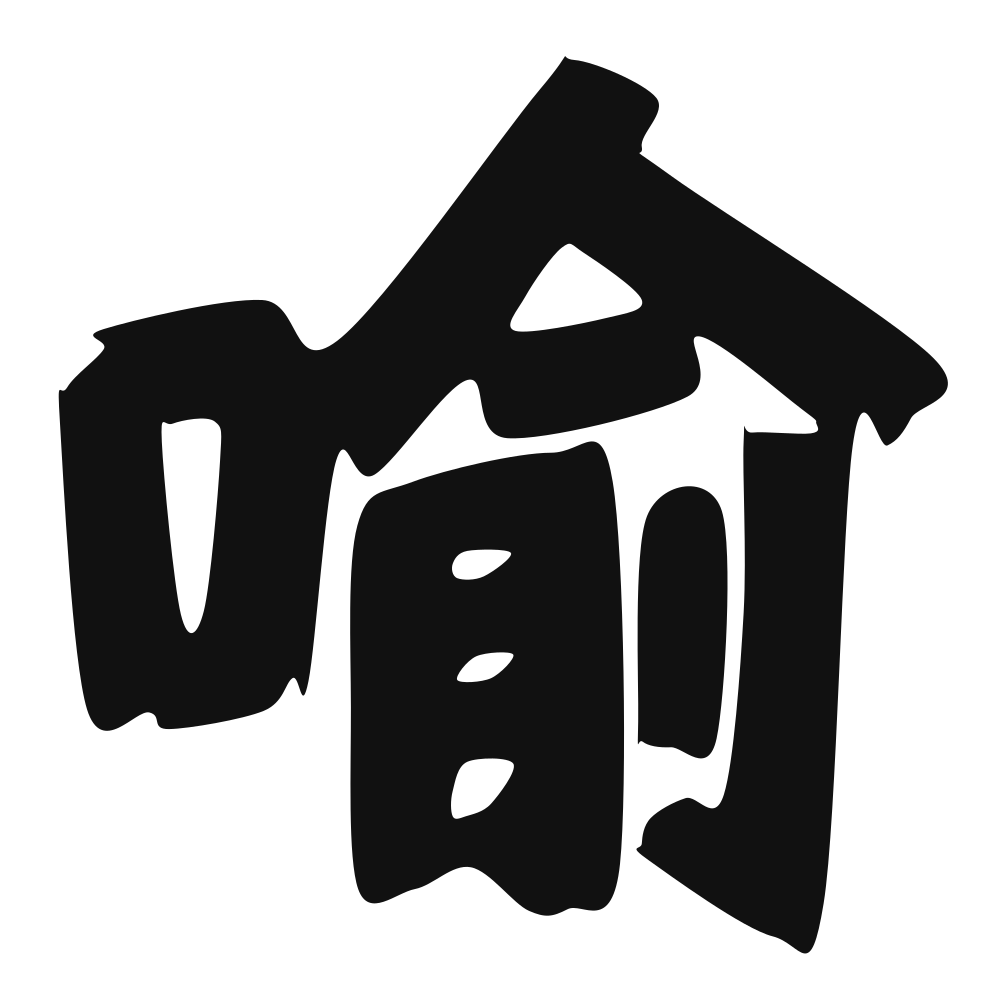
喻
surname Yu; to describe sth as; an analogy; a simile; a metaphor; an allegory
Closest English meanings
to explain·metaphor·analogy·to understand
The Calligrapher — Yú Hé 俞和
Yuan calligrapher of refined regular and running-cursive script.
Yuan calligrapher (), master of regular script/running-cursive — known for 学赵孟頫. Yuan dynasty
Etymology & Meaning · 字义溯源
2 · The Character: 喻 Yù (4th tone). Note: 喻 has no independent Shuowen head; its proper graph is 諭, glossed 「告也。从言,俞声」 — to tell, to make a matter plain by words. From the Tang the two interchanged, and 喻 became the everyday character for 'explain / understand'. Mencius makes it a method: 「引譬设喻」 — 'draw analogies, set forth parables' — and the saying 「不言而喻」 means 'understood without words'. The Songs already work the neighboring sense of making things clear. So 喻 is the character of comprehension and of the figure that carries meaning — metaphor (比喻). It is a free morpheme and stands acceptably alone as 'understanding / to make plain'; many choose it for the idea of a truth that needs no words. Disclosures: a literate reader may expect the edict-graph 諭 or read 喻 as 'metaphor' (比喻); 喻 is also a surname. Do not market it as 'wisdom' — its force is comprehension, the clear showing-forth. Element tables assign Metal (金).
Cultural Story
The Shuowen reads 喻 as 告也, 'to tell, to make known,' and Confucius gave the word its enduring moral weight: 'The gentleman 喻於義, the petty man 喻於利' — the one understands rightness, the other gain. Beyond instruction, 喻 became the art of teaching by likeness: the Zhuangzi and the parables of the Mohists 喻 their points through fable and analogy rather than bare argument. To 喻 was to make the strange clear, to carry meaning across from the known to the unknown.
Where a Western reader can stand: Making plain, by the man who made the master's style plain to history: 喻 in Yu He's faithful Zhao-manner hand. Western readers should know it is also a surname and not 'wisdom'; the hand is authentic.
Common words & phrases
- 比喻 metaphor · simile · figure of speech
- 晓喻 to inform · to proclaim · to make known
- 讽喻 allegory · satire · to admonish by analogy
- 喻示 to indicate · to suggest · to hint
Read the story behind the character
A teacher explains a hard idea with a 比喻 (metaphor, simile, figure of speech), saying life is like a journey; a notice 曉喻 (informs, proclaims, makes known) residents that the water will be cut off. A cartoon 諷喻 (satirizes by analogy) corrupt officials, and a falling stock price 喻示 (indicates, suggests, hints) trouble ahead. 喻 is the quiet work of making things understood — in a classroom, a headline, or a warning read between the lines.
Why this character belongs on skin
喻 is the character of understanding arriving sideways. Its old work was to make something clear by pointing at something else — the parable, the simile, the metaphor that slips past the guarded mind. Set a mouth beside 俞, a sound of consent and ease, and you have the whole mechanism: words that land so gently the listener says yes before he knows he has been taught. The Buddhist sutras are built from 喻 — the raft you abandon after crossing, the burning house with its clever toys, the moon in the water that is not the moon. Confucius and Zhuangzi argued in images for the same reason: a doctrine can be disputed, but a story has already been lived. To carry 喻 is to trust indirection — to know that the deepest truths come to us as images, and that the right image, like the right tattoo, says everything without insisting.
Own this character
Purchase delivers the original SVG of this glyph, brushed by Yú Hé 俞和, ready to place on skin, paper, or screen.