
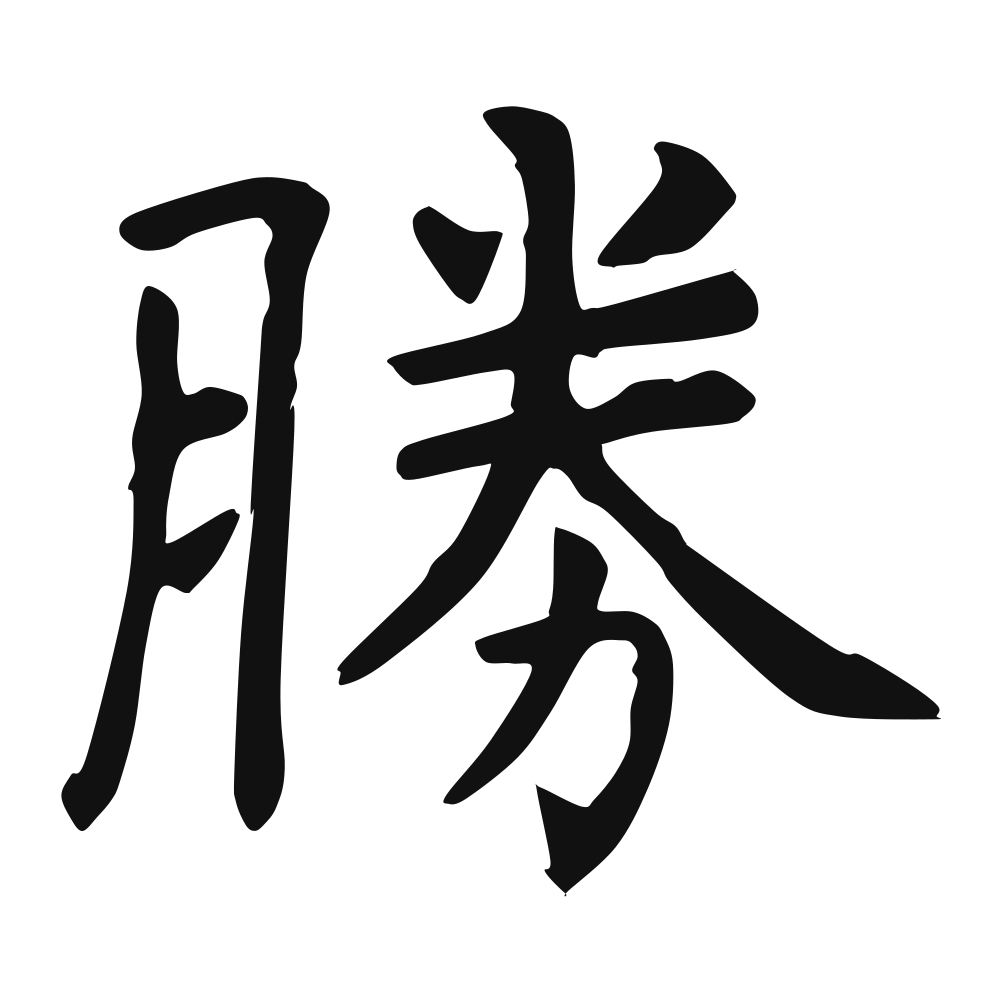
勝
victory; success; to beat; to defeat; to surpass; victorious; superior to; to get the better of; better than; surpassing; superb (of vista); beautiful (scenery); wonderful (view); (Taiwan pr. [sheng1]) able to bear; equal to (a task)
Closest English meanings
victory·win·surpass
The Calligrapher — Yú Shìnán 虞世南
Tang court calligrapher revered for refined, restrained regular script.
Tang calligrapher (558–638), master of regular script — Tang master of quiet, inward regular script and teacher to the imperial academy. Tang dynasty
Etymology & Meaning · 字义溯源
### Soundshèng — shèng (4th tone). Free-standing morpheme ### Original meaningShèng (4th tone). The Shuowen Jiezi defines it as 「任也。从力朕聲」 — 'to bear, to be equal to', built from 力 (force) with 朕 as the sound. The original sense is 'to be able to carry it, to be a match for it' — as in 勝任 (equal to the task) and 不勝 (unable to bear). 'To win, to surpass' is the sense that later grew on top. An honest note: the simplified form 胜 is properly a *different* character (月/肉 phonic, originally 'the rank smell of dog fat'), which was borrowed for 勝 in the simplification — so a reader of the traditional 勝 is reading the true 'bear / win' graph, and the康熙 stroke count below belongs to that graph. ### The structure (形聲 · 从力朕聲 — force (力) with 朕 as sound; the character of strength that proves equal to the load)①力lìforcethe muscle at the core②朕zhènsound elementthe phonetic that gives shèng③勝shèngto bear / winstrength equal to the task④胜shèngsimplifiedborrowed graph — a different character originally ### In use todayItemReading / meaningNoteReadingshèng (4th tone)single syllableCore senseto win / to surpassroot sense 'to bear, be equal to'Grammarfree morpheme胜利 victory; 胜任 equal to; 名胜 scenic spotTattoo fityes-standalone — but a martial registerpair it if you want softness ### Closest words in English — and what each misses - Win / Victory — 勝 is broader: it also means 'to bear' and 'to equal'; victory is only its second sense - Beat — 打敗 is the blunt verb; 勝 implies a contest one was equal to, not a beating - Strength — 力/強 hold force; 勝 is force that has already met its match and stood - Succeed — 成 holds accomplishment; 勝 holds contest — you win against somethingAn honest note on grammar. Free morpheme — stands alone (勝 = victory) and carries both 'to be a match for' (勝任) and 'to defeat' (勝過, 勝利); also used as 名勝 (scenic spot).Where a Western reader can stand: 勝 (shèng) has a root that surprises — the Shuowen says it means 'to bear, to be equal to', as in being equal to a task. Victory is the sense built on top: the one who bears the weight is the one who wins. Worn as a tattoo it is resolve under load — martial, disciplined, and honest about the fact that it is a competitive word.
Cultural Story
Sunzi holds that the winning army “先勝而後求戰” — secures victory before engaging. The same character names 名勝, a famed place worth the climb: Hangzhou's West Lake, the cliffs at Guilin. 勝负 is the board game's whole stakes, and 戰勝 the monk's word for conquering his own anger in the Chan hall.
Where a Western reader can stand: Winning, in the oldest sense of 勝, is being equal to the weight. Yu Shinan's quiet, scholarly hand makes that plain: strength kept in check. As a tattoo it is composure under pressure — power that needs no display.
Common words & phrases
- 勝利 victory
- 戰勝 defeat · win
- 勝負 victory or defeat
- 名勝 scenic spot
- 不勝 cannot bear
Read the story behind the character
A scoreboard flashes 勝利; 戰勝 the illness is what a hospital wall wishes a patient. Travel apps rank 名勝 by crowd size, and a runner posts 不勝其烦 only half-jokingly about race fees. The word 勝 carries from a child's video-game win to a city's relief when the floodwaters finally fall.
Own this character
Purchase delivers the original SVG of this glyph, brushed by Yú Shìnán 虞世南, ready to place on skin, paper, or screen.