
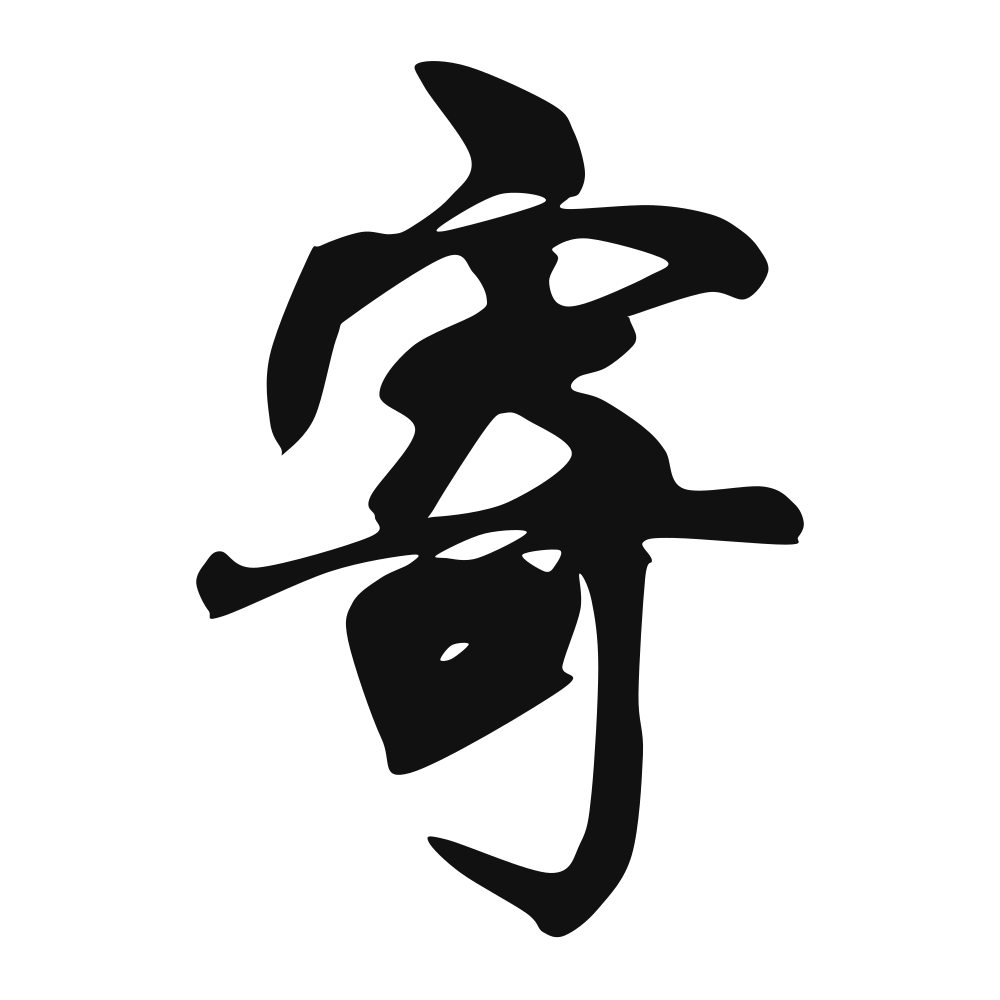
寄
寄 (jì) — to send, lodge, entrust. Roof 宀 + 奇: to place something under a roof. Classical life: 寄情 — lodge one's feelings (in scenery); 寄 is to entrust. Grammar: free morpheme — also: to entrust; to place in sb's care; (bound form) to depend on; to attach oneself to; to reside temporarily; (bound form) foster (as in 寄女[ji4 nu : 3] foster daughter); to send by post; to mail
Closest English meanings
send·entrust·lodge
The Calligrapher — Yǔ Yì 庾翼
Jin general and calligrapher of cursive script who once rivaled Wang Xizhi.
Jin calligrapher (), master of cursive script — known for 与王羲之齐名. Jin dynasty
Etymology & Meaning · 字义溯源
2 · The Character: 寄 Jì (4th tone). The Shuowen reads 寄 as 「托也。从宀奇声」 — 'to entrust; from 宀 and 奇 (phonetic).' It is to lodge something precious with another — to deposit trust. Zhuge Liang's last charge is the type: 《出师表》 「先帝知臣谨慎,故临崩寄臣以大事也」 — 'the late emperor, knowing my care, on his deathbed entrusted me with the great affair.' So 寄 is entrusted deposit, and by drift 'to send' (寄信) and 'temporary' (寄居). Grading: a free, trusting morpheme — to entrust, to lodge. No negative sense. Disclose that 寄 carries 'temporary / by post' too; the noble sense is entrusted trust (寄託). A 寄生 (jìshēng) is a parasite, a 寄居蟹 a hermit crab — life lived in another's shell. The noble use is 寄託, to lodge one's hopes or heart in something greater. The tattoo works best as entrusted trust; alone it can drift toward 'temporary', so anchor it.
Cultural Story
Du Fu's 'Moonlit Memory of Brothers' laments 'letters sent never arrive' — 寄书长不达 — in a war that keeps kin apart. 寄托 lodged hope in another; 寄生 lived off a host. The graph sets a roof over a strange, a thing placed with the not-own. Distance and dependence shared one shelter.
Where a Western reader can stand: Where a Western reader can stand: 'to entrust, to send' — the correspondence, the trust held in exchanged paper, set beside the general who demanded his old letters back. Honest caveats: 寄 also means temporary (寄居) and by post (寄信), and Yu Yi's specific works are rare.
Energy Reading
Wood (木)
Comparative symbology, not fortune-telling.
Common words & phrases
- 寄托 entrust · place hope
- 寄生 parasitic · live on
- 寄信 mail a letter
- 寄存 deposit · check
- 寄居 live · lodge
- 寄宿 board · lodge
Read the story behind the character
Post offices 寄信 still, and stations 寄存 bags by the hour. Biology diagrams 寄生 organisms, while boarding schools 寄宿 teens. The unarriving letter of the Tang now means a stamp, a locker, and a lab drawing — the placed-with-another still defining distance and debt.
Why this character belongs on skin
We are all passengers, lodged for a while in borrowed rooms. The word sets a roof over 'strange, uncommon,' and so 寄 means to lodge, to send, to entrust — 寄托, to place your hope in another; 寄生, to live upon a host. The Buddhist reads it as the homelessness of the soul, pitched like a tent in the world; the poet sends his letter across a continent and calls it 寄信, trusting the road. To 寄 is to admit you cannot hold everything yourself, that love means handing something precious into unknown hands and hoping. We are entrusted, too — with children, with promises, with the brief warm confidence of a friend. Wear this character as a seal of trust given and received. It says you have dared to lodge your heart somewhere outside your own chest, and that the risk was worth the belonging. The wanderer who learns to entrust is richer than the king behind his wall. Let the ink mark you as one who stayed open enough to depend, and brave enough to be carried.
Own this character
Purchase delivers the original SVG of this glyph, brushed by Yǔ Yì 庾翼, ready to place on skin, paper, or screen.