
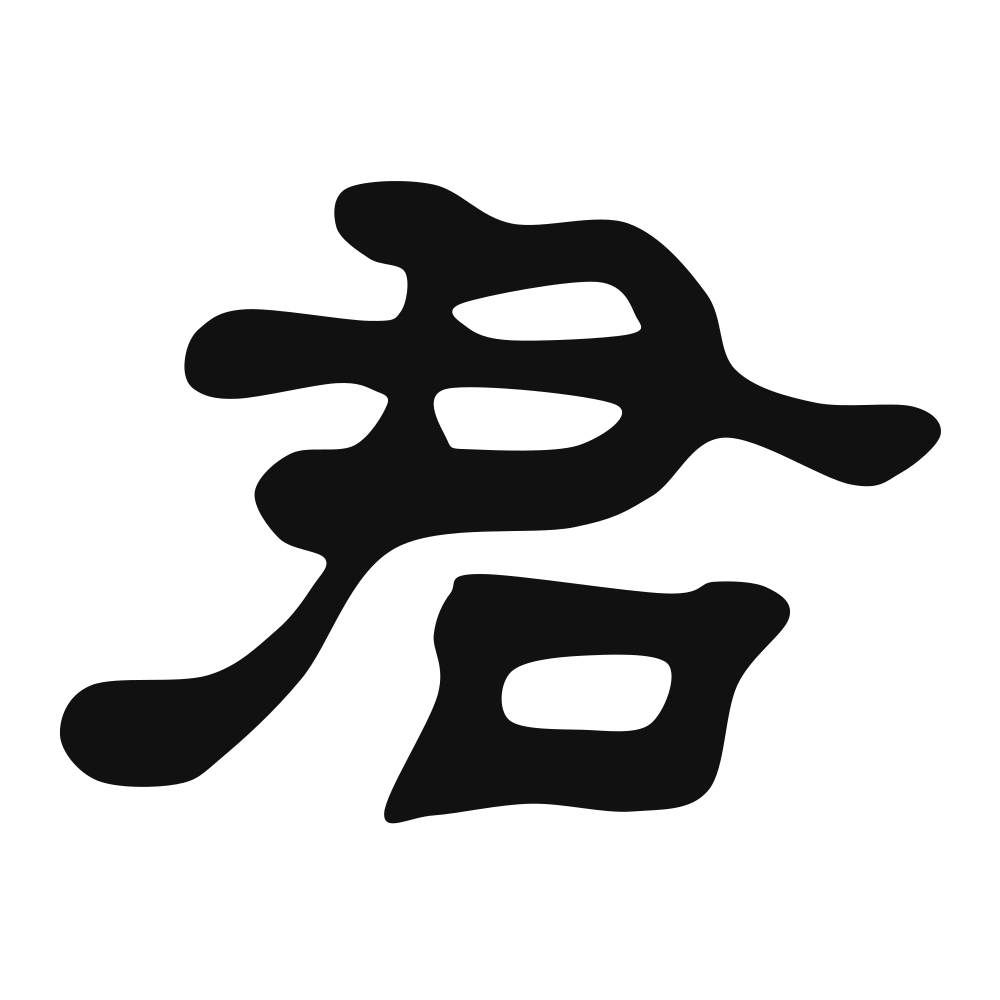
君
君 (jūn) — lord, gentleman, ruler. Person 尹 (office) + 口: the one who speaks with authority. Classical life: 君子 — the gentleman (Confucian ideal); 君 is the noble person. Grammar: free morpheme — also: monarch; lord; gentleman; ruler
Closest English meanings
gentleman·lord·ruler·monarch·you (honorific)
The Calligrapher — Zēng Xī 曾熙
Qing master of the 'Southern' school paired with Li Ruiqing as 'South Zeng'.
Qing calligrapher (), master of regular script — known for 与李瑞清并称. Qing dynasty
Etymology & Meaning · 字义溯源
2 · The Character: 君 Jūn (1st tone). 《说文·口部》: 「君,尊也。从尹。发号,故从口。」 — 'the honoured one; from 尹 (a hand gripping the baton of office), and from 口 because he issues commands.' Authority is drawn as a hand plus a mouth. The Confucian tradition then moved the word off rank and onto character. 《易·乾·大象》 「天行健,君子以自强不息」 — heaven moves without ceasing; the noble one strengthens himself without rest. 《诗经·卫风·淇奥》 「有匪君子,如切如磋,如琢如磨」 — cut, filed, chiselled, polished: a person made the way jade is made. 《论语·学而》 「君子务本,本立而道生」. Honest disclosure: 君 also means a courteous 'you' in classical address, and in Japanese it is both the sovereign and the familiar 君 (kimi) plus the -kun suffix, so a Japanese-literate viewer reads something far more intimate. Standing alone it can also read as a claim to rule; 君子 states the intention more safely.
Cultural Story
君 joins 尹 (to govern, a hand gripping the brush of authority) with 口 (mouth, command). Shuowen explains it as 尊也, "one who is honored." In the 詩經 a lady sighs 君子 于役, "my lord is on distant service." 論語 makes 君子 the morally perfected gentleman, the measure of all conduct, while 君主 and 国君 name kings and rulers of states. 莊子 and 史記 use 君 for lords and worthies. It carries the weight of both power and virtue in traditional China.
Where a Western reader can stand: Zeng Xi was a late-Qing stele-school master whose brush carried the weight of carved stone. Set 君 — 'ruler / gentleman,' the 君子 ideal of integrity — in his hand and it reads as a dignified personal emblem, the 'noble person' rather than the 'lord.' Western wearers get a character-mark of virtue and self-possession, close to 'gentleman' without the English class baggage.
Energy Reading
Wood (木)
Comparative symbology, not fortune-telling.
Common words & phrases
- 君子 gentleman · man of virtue · superior man
- 君主 monarch · sovereign · ruler
- 国君 ruler · monarch · king
- 君临 rule over · reign over · command
- 诸君 gentlemen · everyone · you all
- 郎君 gentleman · husband · young man
Read the story behind the character
At a wedding the emcee toasts 诸君 (everyone, gentlemen all) and calls the groom a fine 郎君 (young husband). History buffs debate whether a 君主 (monarch) or 国君 (ruler of a state) was wiser, while a CEO may 君临 (reign over) a company with calm authority. Parents still hope their son grows into a true 君子 (gentleman of virtue), the ideal Confucius praised. The word travels from palace to classroom to family dinner without losing its honor.
Why this character belongs on skin
There is a moment when a stranger is addressed not by name but by weight — 君, the one who stands above the river of ordinary men. In the old courts it meant the sovereign, the gentleman whose word carried the season. Confucius used it for the person who has disciplined desire into grace. To be called 君 is to be seen as more than flesh: a keeper of order, a quiet king of your own small realm. The Daoists soften it — 君 as the honored guest within, the you that watches the you that acts. Wear it and you are reminded that sovereignty is not a crown but a posture: the spine straight, the voice even, the hand generous. It is the self you owe to yourself. Let this character rest on your skin as a vow that you answer to no lesser throne. The ink becomes the court you carry.
Own this character
Purchase delivers the original SVG of this glyph, brushed by Zēng Xī 曾熙, ready to place on skin, paper, or screen.