
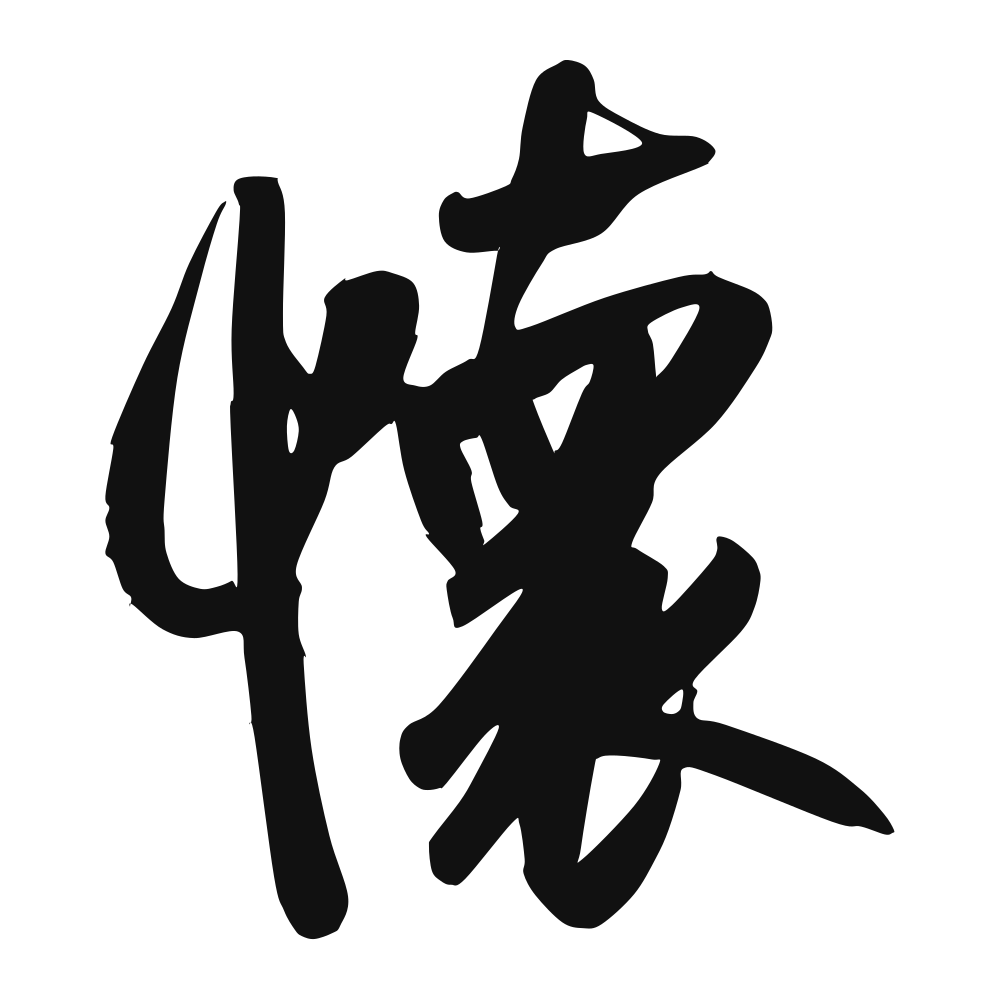
怀
怀 (huái) — bosom, to cherish, to miss. Heart 忄 + 褱 (wrap): the heart that holds. Classical life: 怀旧 — cherish the past; 胸怀 — one's breast/mind. Grammar: free morpheme — also: surname Huai; bosom; heart; mind; to think of; to harbor in one's mind; to conceive (a child)
Closest English meanings
bosom·cherish·mind·embrace·doubt
The Calligrapher — Zhāng Chǎng 张昶
Eastern Han 'second sage' of cursive; younger brother of the 'Sage of Cursive,' Zhang Zhi.
Han calligrapher (), master of clerical cursive — known for 张芝之弟. Han dynasty
Etymology & Meaning · 字义溯源
2 · The Character: 怀 Huái (2nd tone). Shuowen Jiezi glosses 懷 as 念思也 — 'to hold in mind, to cherish, to embrace (a thought)'. The graph joins 心 (heart) with 褱 (to enclose), a feeling kept close. The Analects (陽貨) records 子生三年,然後免於父母之懷 — 'a child stays in the parents' arms three years', fixing 懷 as the clasp of love. The Shi Jing (邶風·泉水) sighs 有懷于衛,靡日不思 — 'I cherish Wei; not a day I do not think of it'. Qu Yuan's 楚辭·九章·懷沙 gives 懷瑾握瑜兮 — 'I hold a jade scepter and grasp a gem', a metaphor for unspoiled integrity. Kangxi counts twenty strokes (simplified 怀 = 7). Honest disclosure: 懷 also means 'to conceive' (懷孕) and, in 懷疑, 'to doubt'; a Chinese-literate reader may first parse it as 'to miss / to harbour'. It is a free, gentle morpheme — safe alone, best inked as 懷瑾 or 懷抱 (embrace).
Cultural Story
怀 is the bosom, the place you fold a thing into. 懷素 was the monk whose wild cursive brush seemed to write from the chest, and 懷抱 is the embrace and the keeping both. The character is the inward hold — of a child, a grievance, a plan not yet spoken.
Where a Western reader can stand: Where a Western reader can stand: the chest as a container — a person you miss, a jade of integrity (懷瑾握瑜), an ambition unspoken. Honest caveat: 懷 also heads 懷孕 ('pregnant') and 懷疑 ('to doubt'), so a Chinese reader may read 'miss / harbour' first; pair it (懷瑾, 懷抱). Zhang Chang's squared Han chapter-cursive gives the word deep antiquarian roots — but his exact dates are lost to the Eastern Han (c. 2nd–3rd century), and fewer of his works survive than his brother's, the 'Sage of Cursive.'
Energy Reading
Water (水)
Comparative symbology, not fortune-telling.
Common words & phrases
- 怀抱 embrace · bosom · cherish · hold
- 怀念 miss · cherish the memory of · recall
- 胸怀 mind · bosom · heart · breadth of mind
- 关怀 care for · concern · show solicitude · look after
- 怀疑 doubt · suspect · distrust
- 释怀 let go · relieve one's mind · forget
Read the story behind the character
怀念 is the ache for a place, 关怀 the care a boss performs, 怀疑 the doubt you will not voice, 释怀 the letting a year finally allows. The chest is a chat now; the hold is real. We fold things in and call it love or worry, and the old monk would say the brush knew which.
Why this character belongs on skin
You fold the world into the space beneath your ribs and keep it there—this is 怀, the bosom, the embrace, the mind that holds what it will not let go. To carry the past is to keep it like a child; to gather another against your chest is the oldest human gesture. Confucius spoke of keeping virtue close as breath. It is the whole architecture of tenderness: the chest as sanctuary, the heart as keeper. To ink 怀 is to declare yourself a keeper of things—of people, of promises, of the small warm objects the world would have you drop. Wear it over the heart, where it belongs, and let it be the last mark you choose, the one that holds all the others. You were made to hold. Whatever you love, hold it here, in the quiet dark, for life, unbroken.
Own this character
Purchase delivers the original SVG of this glyph, brushed by Zhāng Chǎng 张昶, ready to place on skin, paper, or screen.