
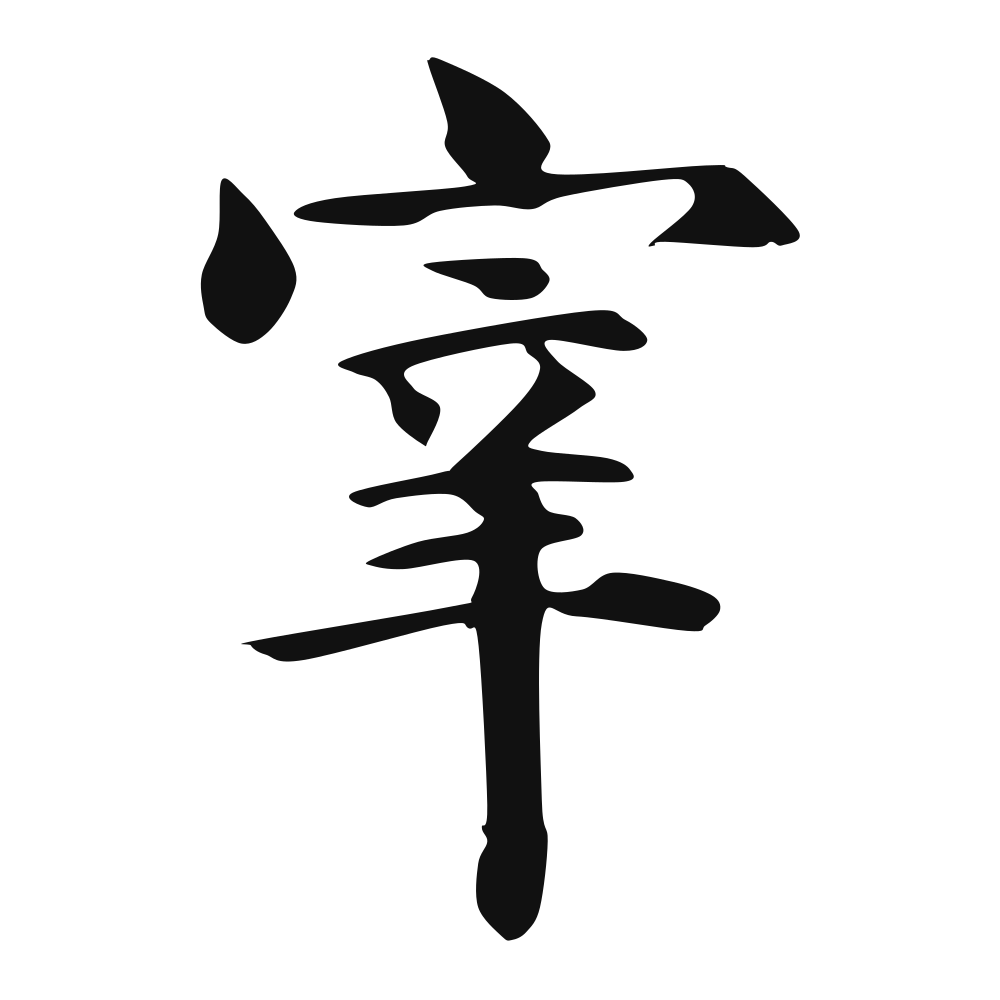
宰
to slaughter; to butcher; to kill (animals etc); (coll.) to fleece; to rip off; to overcharge; (bound form) to govern; to rule; (bound form) (a title for certain government officials in ancient China)
Closest English meanings
slaughter·govern·rule
The Calligrapher — Zhāng Zhī 张芝
Han 'Sage of Cursive', father of the connected-cursive style.
Han calligrapher (?–192), master of cursive script/clerical cursive — Han dynasty 'Cursive Sage' who turned rapid writing into an art form centuries before cursive peaked. Han dynasty
Etymology & Meaning · 字义溯源
2 · The Character: 宰 Zǎi (3rd tone). The Shuowen reads 宰 as 「辠人在屋下执事者。从宀从辛」 — 'a offender set to work under the roof; from 宀 and 辛 (a tool of punishment / labour).' Strangely, the graph of a convict at labour rose to mean the one who governs — the steward, the 太宰 (prime minister). 《周礼·天官》 opens 「太宰,掌建邦之六典」 — 'the Grand Steward holds the six codes that build the state.' So 宰 is the master-administrator, the one who cuts and orders. Grading: a free, authoritative morpheme — to govern, a steward. No negative sense. Disclose the odd root (convict-at-labour → governor) so the client enjoys the irony of rise-through-service. The graph's 辛 is both a labour-tool and an old mark of punishment, so 宰 literally pictures service rendered under authority — and rises from that to command it. 主宰 means 'to dominate / be master of', the personal, modern use. The arc is service to sovereignty.
Cultural Story
The 'Rites of Zhou' set the 太宰 to govern the realm's household, and Wang Anshi served as 宰相 under the Song. 屠宰 bled the sacrifice; the graph sets a roof over a convict — the one who orders the cut. Power and the knife shared one word from the start.
Where a Western reader can stand: Where a Western reader can stand: 'to govern; the steward' — the governing hand, and the office refused by the Sage of Cursive for the pool. Honest caveats: the etymology is a story of rise through service, and 冠军帖 survives only as a contested tracing.
Common words & phrases
- 宰相 prime minister
- 屠宰 slaughter · butcher
- 主宰 dominate · control
- 宰杀 slaughter · kill
- 宰割 invade · oppress
- 太宰 grand steward
Read the story behind the character
Meat plants 屠宰 by line speed, and sports casters call a striker the 主宰 of the match. History dramas costume a 宰相 in embroidered robes, while editorials warn a great power may 宰割 the weak. The governor's blade now runs a factory floor and a commentary — still cutting, still ruling.
Why this character belongs on skin
Two old meanings live in one bone: to govern, and to slaughter—the prime minister and the butcher, the hand that rules and the hand that cuts. 宰 tells the truth that mastery and mercy share a blade. The Daoist butcher carved the ox along its natural seams, effortless, reverent, never wasting a stroke; the king who governs well does the same with men. To carry this character is to claim the seat of your own life, the authority to decide what is kept and what is cut away. It is a fierce, clean ownership. Let it be inked like a sigil of self-rule, a reminder that no one else holds the knife to your days. The mark says you are both the one who governs and the one unafraid to make the hard cut, and that freedom was always this: being the 宰 of your own small, mortal kingdom.
Own this character
Purchase delivers the original SVG of this glyph, brushed by Zhāng Zhī 张芝, ready to place on skin, paper, or screen.