
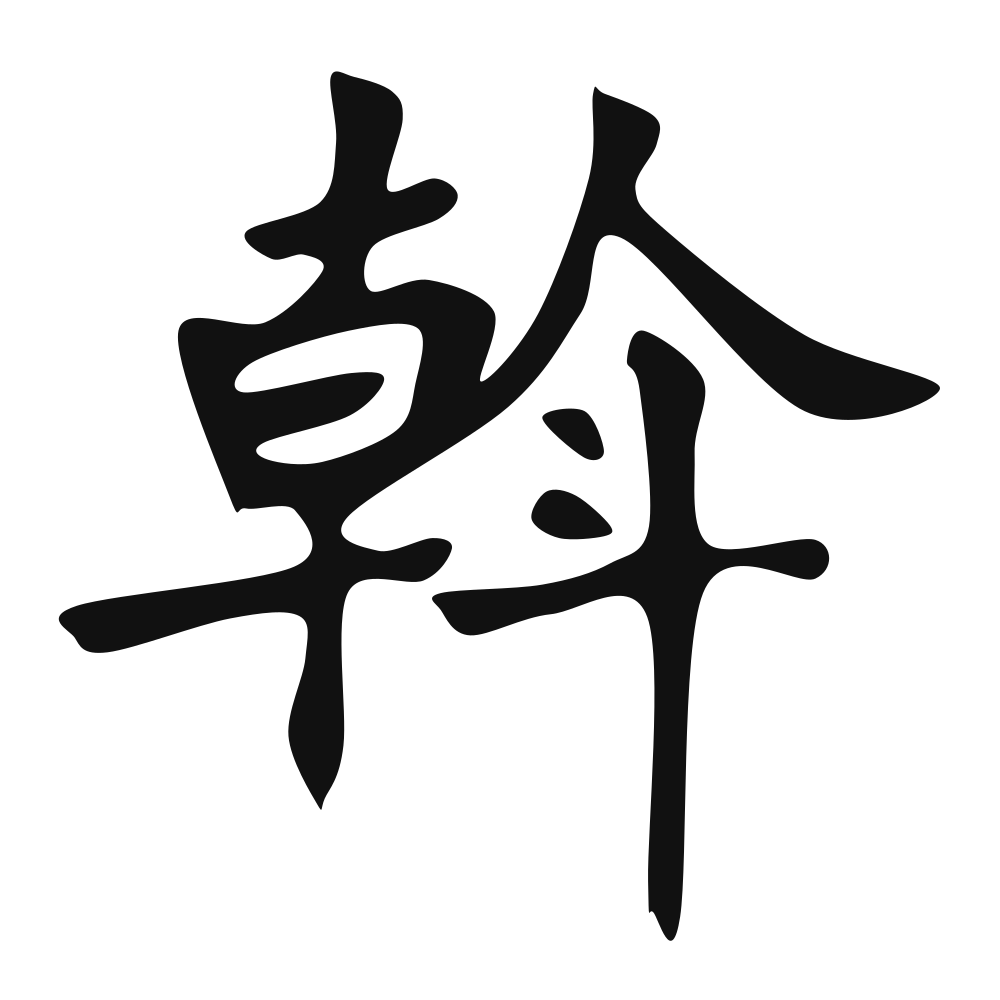
斡
to turn
Closest English meanings
turn·mediate·revolve·rotate
The Calligrapher — Zhāng Zhī 张芝
Han 'Sage of Cursive', father of the connected-cursive style.
Han calligrapher (?–192), master of cursive script/clerical cursive — Han dynasty 'Cursive Sage' who turned rapid writing into an art form centuries before cursive peaked. Han dynasty
Etymology & Meaning · 字义溯源
2 · The Character: 斡 Wo (4th tone). The Shuowen Jiezi reads 「斡, 蠡柄也」 — the handle of a 蠡 (a gourd-ladle), the part one turns; from 斗 (the dipper) with the sound of 倝. To 斡 is to rotate, to steer. The Chuci, Summons of the Soul, accuses a traitor of 「斡弃周鼎」 (casting away the Zhou cauldron — i.e. usurping the state); later idiom 斡旋 means to mediate and turn a matter around. The word carries the image of a hand on the ladle-handle, pivoting fate. Name-lore is sparse; one source assigns Wood (木) — (verify). Kangxi fourteen strokes (斗部). As a free morpheme 斡 is rare and weighty — agency, mediation, the turning point. Honest route: 斡 is uncommon even to literate Chinese; pair it with a familiar word (旋 = 斡旋) or explain it, or it will read as a blank glyph to most viewers.
Cultural Story
斡 is the axle that turns the whole. In the Zhuangzi the cosmos 斡 the seasons round; 斡旋 is the mediator's art, the hand on the pivot that swings the dispute shut. 斡运 once moved the empire's grain by canal. The word is leverage at the center — small turn, large consequence, the quiet wheel beneath the noisy world.
Where a Western reader can stand: Where a Western reader can stand: 斡 is the handle of the ladle — the Latin versare, the part you turn to steer between parties (斡旋, to mediate). It is a rare glyph; a Chinese reader meeting it alone likely shrugs. Pair it with 旋 or gloss it, and it becomes the honest image of a hand at the pivot of things. Its calligrapher, Zhang Zhi, is the founder of cursive — but he left no original work, and his famous Guanjun Tie is disputed, reassigned to Zhang Xu.
Common words & phrases
- 斡旋 mediate · intercede · arbitrate
- 斡运 transport grain · transport · convey
- 回斡 turn back · revolve · reverse
- 斡转 turn around · revolve · rotate
- 斡维 axis · pivot · pole
- 斡流 alternate · rotate · shift
Read the story behind the character
斡旋 is the diplomat's verb — the UN 斡 between the sides. 斡运 is history; 回斡 the market's reversal on the news. The word is rare, formal, almost only spoken in the briefing room. It names the person at the hinge, turning the fight without ever raising a voice or drawing a blade. The pivot does the work unseen.
Why this character belongs on skin
Picture a potter's wheel, or the slow pivot of the heavens themselves: the character's oldest work is revolution—a forceful, deliberate turning of things that seemed stuck. From it comes the great word wo xuan, to mediate: to step between two hard positions and turn them, wheel-like, toward each other until they move again. This is unseen labor, the diplomat's and the healer's labor, and it carries a deep Confucian weight—the belief that conflict is not destiny, that between stubborn men there is almost always a hand patient enough to rotate the wheel. There is something heroic in it, though the hero wears no armor. Fate itself turns this way, the ancients thought, on a hidden axis no one sees until the season changes. Ink of this character is for the one who turns things—quarrels into peace, winters into springs—without ever asking for the story to be told about them.
Own this character
Purchase delivers the original SVG of this glyph, brushed by Zhāng Zhī 张芝, ready to place on skin, paper, or screen.