
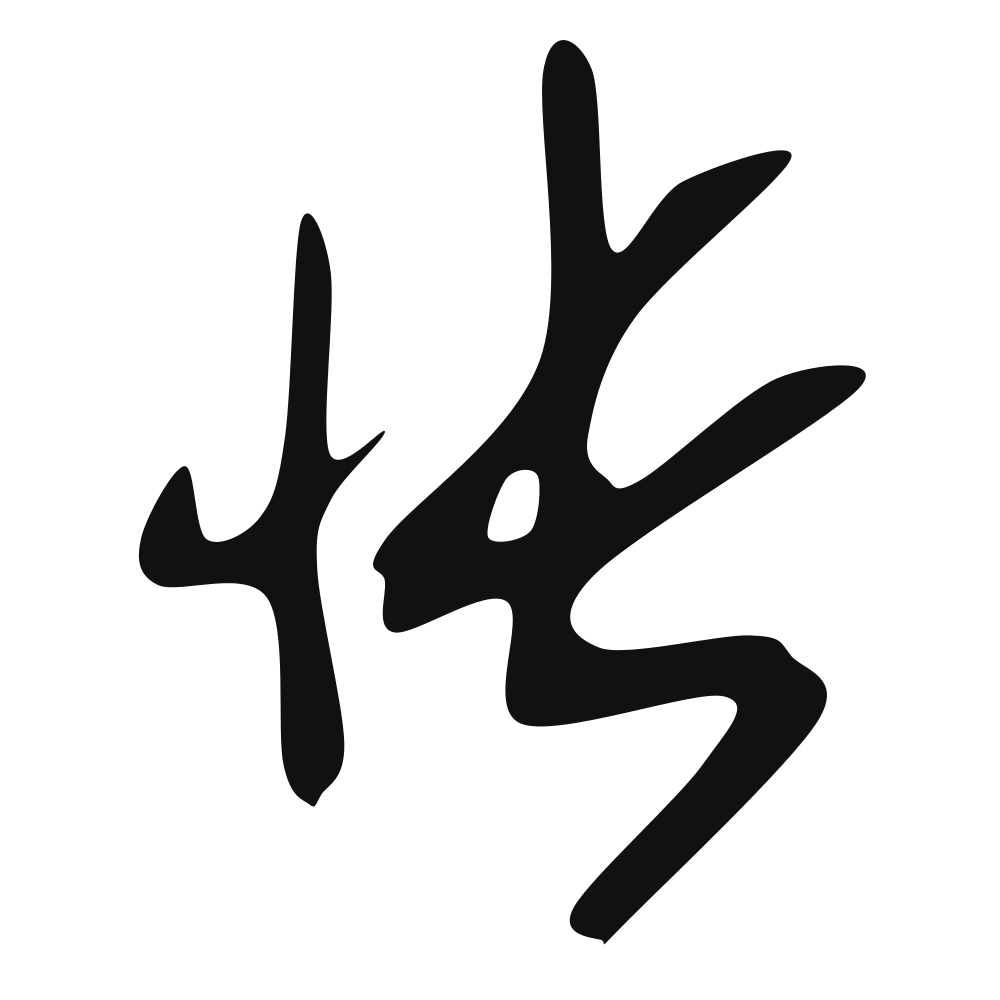
怅
regretful; upset; despairing; depressed
Closest English meanings
disappointed·regretful·melancholy·sorrowful·resentful
The Calligrapher — Zhào Gòu 赵构
Southern Song emperor and prolific patron of running-script calligraphy.
Song calligrapher (1107–1187), master of regular script/running script — known for 《草书洛神赋》. Song dynasty
Etymology & Meaning · 字义溯源
2 · The Character: 怅 怅 (chàng, 4th tone) is glossed by the Shuowen Jiezi as 望恨也。从心長聲 — 'regret born of looking out and not finding; from 心 (heart) and 長 (long) as sound.' Kangxi files it at 7 strokes. As a word 怅 means disappointment, a wistful sense of loss. 陶淵明《歸去來兮辭》 writes 悵然慷慨,深愧平生之志 — 'disappointed yet stirred, I deeply shame my life's ambition.' 《楚辭·九辯》 laments 怆恍懭悢兮,去故而就新 — the ache of leaving the old for the new (悵 and 悢 are kindred sorrow). Honest note: 怅 is almost never positive — it is the sigh after something is gone. For a tattoo it reads as elegant sadness; pair it or you risk broadcasting regret. The character threads through Chinese lyric as the sigh at endings — 悵望 (gazing with regret) is a set phrase for looking toward what is lost.
Cultural Story
怅 is the regret that has no object — 惆怅, the vague loss of a thing you cannot name. The old poems leave a man 怅然 at the empty pavilion, and the word kept that gentle ache: not grief, only the sense that something good was here and is now simply not.
Where a Western reader can stand: Where a Western reader can stand: 怅 reads as 'disappointed / wistful' — the elegant sigh after something is gone, Tao Yuanming's 悵然慷慨 at life's unkept promise. Honest caveat: it is almost never positive and broadcasts regret or loss — pair it (with 望 or 歸) or skip it for uplift, and never send it to a sickbed. Zhao Gou's orthodox imperial hand gives it legitimate, restrained sorrow — but he is a controversial ruler who lost the north and shielded the traitor Qin Hui, even as his cultural legacy (anchoring the Wang tradition) is positive.
Common words & phrases
- 惆怅 melancholy · dejected · wistful · sad
- 怅然 disappointed · regretful · frustrated · sorry
- 怅惘 lament · disconsolate · lost · sorrowful
- 怅望 gaze sadly · look with regret · peer · long
- 悲怅 sad · sorrowful · grieved · mournful
Read the story behind the character
惆怅 is the mood a song sells, 怅然 the look at the closed shop, 怅惘 the feeling a hometown visit brings. The pavilion is a renovated block now; the ache is current. We still feel the nameless loss, mostly at endings that were not even sad, which the old poems understood best.
Why this character belongs on skin
Every language needs this word; only Chinese perfected it. Chang — the heart radical beside a sign for long and far — is wistfulness with a horizon in it: the feeling of standing at a gate at dusk, aware that something unnameable is beyond your reach. The great poets used it for everything: Li Shangyin's line — this feeling could become a memory, only already it was a lost haze — carries chang in its marrow. It is not grief, which has an object. It is the ache of time passing through you, beauty registering as loss even as it happens. And here is the secret: people who never feel it are poorer. Wistfulness is proof of depth, evidence that every evening is an appointment with distance. To wear this character is to choose feeling over armor. Put it on the inside of the wrist, where you will see it whenever you reach for things — and everything you reach for becomes its commentary. It will not console you. That is not its trade. It will simply stand at the gate with you, at dusk, and make the ache elegant.
Own this character
Purchase delivers the original SVG of this glyph, brushed by Zhào Gòu 赵构, ready to place on skin, paper, or screen.