
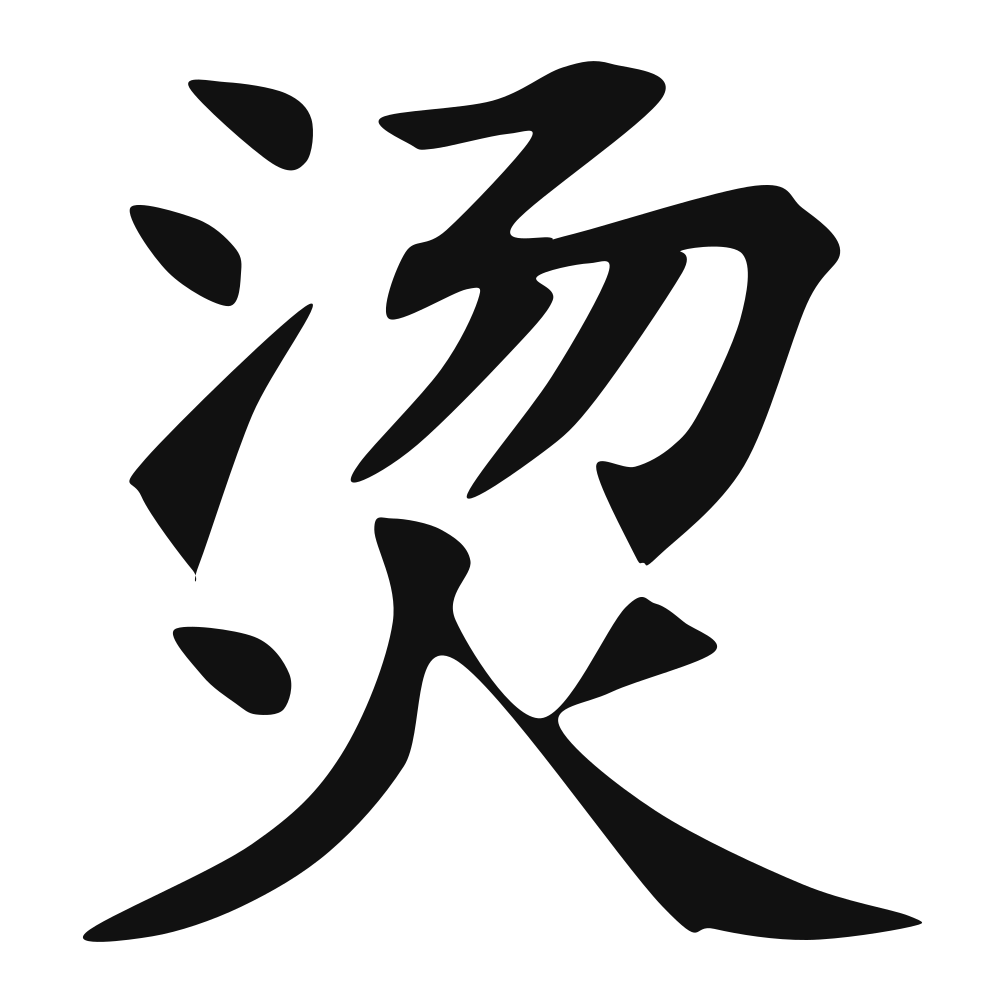
烫
to scald; to burn (by scalding); to blanch (cooking); to heat (sth) up in hot water; to perm; to iron; scalding hot
Closest English meanings
hot·scald·iron
The Calligrapher — Zhào Jí 赵佶
Song emperor who created the slender, jewel-like 'Slender Gold' script.
Song calligrapher (1082–1135), master of regular script/cursive script — Emperor Huizong of Song, artist on the throne and inventor of the slender 'Slender Gold' script. Song dynasty
Cultural Story
烫 is scalding heat, the burn of contact with something too hot. Classical medicine warned of 烫 from moxibustion and hot compresses used to treat illness. Folk wisdom taught children to blow on 烫 soup. The character is the body's sharp lesson in temperature — a word learned at the lip and fingertip, where pleasure and pain meet at the edge of heat.
Common words & phrases
- 烫发 perm · permanent wave
- 烫伤 scald
- 烫手 burning hot
- 滚烫 boiling hot
- 熨烫 iron (clothes)
Read the story behind the character
You 烫发 at the salon for curls, fear a 烫伤 from the kettle, and drop a 烫手 mug with a yelp. Water is 滚烫 after boiling, and you 熨烫 shirts with a hot iron. From a bad hair day fixed to a kitchen accident, 烫 marks the moments heat crosses from useful into unforgettable on the skin.
Why this character belongs on skin
烫 is scalding — the heat they told you to hide, the feeling so alive it borders on dangerous. In Chinese it is the touch of something just short of too much: the tea you blow on, the iron you pull back from your skin. But desire was never meant to be tepid. You were trained to dim, to cool, to make yourself easy to be near. 烫 refuses. It is the flush you can't lie about, the want that rises in your throat before you've decided to speak it. To be burned is to be real; the safe temperature is the lie. Wear 烫 where only your person will feel it flare — a private brand, a confession that you are, gloriously, too much. Let the mark say what your mouth used to swallow. Some fires are meant to be carried.
Own this character
Purchase delivers the original SVG of this glyph, brushed by Zhào Jí 赵佶, ready to place on skin, paper, or screen.