
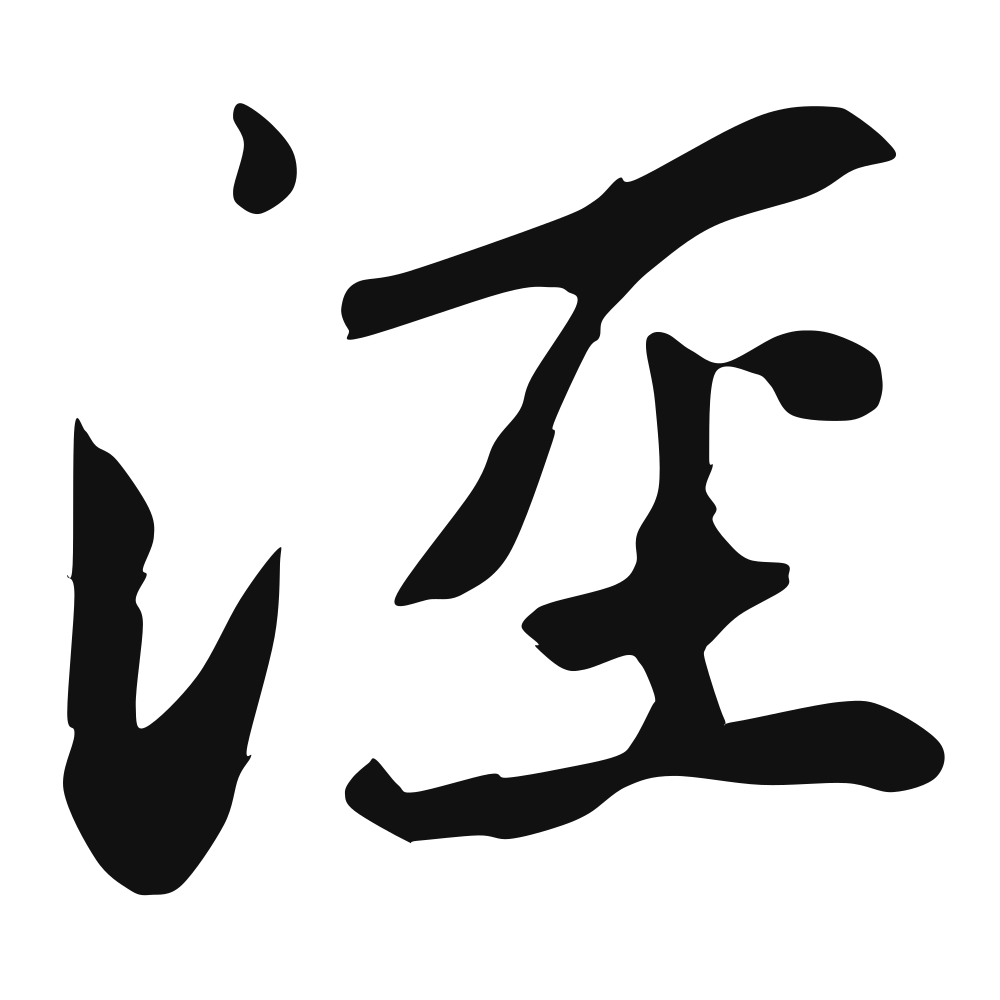
The Calligrapher — Zhào Mèngfǔ 赵孟頫
Yuan master whose elegant regular and running script revived classical tradition.
Yuan calligrapher (1254–1322), master of regular script/running script/cursive script — Yuan reviver of classical elegance who could write any script beautifully and did. Yuan dynasty
Cultural Story
泾 names a tributary of the Wei; the 說文 lists the 泾河. The proverb 泾渭分明 comes from where the clear 泾 meets the muddy Wei, their waters running side by side without mixing—an ancient image of right and wrong kept apart.
Common words & phrases
- 泾河 Jing River
- 泾渭分明 clearly distinct · sharply differentiated
Read the story behind the character
The idiom 泾渭分明 (clearly distinct) fits the two rivals' styles. A teacher draws the 泾河 (Jing River) on the map. We say friend and foe must be 泾渭分明 (sharply differentiated) in a crisis. The 泾 watershed now feeds terraced, tidy farms.
Why this character belongs on skin
Two rivers run through the loess country of Shaanxi — the Jing and the Wei — and for centuries observers argued over which ran clear and which ran muddy, until the confusion became one of China's most durable idioms: 泾渭分明, as distinct as the Jing and the Wei, a difference so sharp no one can pretend not to see it. This character is the Jing itself, water beside the sound of a warp thread — the vertical strand held taut on a loom, which is also the classical word for canon, for scripture, for the straight line that order is woven around. So it carries three strands: a real river, the principle of clear water, and the thread that holds a weaving true. It asks the question the idiom asks: where is your line? Not judgment of others — the Jing only governs its own banks — but the inner distinction, the point at which you know cleanly what you will and will not do. Ink this where the eye finds it daily. The straight strand holds the weave.
Own this character
Purchase delivers the original SVG of this glyph, brushed by Zhào Mèngfǔ 赵孟頫, ready to place on skin, paper, or screen.