
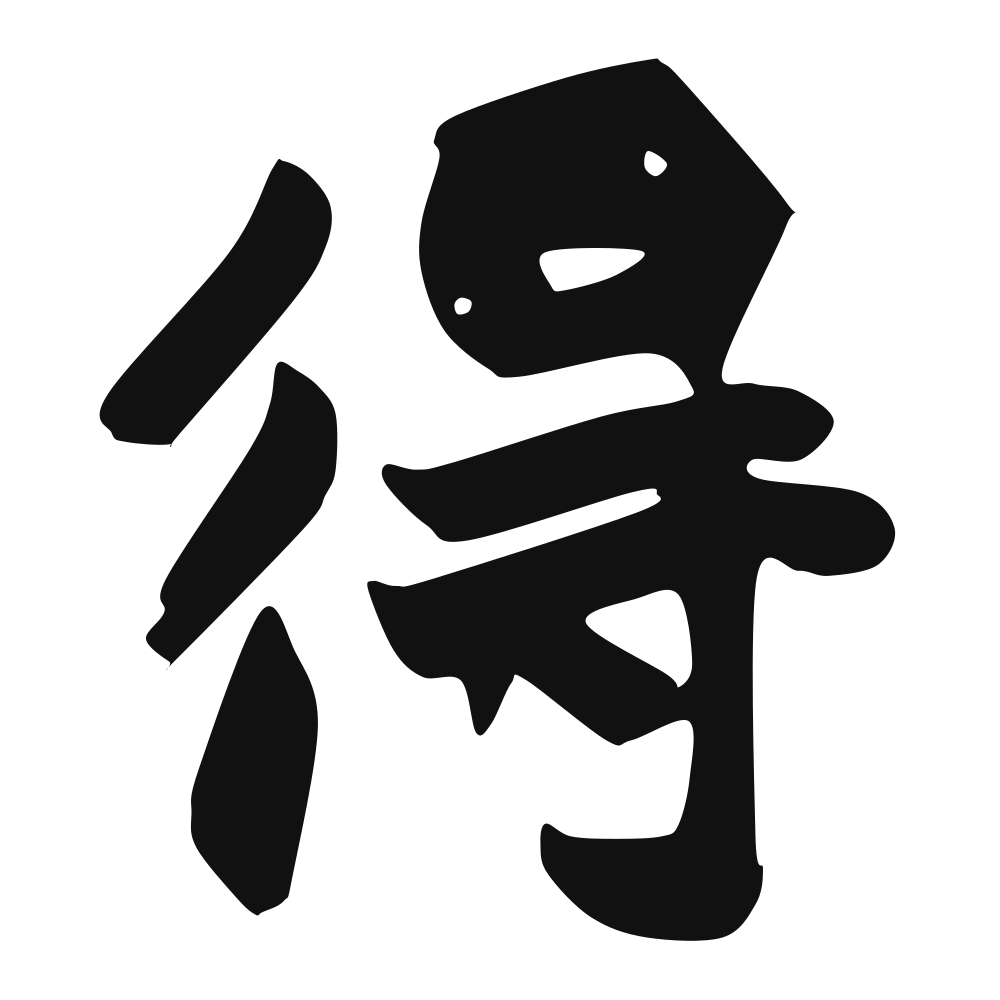
得
to obtain; to get; to gain; to catch (a disease); proper; suitable; proud; contented; to allow; to permit; ready; finished; structural particle: used after a verb (or adjective as main verb), linking it to following phrase indicating effect, degree, possibility etc; to have to; must; ought to; to need to
Closest English meanings
get·obtain·gain·acquire·achieve·result
The Calligrapher — Zhào Zhīqiān 赵之谦
Qing pioneer who fused seal-script vigor into every style.
Qing calligrapher (), master of 篆隶/running script — Qing eclectic who fused seal, clerical and painting sensibilities into one bold hand. Qing dynasty
Etymology & Meaning · 字义溯源
2 · The Character: 得 得 (dé, 2nd tone) is glossed by the Shuowen Jiezi as 行有所得也。从彳㝵聲, with the note 古文省彳 — 'to go and gain something,' the archaic graph showing a hand (寸) closing on a cowrie shell (貝), money picked up on the road; the 彳 step-radical was added later. Kangxi files it at 11 strokes under 彳. 《易·乾·文言》 uses it in its most sobering line: 亢之為言也,知進而不知退,知存而不知亡,知得而不知喪 — 'the arrogant know advance but not retreat, survival but not ruin, gain but not loss.' 《禮記·曲禮上》 sets the ethical limit: 臨財毋苟得,臨難毋苟免 — 'facing wealth, do not grab; facing danger, do not slip away.' Honest disclosure: in modern Chinese 得 is overwhelmingly a grammatical particle read de, marking degree — 跑得快 (runs fast) — and read děi it means 'must'. Standing alone, it reads like grammar rather than gain.
Cultural Story
得 is to lay hands on what you wanted — a shell, a post, a peace. 得意 is the moment it shows on your face, and the word kept that small triumph: not the having forever, only the having now, the closure of a hand around a thing that was elsewhere.
Where a Western reader can stand: Where a Western reader can stand: 得 is 'to get / gain / attain' — a hand closing on a cowrie found on the road, and the classics answer immediately that knowing gain without loss (知得而不知喪) is arrogance. Honest caveat: modern 得 is chiefly a grammar particle (跑得快 de) or the modal děi 'must', so alone it can read as a stray function word, and 得罪 means 'to offend'. Pair it — 自得, 得道, 得失. Zhao Zhiqian's stele-school forms make it read as an excavated glyph, which is the best defence.
Common words & phrases
- 得到 get · obtain · gain · acquire
- 觉得 feel · think · find · consider
- 记得 remember · recall · keep in mind
- 懂得 understand · know · comprehend
- 获得 obtain · gain · acquire · win
- 使得 make · cause · render · enable
Read the story behind the character
得到 is the parcel at the door, 觉得 the feeling you name halfway through, 记得 the fact that surfaces, 懂得 the lesson that arrives late. The shell is a notification now; the closure is the same. We grasp constantly, and call it knowing when the hand finally closes on the right thing.
Why this character belongs on skin
To get is to close a hand around what was loose in the world, and the old picture shows a man finding something precious under his grasp. To dé is to obtain, to arrive at, to stand at last where the effort led. There is the small daily getting, the wage, the answer, the seat on the train, and the large one, the peace after years of storm, the self after years of hiding. The Confucian seeks the virtuous life as something to be won through discipline; the Daoist finds that what is chased runs, and what is released returns. A man tattooed with this has known both, the grasping that failed and the receiving that surprised him. Let it sit in the palm of the hand, the very instrument of taking, and let it say: I have held what I sought, and I have learned that the truest getting was the self I found while reaching.
Own this character
Purchase delivers the original SVG of this glyph, brushed by Zhào Zhīqiān 赵之谦, ready to place on skin, paper, or screen.