
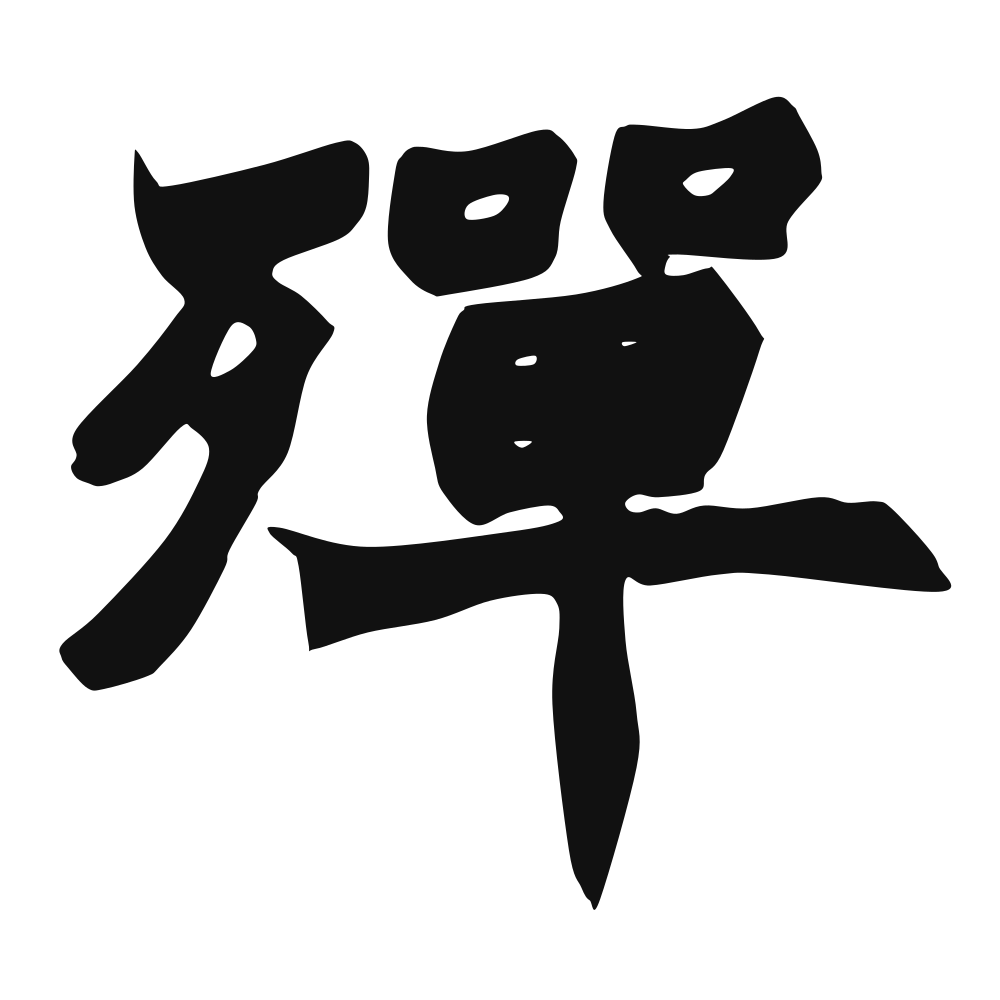
殚
entirely; to exhaust
Closest English meanings
exhaust·use up
The Calligrapher — Zhào Zhīqiān 赵之谦
Qing pioneer who fused seal-script vigor into every style.
Qing calligrapher (), master of 篆隶/running script — Qing eclectic who fused seal, clerical and painting sensibilities into one bold hand. Qing dynasty
Etymology & Meaning · 字义溯源
### Sounddān — dān (1st tone). Free-standing morpheme ### Original meaningDān (1st tone). The Shuowen Jiezi defines it as 「殛盡也。从歺單聲」 — 'brought to the very end', a phono-semantic compound of 歺 (è, the radical of bones and death) with 單 (dān) as the phonetic; 殛 is the word for the extreme, and 盡 is 'finished, drained'. So the root sense is not merely 'to use' but 'to use until there is nothing left'. The character is written 殫 in traditional form. The Han rhapsodies use it as the ordinary word for exhaustive completeness: 司馬相如〈子虛賦〉「殫覩人物之變態」, 張衡〈西京賦〉「殫所未見」, and 班固〈西都賦〉「百獸駭殫」. As a moral word it appears in 柳宗元〈捕蛇者說〉: 「殫其地之出,竭其廬之入」 — drained of everything their land produced and everything their houses took in. The modern idiom 殫精竭慮 (to exhaust one's spirit and thinking) keeps the same shape, and it is genuinely double-edged: it can praise total devotion, but the radical it is written with is 歺, the bone of the dead. Honest disclosure: several naming dictionaries state this plainly — 「字義帶有凶意,不適合作爲名字」 — the sense is inauspicious and the character is not fit for a name. Wuxing: the standard naming tables assign Fire (火); the 歹 radical itself carries no element, being a death-sign rather than a phase, so the Fire reading is a stroke-and-radical convention of the naming schools and should be treated as verify rather than settled. ### The structure (形聲 · 从歺,單聲 — the bone-radical 歺 (è) + 單 (dān) as phonetic; depletion written with the sign of death)①歺èbroken bone / deaththe radical — the whole reason the character reads as inauspicious②單dānsingle / alonethe phonetic; 'one' left, and then not even that③盡jìnfinished, drainedthe word Shuowen uses to define it (殛盡也)④殫dānto exhaustthe traditional form, 16 strokes in Kangxi ### In use todayItemReading / meaningNoteReadingdān (1st tone)traditional form 殫Core senseto exhaust, to drain completely殫精竭虑, 殫心, 殫力Grammarbound morpheme (literary)idiom-bound in modern Chinese; no free everyday useTattoo fitno — death radical, depletion meaning, and naming dictionaries flag it as inauspiciousoffer 尽, 专 or 笃 instead ### Closest words in English — and what each misses - Tired — 累/疲 hold ordinary tiredness; 殫 means drained to nothing, and it is written with the bone-radical - Finish — 盡/完 hold 'to finish' neutrally; 殫 finishes with a death sign attached - Devotion — 專/篤 hold wholehearted devotion; 殫精竭慮 is devotion described from the side of depletion - Fear — 憚 (dàn) holds to fear, and 癉 holds illness — the old texts borrowed 殫 for both, which is a borrowing, not a meaningAn honest note on grammar. Bound morpheme in modern Chinese — i
Cultural Story
殚 meant to exhaust, to spend utterly until nothing remains. The Shuowen reads it as draining to the end, and the highest praise was 殚精竭虑 — to exhaust one's mind and wear out one's thoughts for a cause. A loyal minister 殚心 exerted his whole heart, and 殚力 spent all his strength, the character of total, unreserved devotion.
Where a Western reader can stand: 殚 (dān) means to exhaust, to use up to the very last drop — the Shuowen's gloss is literally 'brought to the end'. It appears in Chinese as 'entirely' in Han poetry, but it is written with the bone-radical 歺, which is the same sign inside the characters for death and for a funeral. That is not decoration: Chinese dictionaries of names state outright that its sense is inauspicious. So a Western reader should hear it as the character for giving everything and being emptied by it, not for generosity or victory.
Common words & phrases
- 殫精竭慮 exhaust one's mind
- 殫心 exert one's heart
- 殫力 exert all strength
- 殫竭 exhaust
Read the story behind the character
Today 殚 lives in admiration for effort: we say a scientist 殚精竭虑 exhausted his mind on a cure, a writer 殚心 poured his heart into a novel, and a team 殚力 exerted all strength to finish. Though formal, the word appears in eulogies and award speeches, the solemn way Chinese honour someone who gave everything, every last thought and breath, to the work.
Why this character belongs on skin
Every tradition keeps one commandment it never prints: give everything. This character is the giving—death's radical bent into a verb meaning to spend completely, to exhaust, to hold nothing back. It lives in the phrase for total devotion: exhausting the essence, exhausting the thought, the official who worked until the lamp had no oil, the mother whose giving outran arithmetic. The old memorials ended with it like a signature—your servant's strength is spent. The West has its version: the runner collapsing past the tape, the soldier's last measure, Christ's final cry, it is finished—not a complaint but a completion. Here is the strange arithmetic of this word: what is fully spent is never fully lost. The lamp that burned out lit the room; the strength that emptied itself built the thing. Reserve nothing. Half-given things rot in the middle. This ink is a receipt for everything you will pour out and somehow, impossibly, not miss.
Own this character
Purchase delivers the original SVG of this glyph, brushed by Zhào Zhīqiān 赵之谦, ready to place on skin, paper, or screen.