
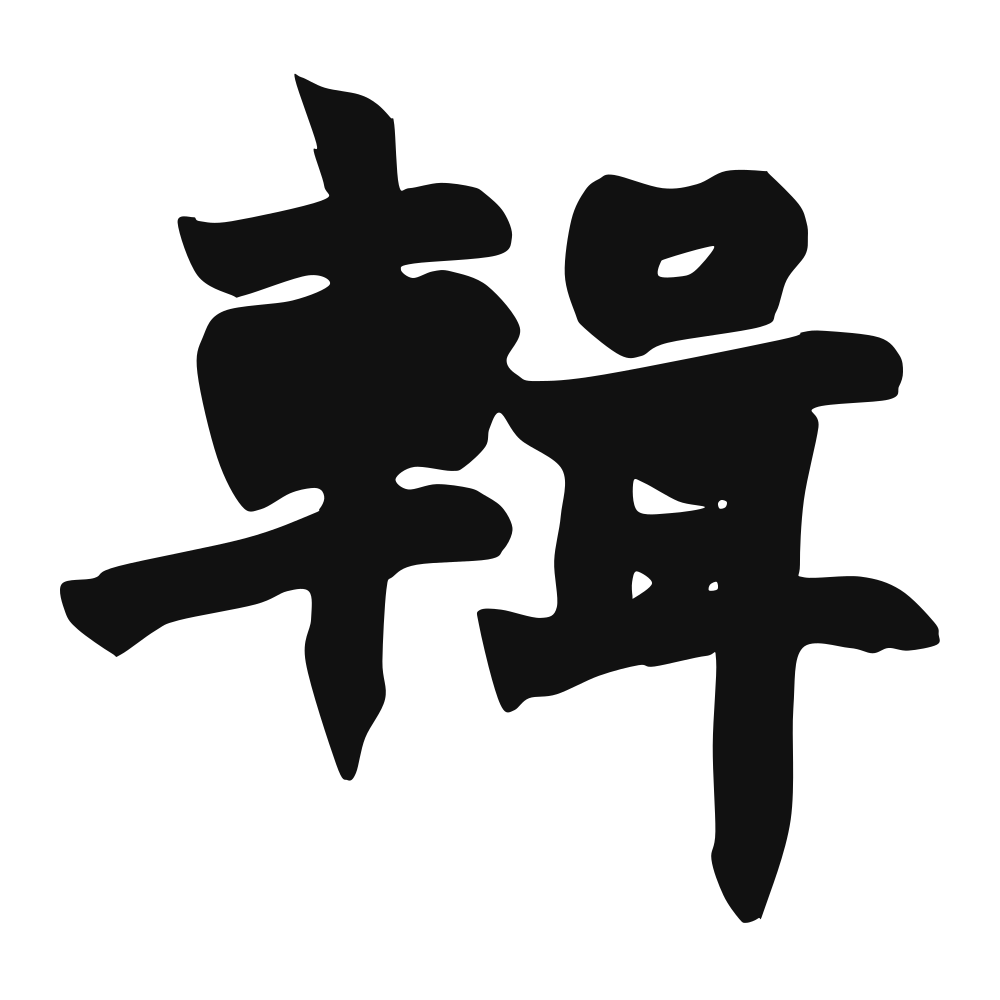
辑
to gather up; to collect; to edit; to compile
Closest English meanings
compile·collection·edit
The Calligrapher — Zhào Zhīqiān 赵之谦
Qing pioneer who fused seal-script vigor into every style.
Qing calligrapher (), master of 篆隶/running script — Qing eclectic who fused seal, clerical and painting sensibilities into one bold hand. Qing dynasty
Etymology & Meaning · 字义溯源
### Soundjí — jí (2nd tone). Free-standing morpheme ### Original meaningJí (2nd tone). The Shuowen Jiezi defines it as 「車和輯也。从車咠聲」 — 'the harmonious fitting of a carriage': the parts of a cart brought together so that they work as one. The Song lexicographer Dai Tong's 《六書故》 expands it: 「合材爲車,咸相得謂之輯」 — when the assembled timbers all suit one another, that is 輯. From the well-built cart the word moves to concord and then to gathering: 《書·湯誓》「輯寧爾邦家」 (to bring peace and stability to your state and house), 《詩·大雅》「辭之輯矣」 (words brought into harmony) and 「輯柔爾顏」 (a face softened into gentleness), and 《書·舜典》「輯五瑞」 (to gather in the five jade tokens). By the Han it is used interchangeably with 集 'to collect' — 《漢書·郊祀歌》「澤汪濊,輯萬國」. Kangxi counts 16 strokes (車部+9); naming tables give 金. Honest disclosure: 輯 is a genuinely positive word — harmony, concord, gathering — but in modern Chinese the single graph 辑 has been narrowed to publishing vocabulary (第一辑 'volume one', 编辑 'to edit'). The classical warmth survives in compounds, not in the bare character. ### The structure (形聲 · 从車咠聲 — carriage (車) + the phonetic 咠 (qì); the sense is the well-fitted cart)①車chēcarriage / cartthe assembled object②咠qìwhisper (phonetic)supplies the sound jí; contributes no meaning③輯jíto fit / to gatherthe Shuowen sense: 車和輯也④集jíto collectthe Han interchangeable twin; 輯 borrows its gathering sense ### In use todayItemReading / meaningNoteReadingjí (2nd tone)single syllableCore senseto gather; concord; to compileoriginally the well-fitted cartGrammarbound morpheme (modern)編輯 to edit, 輯錄 to compile, 第一輯 volume oneTattoo fitcaution — warm in classical Chinese, bureaucratic todayreads as publishing vocabulary to a modern reader ### Closest words in English — and what each misses - Edit — 編/纂 hold compiling; 辑 alone reads 'volume' to a modern reader - Harmony — 和 holds harmony outright; 輯's concord is the older, narrower sense - Gather — 集 holds 'to gather'; 輯 is gathering as fitting-together - Peace — 寧 holds 'peace, stability'; 輯寧 is the compound, not the single graphAn honest note on grammar. Bound morpheme in modern Chinese — 編輯 to edit, 輯錄 to compile, 第一輯 volume one; free as a verb ('to harmonise, to gather') only in classical usageWhere a Western reader can stand: 辑 (jí) began as a carriage whose parts all fit — the Shuowen gloss is literally 'the harmonious cart'. From that came concord between people, and then the act of gathering texts together. Its modern job is publishing: 编辑 'to edit', 第一辑 'volume one'. So the character is warm in classical Chinese and faintly bureaucratic today. If you
Cultural Story
Gathered like a cart's side-rails, the character 辑 was the parts collected into one frame, and from 'gathered' it became 'compiled' — a 辑录 is a record assembled from many sources, a 专辑 a collected album of one artist's work. To 编辑 is to edit, to bring scattered pieces into one bound order, the carpenter's gathering of wood become the editor's gathering of words on a page.
Where a Western reader can stand: 辑 (jí) began as a carriage whose parts all fit together — the Shuowen's gloss is literally 'the harmonious cart'. From there it came to mean concord between people, and then the act of gathering texts into one volume. Its modern job is publishing: 编辑 'to edit', 第一辑 'volume one'. So it is warm in classical Chinese and faintly bureaucratic today. A Western reader should hear 'many parts made to fit', not 'creativity' or 'peace' — those are 和 and 集.
Common words & phrases
- 編輯 edit · editor
- 輯錄 compile · record
- 輯要 essentials
- 專輯 album · special collection
Read the story behind the character
A newspaper 编辑 cuts the late story and lays out the page; a musician releases a 专辑 of songs recorded across a year. The 辑要 of a long report gives the busy reader only the bones. The character that named a cart's collected rails now names a desk, a playlist, and a summary — the same old act of gathering many pieces into one thing a hand can hold and a mind can follow.
Why this character belongs on skin
The character began as a carriage bed—a place where things are gathered and carried—and became the scholar's word for compilation: 编辑, to edit; 辑录, to collect what matters and let the rest fall away. There is quiet power in this. Anyone can be struck by the world; the editor decides what the record keeps. Chinese anthologists spent lifetimes choosing which poems would survive their century, and their choices became the tradition. You are doing this too, whether you know it or not—compiling a self from memory's chaos, keeping some scenes, releasing others. 辑 is the wisdom of the curator over the hoarder. Ink it on the inner forearm, where you'd rest a book. Let it be your doctrine of attention: what you choose to carry is who you become. Choose like it matters. It does.
Own this character
Purchase delivers the original SVG of this glyph, brushed by Zhào Zhīqiān 赵之谦, ready to place on skin, paper, or screen.