
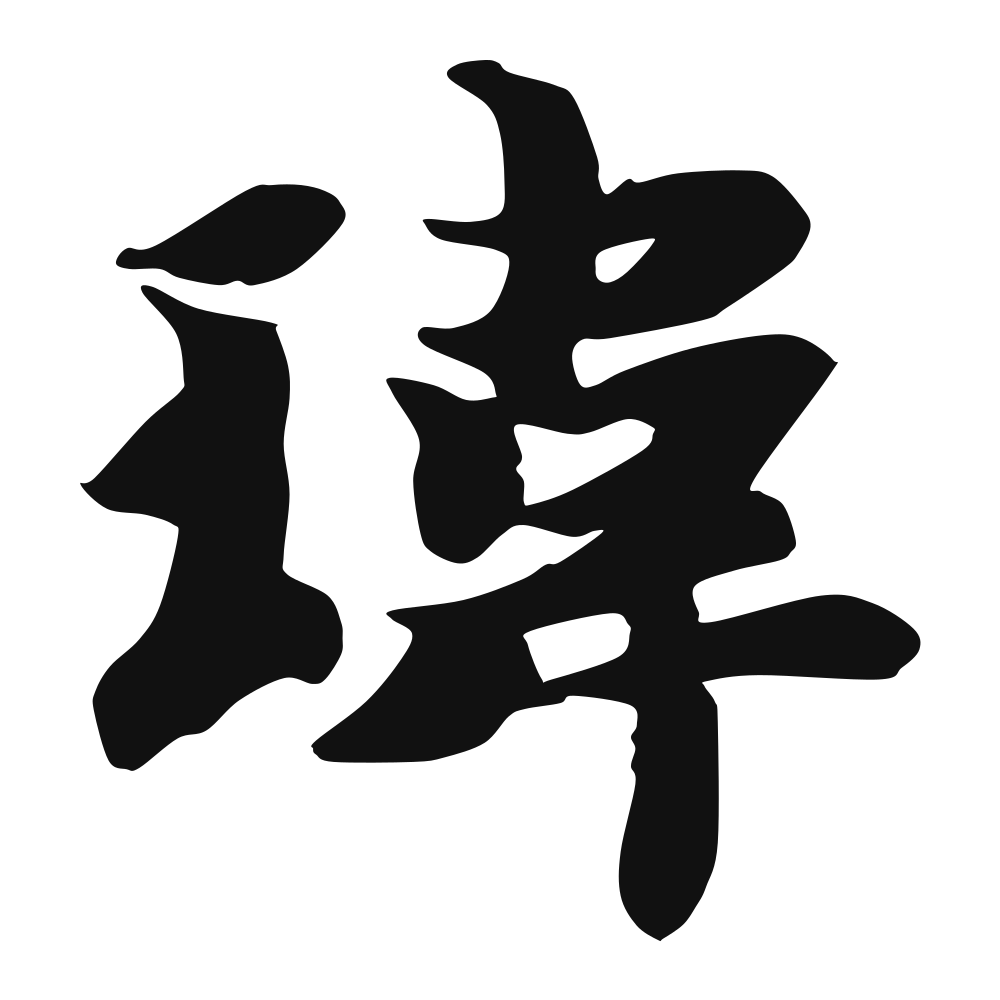
玮
(reddish jade); precious; rare
Closest English meanings
jade·rare
The Calligrapher — Zhì Yǒng 智永
Sui monk who spread Wang Xizhi's art via his 'Thousand Characters'.
Sui calligrapher (生卒年不详(陈/隋)), master of regular script/cursive script — monk and seventh-generation descendant of Wang Xizhi who wrote a thousand copies of the Thousand Character Classic to pass the family hand down. Sui dynasty
Cultural Story
瑋 means rare jade or something extraordinary; the 說文 gives '石之美者' and '珍奇.' Histories praised a 瑋奇 (rare and wonderful) sight, and a 瑋器 (rare talent) was a person of uncommon gifts. The word lifts both stone and human above the merely ordinary.
Common words & phrases
- 玮奇 rare and wonderful
- 玮器 rare talent
Read the story behind the character
We call a once-seen spectacle 玮奇 (rare and wonderful), like a double rainbow over the city. A child prodigy is praised as a 玮器 (rare talent) in music or math. Though uncommon in speech, 玮 still appears in tributes and bios when someone or something truly stands apart.
Why this character belongs on skin
Some things are not valuable because they are priced, but because they are rare and the world knows it instantly. 玮 means precious jade—fine, rare, admirable—and it lives in names the way 'rose' lives in names, as a wish made material. Jade in China was never mere ornament: Confucius listed its virtues—warm but firm, bright but not loud, breaking before it bends—and men wore jade discs against their hearts to remember how to be. 玮 is that stone in superlative, the piece a connoisseur keeps in a lined box and shows no one. A tattoo of it is a private appraisal: I know what I am worth, and I do not need the market's opinion. It suits the few, the particular, the ones who would rather be a small true thing than a large loud one. Set it where only mirrors can read it. Rarity does not advertise. It simply is, and the room adjusts around it without knowing why.
Own this character
Purchase delivers the original SVG of this glyph, brushed by Zhì Yǒng 智永, ready to place on skin, paper, or screen.