
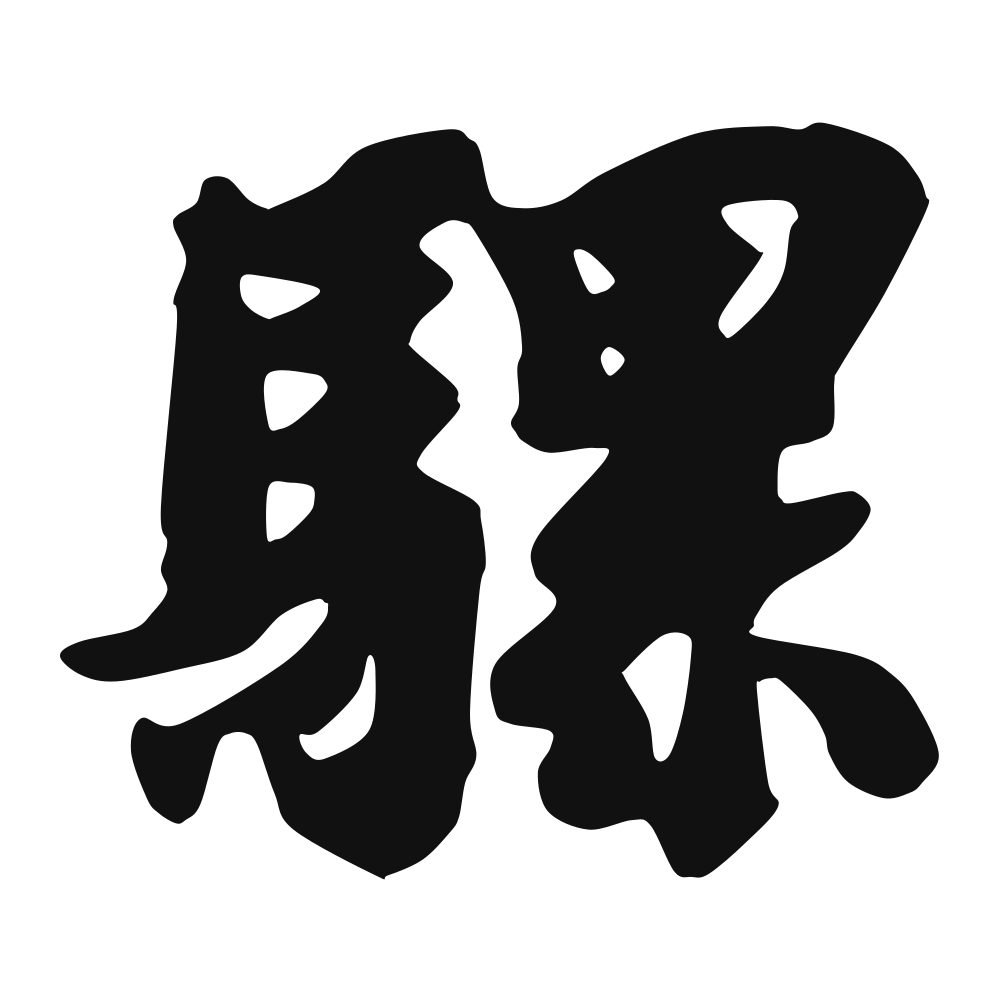
The Calligrapher — Zhì Yǒng 智永
Sui monk who spread Wang Xizhi's art via his 'Thousand Characters'.
Sui calligrapher (生卒年不详(陈/隋)), master of regular script/cursive script — monk and seventh-generation descendant of Wang Xizhi who wrote a thousand copies of the Thousand Character Classic to pass the family hand down. Sui dynasty
Cultural Story
骡 combines 马 with 累. The 《説文解字》 calls it 驴父马母也—the offspring of a donkey father and a horse mother. Sterile yet tireless, the mule became the peasant's faithful beast of burden.
Common words & phrases
- 骡子 mule
- 驴骡 hinny
- 马骡 mule
- 骡马 mules and horses
- 骡车 mule cart
Read the story behind the character
骡子 is a mule, and 骡马 means mules and horses together for haulage. A 骡车 is a mule cart, while 驴骡 names the slighter hinny. In mountain villages 骡 still carries grain where trucks cannot climb, a living link to old transport.
Why this character belongs on skin
The mule is a hybrid—horse and donkey, strength and patience—and like most hybrids it was born unable to reproduce its own kind, which is the whole tragic, beautiful arrangement. 骡 is that animal: sure-footed where horses panic, tireless where oxen grumble, famously stubborn for the excellent reason that it refuses to be broken past the breaking point. Caravans crossed the longest, highest trade roads on mule-back for centuries; whole mountain economies moved on those patient hooves. There is a lesson in being made of two worlds—belonging fully to neither, useful precisely because of the mixture. If you have ever felt like a crossing, a between, a one-of-a-kind that cannot quite repeat itself—the mule walks beside you. Load up. Keep climbing.
Own this character
Purchase delivers the original SVG of this glyph, brushed by Zhì Yǒng 智永, ready to place on skin, paper, or screen.