
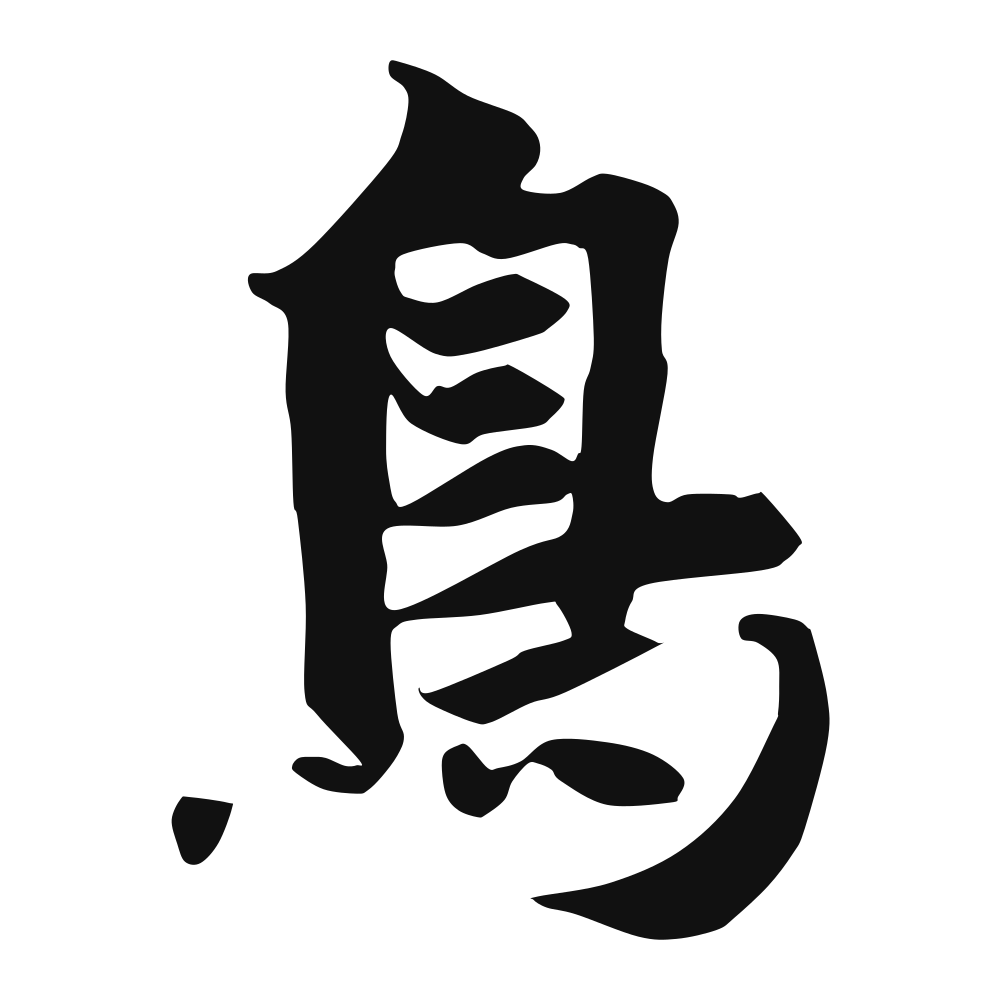
鸟
penis; bird; "bird" radical in Chinese characters (Kangxi radical 196); (dialect) to pay attention to; (intensifier) damned; goddamn
Closest English meanings
bird·fowl·avian·feathered creature
The Calligrapher — Zhì Yǒng 智永
Sui monk who spread Wang Xizhi's art via his 'Thousand Characters'.
Sui calligrapher (生卒年不详(陈/隋)), master of regular script/cursive script — monk and seventh-generation descendant of Wang Xizhi who wrote a thousand copies of the Thousand Character Classic to pass the family hand down. Sui dynasty
Etymology & Meaning · 字义溯源
2 · The Character: 鸟 鸟 (niǎo, 3rd tone; traditional 鳥) is the general word for a bird. The Shuowen Jiezi: 鳥,長尾禽緫名也。象形 — 'the collective name for long-tailed fowl; the graph is a picture' — and it is set against 隹, the short-tailed birds. Chinese writing claims this creature as its origin: Cai Yong's own 篆勢 opens 字畫之始,因於鳥跡, 'the beginning of strokes lay in bird tracks.' The Shijing simply listens — 伐木丁丁,鳥鳴嚶嚶 (《小雅·伐木》), 'the axe rings, the birds cry ying-ying.' The Yijing gives the wisest line in Xiao Guo: 飛鳥遺之音,不宜上,宜下,大吉 — 'the flying bird leaves its call behind; not upward, downward is greatly auspicious.' Kangxi: 11 strokes, 鳥部 (simplified 鸟 is 5). Free morpheme — 鸟 stands alone as 'bird'. Honest disclosure, and it is serious: since the Ming vernacular novels, above all 水滸傳, 鳥 has doubled as diǎo, a coarse word for the penis, and 鳥人, 鳥事, 關我鳥事 are still live mild obscenities. Add 鳥盡弓藏 — birds gone, bow stored — the proverb of allies discarded once useful.
Cultural Story
《説文解字》explains 鸟 as “长尾禽緫名也” (the general name for long-tailed fowl), and the character is a pictograph: an oracle-bone form shows the head, eye, body, wings, and tail of a bird. Over millennia the brush simplified it, yet the side profile of a perched bird remains unmistakable in the modern shape.
Where a Western reader can stand: Where a Western reader can stand: 鸟 is remembered in China less as a symbol of freedom than as the origin of writing — Cangjie read bird tracks in mud and the first graphs followed (字畫之始,因於鳥跡) — while the Yijing tells the flying bird 不宜上,宜下, descend rather than climb. Zhiyong, the monk who wore out ten baskets of brushes copying the Thousand-Character Classic and buried them under a Retired Brush Mound, is a fitting hand for a character about marks that outlast their maker. Serious caveat: read diǎo, 鳥 is a coarse vernacular term for the male member, alive in 鳥人 and 關我鳥事, so a bare 鸟 can land on a Chinese reader as an obscenity; 鳥盡弓藏 also frames it as the ally discarded once the birds are shot.
Common words & phrases
- 小鸟 bird · little bird · small fowl
- 飞鸟 flying bird · bird in flight · bird on the wing
- 鸟类 birds · birds as a class · avifauna
- 候鸟 migratory bird · bird of passage · migratory fowl
- 花鸟 flowers and birds · bird-and-flower · bird-and-flower painting
- 鸟语 bird song · birdsong · twittering
Read the story behind the character
Children spot a 小鸟 (little bird) at the feeder, while 飞鸟 (birds in flight) wheel across city skies. Biologists catalog 鸟类 (birds as a class), and 候鸟 (migratory birds) mark the seasons' turn. In art, 花鸟 (bird-and-flower) painting thrives, and we pause to enjoy 鸟语 (birdsong) on a quiet morning.
Why this character belongs on skin
A bird is what the soul looks like when it finally remembers it can leave. 鸟 needs no philosophy; it only needs the air, and the air has always been there, waiting. The Chinese saw in the small ordinary bird the great liberated spirit — released from the cage, gone over the wall, singing back at the one who locked it. To wear this character is to mark the moment you chose flight over safety, the day you stopped pretending the open door was a threat. There is no sermon in a bird, only the fact of departure and the lightness after. Carry 鸟 and you are telling your own ribs: you were never meant to stay caged. Somewhere a window is open. Somewhere you are already out.
Own this character
Purchase delivers the original SVG of this glyph, brushed by Zhì Yǒng 智永, ready to place on skin, paper, or screen.