
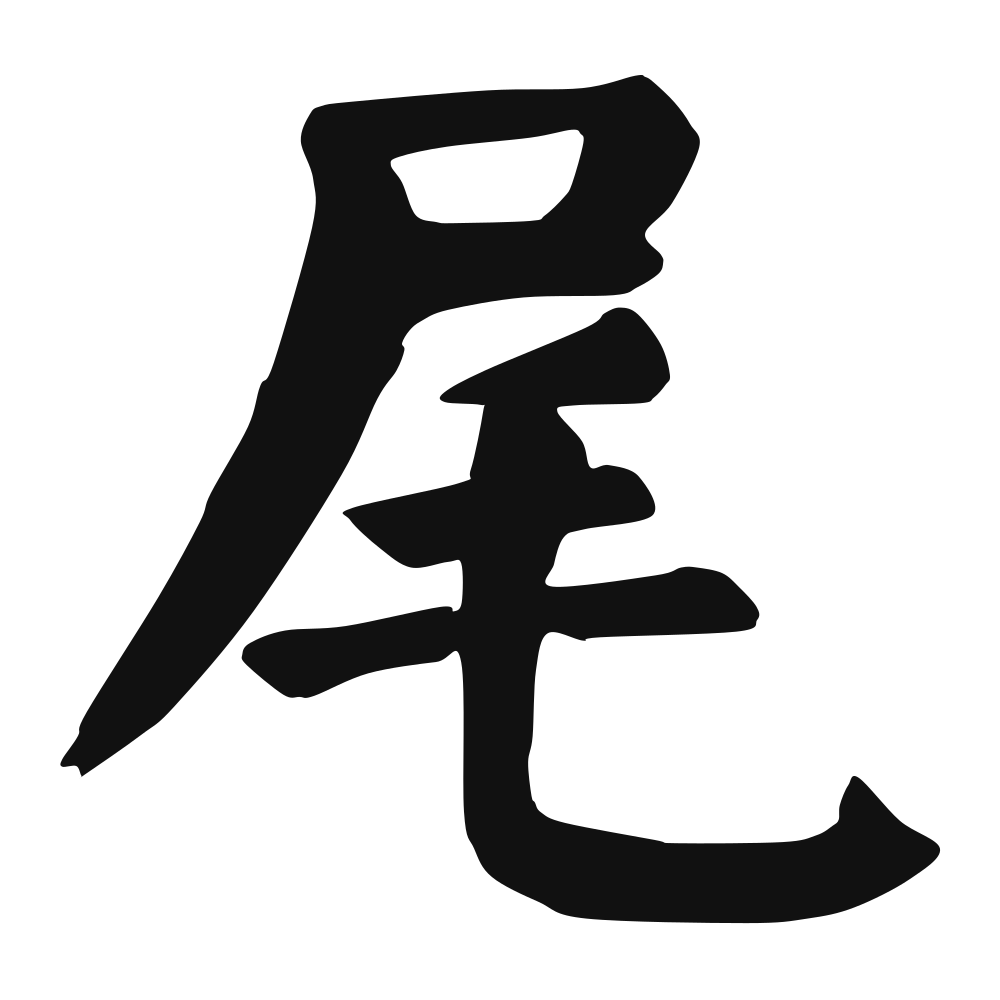
尾
tail; remainder; remnant; extremity; sixth of the 28 constellations; horse's tail; pointed posterior section of a locust etc
Closest English meanings
tail·end
The Calligrapher — Zhōng Shàojīng 钟绍京
Tang calligrapher famed for the regular-script Lingfei Jing.
Tang calligrapher (), master of regular script — known for 《灵飞经》. Tang dynasty
Cultural Story
尾 shows a person with an animal tail, meaning tail or end; the Shuowen gives the tail. A 尾巴 (tail) marked the rear of a beast, and the 末尾 (tail end) of a scroll held the colophon. To 尾随 (tail, follow) someone was to dog their steps, and the 尾数 (odd amount) closed an old account book.
Common words & phrases
- 尾巴 tail
- 结尾 ending · conclusion
- 末尾 end · tail end
- 尾数 odd amount · mantissa
- 尾随 tail · follow
Read the story behind the character
A dog wags its 尾巴 (tail), and the movie's 结尾 (ending) surprises everyone. You stand at the 末尾 (end) of the queue, and a detective 尾随 (tails) a suspect. The 尾数 (odd amount, mantissa) on your bill rounds to cents; the word trails from beasts to bar tabs.
Why this character belongs on skin
Everything that moves leaves something behind it. 尾 is the tail, the trailing edge of the comet, the last note of a song still humming after the singer is gone. In the old hunt the tail was the tell — follow 尾 and you find the beast. The Daoist reads it as what follows desire: the consequence that dogs every step, faithful as a shadow. To lose your tail is to lose your story; to cut it off is to pretend you began today. We are all the tail of someone who came before — an ancestor's gesture, a mother's laugh riding at our back. Wear 尾 and you accept the part of you that trails, that lingers, that refuses to be finished. Let it mark your skin as the comma at the end of a sentence still being written. The ink is your lingering.
Own this character
Purchase delivers the original SVG of this glyph, brushed by Zhōng Shàojīng 钟绍京, ready to place on skin, paper, or screen.