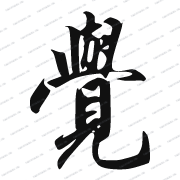
觉 (jué) — Awakening
Single-character Chinese tattoo · verified meaning · awakening & awareness theme
Browse all 觉 glyphs ↗Meaning & Nuance
觉 (jué) means “to awaken,” “to realize,” or “to perceive.” It is the “awakening” of Buddhist enlightenment (觉悟) and also everyday “feeling” (感觉). As a tattoo it marks a moment of clarity — waking up to oneself, to truth, or to a new way of living. It differs from 悟 (wù, sudden insight) in being the broader act of becoming aware.
Pronunciation & Form
Pinyin: jué — a second-tone (rising) syllable. (Note: the same character is read jiào in 睡觉, “to sleep.”) The simplified form sets 见 (jiàn, to see) at the bottom, as if awakening is a kind of seeing.
Common Words & Phrases
Why Get 觉 as a Tattoo
觉 is a meaningful tattoo for anyone who has “woken up” — to themselves, to recovery, to a truth. It reads as “awakening/awareness” to Chinese readers and is compact enough to stay legible for decades. It pairs with 醒 (xǐng, wake) as 觉醒, or stands alone as a quiet emblem of consciousness.
Tattoo Style & Placement
Best fits: fine-line, minimalist, or calligraphic. 觉 has a tall, centered structure that works as a single character on the inner forearm, collarbone, or spine. A small 觉 behind the ear or on the wrist is understated. Keep it at least ~4–5 mm tall so the bottom 见 stays clear.
Authenticity & Cultural Note
Always confirm the character with a native speaker or linguist before inking. 觉 is read jué for “awaken/feel” but jiào in 睡觉 (“sleep”); make sure your artist renders the intended sense. handmade.ink meanings are checked by native Chinese linguists.
Frequently Asked Questions
What does the Chinese character 觉 mean?
How do you pronounce 觉?
Is 觉 a good tattoo for awakening?
What words use the character 觉?
What is the difference between 觉 and 悟?
Can 觉 be paired with another character?