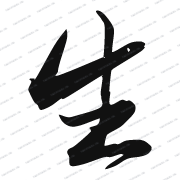
生 (shēng) — Life
Single-character Chinese tattoo · verified meaning · life & growth theme
Browse all 生 glyphs ↗Meaning & Nuance
生 (shēng) means “life,” “to be born,” and “to grow.” It is one half of the great Chinese pairing 生死 (life and death) and carries a buoyant, forward energy — sprouting, births, vitality. As a tattoo it celebrates being alive, survival, or new beginnings. It is warmer and more active than 存 (cún, to exist/keep).
Pronunciation & Form
Pinyin: shēng — a first-tone (high, level) syllable, bright and even. The character is traditionally read as something sprouting upward from the earth; it is short and very legible.
Common Words & Phrases
Why Get 生 as a Tattoo
生 is a powerful, life-affirming tattoo — chosen to mark survival, a fresh start, or simply the miracle of being alive. It is a single compact character that reads instantly as “life” to Chinese readers and stays crisp at any size. It pairs with 死 (sǐ) for the full 生死, or with 命 (mìng) as 生命.
Tattoo Style & Placement
Best fits: fine-line, minimalist, or bold brush. 生 is small and graphic, great for the inner wrist, collarbone, behind the ear, or ankle. A larger 生 on the forearm or ribs reads as a personal creed. Keep it at least ~4 mm tall for clarity.
Authenticity & Cultural Note
Always confirm the character with a native speaker or linguist before inking. 生 (shēng) is sometimes confused with 声 (shēng, sound) or 升 (shēng, rise) by translation tools; a verified 生 reads as “life/birth.” handmade.ink meanings are checked by native Chinese linguists.
Frequently Asked Questions
What does the Chinese character 生 mean?
How do you pronounce 生?
Is 生 a good tattoo for survival or new beginnings?
What words use the character 生?
What is the difference between 生 and 死?
Can 生 be paired with another character?