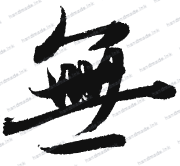
无 (wú) — Nothingness
Single-character Chinese tattoo · verified meaning · nothingness & freedom theme
Browse all 无 glyphs ↗Meaning & Nuance
无 (wú) means “nothing,” “without,” or “non-being.” In Daoist thought it is the source from which form arises — 无中生有 (something from nothing). Far from negative, it suggests freedom from attachment and the open ground of possibility. As a tattoo it is a bold, almost punk statement of independence or a serene nod to non-attachment.
Pronunciation & Form
Pinyin: wú — a second-tone (rising) syllable. The modern form 无 is a simplification of an ancient pictograph suggesting a person with no possessions; it is short and highly legible.
Common Words & Phrases
Why Get 无 as a Tattoo
无 is chosen by people who want to express freedom, non-attachment, or a carefree spirit — 无忧 (carefree) is a particular favorite. It is a single, clean stroke-group that stays readable for decades and reads as “nothing/without” to Chinese readers. It pairs naturally with 畏 (wèi, fear) for 无畏 (fearless) or stands alone as a minimalist manifesto.
Tattoo Style & Placement
Best fits: fine-line, minimalist, or bold single-stroke. 无 is compact and graphic, ideal for the inner wrist, collarbone, ankle, or behind the ear. A larger 无 on the forearm or ribs reads as a quiet rebellion. Keep it at least ~4 mm tall so the strokes don't blur.
Authenticity & Cultural Note
Always confirm the character with a native speaker or linguist before inking. 无 (wú) is occasionally confused with 舞 (wǔ, dance) or 吴 (Wú, a surname) by translation tools; a verified 无 reads as “nothing/without.” handmade.ink meanings are checked by native Chinese linguists.
Frequently Asked Questions
What does the Chinese character 无 mean?
How do you pronounce 无?
Is 无 a good tattoo for freedom or non-attachment?
What words use the character 无?
What is the difference between 无 and 空?
Can 无 be paired with another character?